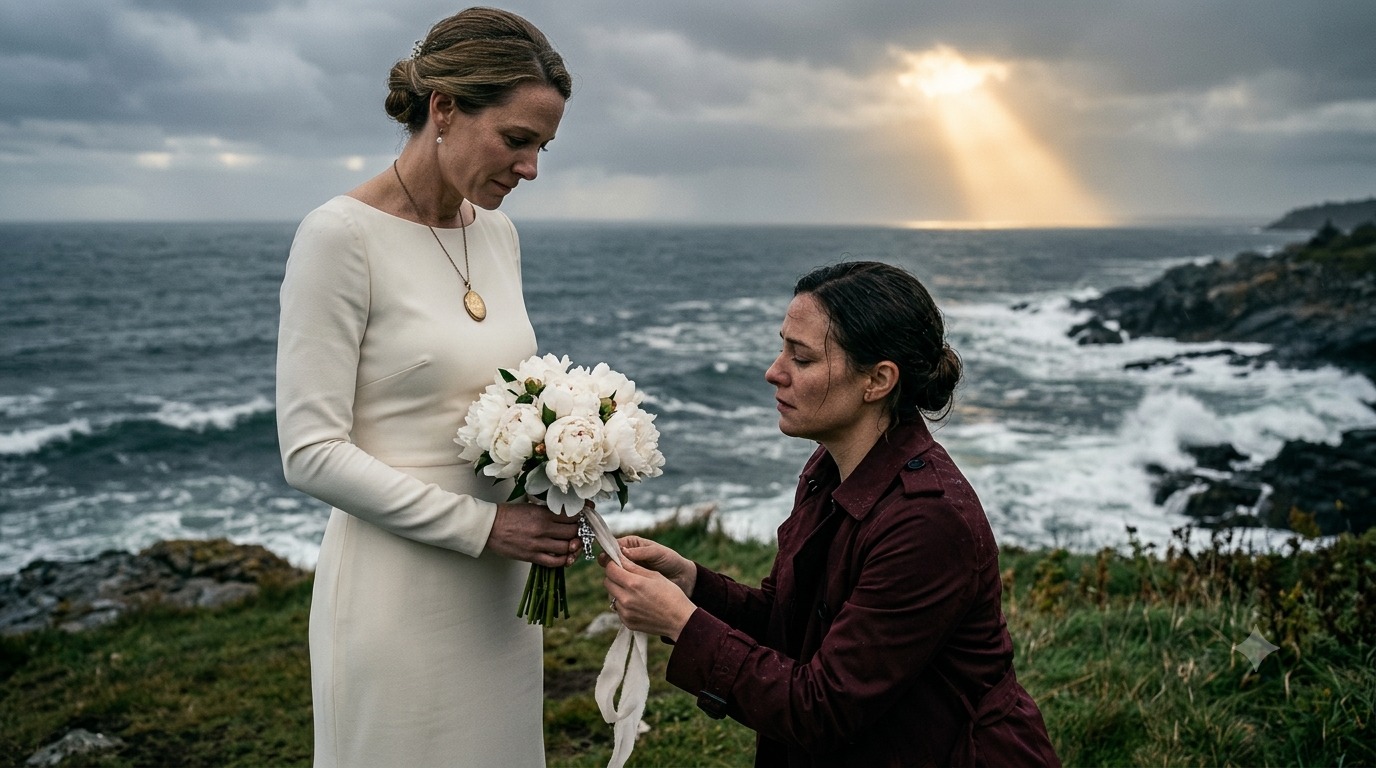



My name is Desmond. I am thirty-three years old, and today I watched my father shatter the very last illusion that held our family together.
We were gathered for a lavish, picture-perfect Christmas dinner inside my parents’ sprawling, ivy-covered estate in suburban Boston. The dining room was illuminated by a towering, twelve-foot spruce decorated with imported Austrian glass, while a grand crystal chandelier cast shimmering gold reflections across a mahogany table laden with roasted lamb and vintage wines. Everything smelled of fragrant pine needles, melted beeswax, and exorbitant, unearned privilege.
Beside me sat my eight-year-old daughter, Margo. She was wearing a simple, dark green velvet dress that we had picked out together at a local boutique. She had spent the entire afternoon brushing her hair, her small hands trembling with quiet excitement because she genuinely believed her grandparents and her aunt would finally look at her with warmth. Margo is a gentle child, deeply observant, with the fragile heart of an artist. She is my entire world.
The catastrophe began over an accident that barely warranted an apology.
Margo reached for her water goblet, and her small fingers bumped against her heavy silver fork. It slipped from the edge of the linen and hit her porcelain dinner plate with a sharp, metallic clink.
Across the wide expanse of the mahogany table, my younger sister, Cecilia, stopped mid-sentence.
Cecilia was draped in a bespoke silk gown, her wrists weighed down by diamond tennis bracelets, her face sculpted beneath layers of high-fashion cosmetics designed to project effortless nobility. For the past twenty minutes, she and her husband, Preston—a man who spent eighty percent of his waking hours bragging about his customized Aston Martin and his phantom venture investments—had been loudly detailing their upcoming first-class ski retreat to St. Moritz.
When the fork clinked, Cecilia rolled her eyes with theatrical disgust. The cultivated veneer of high-society elegance peeled away in a split second, exposing the raw, venomous narcissism underneath.
She leaned forward over the candlelit table, locking her cold, mascara-rimmed eyes directly onto my terrified daughter.
“That dress looks like it was fished out of a discount clearance bin at a church basement,” Cecilia spat, her voice slicing through the quiet room like a serrated blade. “You look cheap, clumsy, and entirely out of place in this house, Margo.”
Margo froze. Her little shoulders hitched up toward her ears.
Cecilia let out a sharp, mocking laugh that bounced off the vaulted plaster ceilings. “Then again, what else should anyone expect? When a child grows up without a mother to teach her basic table manners or high-society decorum, she’s naturally going to behave like a stray animal. You two are nothing but a pathetic charity case ruining our holiday photographs.”
Margo’s lower lip began to tremble violently. A single tear tracked down her pale cheek, and she shrank back into the high oak chair as if trying to disappear into the upholstery.
Something ancient, primal, and volcanic fractured inside my chest. For five years, I had swallowed their passive-aggressive digs. For five years, I had smiled through their condescending pity. I had allowed them to treat me like a subhuman doormat because I foolishly believed my daughter deserved an extended family.
That foolishness died right there.
I pushed my heavy mahogany chair back with such violent force that the legs screeched against the parquet floor. I stood at my full height, stepping between Cecilia and my child, my left hand resting firmly on Margo’s trembling shoulder.
I looked straight down the table into Cecilia’s arrogant face.
“Shut your mouth,” I said. My voice was not loud. It was a flat, freezing monotone that dropped the temperature of the room to zero. “You are a hollow, parasitic narcissist projecting your own failing life onto an eight-year-old child. If you utter another syllable in her direction, I will dismantle you.”
Before Cecilia could even muster a shrill reply, the heavy air exploded behind me.
A heavy hand gripped the collar of my shirt and yanked me around with vicious, erratic fury. It was my father, Wallace.
At sixty-four, Wallace still carried himself like an untouchable feudal lord. His face was mottled dark purple with uncontrolled rage, the thick veins along his temples throbbing as if they were about to burst through the skin. He seized a heavy, faceted crystal wine goblet from the table—heavy enough to break bone—and smashed it directly down onto my left shoulder.
The glass shattered with a deafening crack. Jagged crystal shrapnel rained down over the Persian rug, slicing through the fabric of my cotton dress shirt. Two cups of dark, heavy cabernet splashed across my chest and neck, dripping onto the floorboards like arterial blood.
Wallace shoved me backward with both hands, stepping over the glistening shards, and spat directly at the tips of my shoes.
“You disgusting, ungrateful parasite!” Wallace roared, his spit flying across the candlelight. “Your sister is a chief executive officer! She is building an empire while you drag your pathetic, motherless burden into my home and ruin our celebration! You are a stain on this family’s name!”
At the head of the table, my mother, Estelle, sat completely motionless. She didn’t flinch. She didn’t gasp. She simply raised her own glass, took a delicate sip of red wine, and stared at the pool of wine on the floor with mild, bored annoyance, as if a servant had dropped an appetizer. Beside her, Preston crossed his arms and smirked, thoroughly amused by the spectacle of domestic brutality.
Behind my legs, Margo was weeping silently, clinging to the fabric of my trousers.
I stood completely erect. The physical throb in my shoulder was nothing compared to the crystal-clear, icy serenity that flooded my mind. The invisible chains of filial loyalty and generational guilt dissolved into ash.
I didn’t yell. I didn’t raise a fist. I reached up with two fingers, calmly wiped a stray drop of cabernet from my jawline, and reached into my coat pocket.
The entire dining room watched in baffled silence as I pulled out my secure satellite phone, dialed a dedicated private line from memory, and put the call on speaker.
It rang once. It rang twice. Then a crisp, professional voice answered: “Apex Strategic Private Client Services. Good evening, Mr. Vance.”
I spoke with surgical, absolute detachment.
“Initiate immediate termination protocols on the auxiliary accounts,” I commanded, my voice echoing off the stone hearth. “Freeze the one-million-dollar discretionary trust fund for the Brooks estate. Terminate all automatic wire transfers, clear all recurring debt authorizations, and revoke all guarantor lines on property taxes, secondary mortgages, and vehicle leases associated with Wallace, Estelle, Cecilia, and Preston Brooks. Effective this exact second.”
The banker’s response was immediate and mechanical: “Confirmed, Mr. Vance. The trust fund has been frozen. All guarantor credit facilities have been locked, and notification notices are transmitting to the credit clearinghouses now.”
Wallace’s furious sneer wavered. His brow furrowed into sudden, chaotic confusion. “What kind of pathetic, delusional theatre are you playing, Desmond? Who do you think you’re impressing with this garbage?”
I unzipped the inner pocket of my leather satchel. I pulled out a heavy, three-inch binder filled with certified financial ledgers, lien satisfactions, and original promissory notes.
With a single, dismissive flick of my wrist, I slammed the stack across the center of the table.
It crashed through the silver bread baskets and slid to a halt directly in front of Wallace’s plate.
“For the past five years, Father,” I said, leaning forward until our faces were inches apart, “you have lived under the delusion that your high-society friends and your old business acumen were paying for this estate. The truth is sitting on that table. The anonymous trust shield that has been paying your balloon mortgage, your four-hundred-thousand-dollar tax liens, and keeping Preston’s car out of the impound yard belongs to one person.”
I tapped my index finger against the top deed.
“Me.”
The color fled from Wallace’s face in an instant, leaving his skin the color of curdled milk. His mouth fell slack. Preston’s smug smirk vanished entirely, his eyes darting frantically to the legal header of the trust documents.
I didn’t give them another second of my life. I reached down, scooped Margo up into my arms, wrapped my wool overcoat around her shaking shoulders, and walked out through the heavy mahogany double doors into the freezing Massachusetts snow.
Part 2: The House of Paper Cards
To truly comprehend the catastrophic rot that detonated that night, you have to understand the family mythology that Wallace and Estelle Brooks spent forty years constructing.
In the insular, old-money enclaves of suburban Boston, appearances are not merely valued; they are the only currency that matters. To my parents, possessing actual liquidity was entirely secondary to the supreme art of appearing obscenely wealthy.
Behind the manicured boxwood hedges and the imposing stone pillars of the family manor, their financial reality was an absolute disaster. Wallace had inherited a modest commercial packaging firm in the late 1980s and promptly driven it into ground through catastrophic speculative trading and a chronic addiction to country-club excess. By the time I turned eighteen, the estate was leveraged to the absolute hilt, drowned in second mortgages, revolving lines of credit, and deferred maintenance.
Yet, they refused to adapt. Instead, they anointed my younger sister, Cecilia, as the family savior.
Cecilia was born with the exact same strain of aggressive vanity that defined my parents. From the moment she could walk, she was paraded through private schools, dressed in designer apparel they couldn’t afford, and told that she was destined for high-society royalty. She absorbed that poison into her marrow, growing into an entitled, deeply cruel woman who treated everyone beneath her tax bracket like insect larvae.
I was the family scapegoat. I was quiet, methodical, and fascinated by hard numbers rather than social posturing. When I refused to attend their country-club mixers and questioned Wallace’s reckless spending, Estelle treated my very existence like an embarrassing stain on her domestic perfection. Wallace made it his daily mission to demean me, reminding me at every dinner that I lacked the “panache” and “vision” of my sister.
Five years before that Christmas dinner, Cecilia married Preston—a man who was her twin soul in superficiality. Preston carried himself like an elite Silicon Valley angel investor, dropping buzzwords about blockchain and seed funding while leasing an Aston Martin DB11 that ate up seventy percent of his actual take-home income. Together, they launched Serenity Botanicals, a luxury skincare venture that was little more than a glamorous cash-burning machine designed to fund their lavish lifestyle.
What none of them ever suspected—what their staggering, blinding arrogance made them fundamentally incapable of seeing—was that their quiet, plain-dressing son was the architect holding their entire world above the abyss.
At twenty-eight, after walking away from their toxic orbit with nothing but an old duffel bag and a laptop, I founded Apex Strategic Equities.
I didn’t trade in hype or social media vanity. Apex specialized in distressed debt restructuring, corporate turnaround logistics, and strategic venture acquisitions. I worked twenty-hour days in an unadorned office, operating with cold, algorithmic precision. Within forty-eight months, Apex had quietly grown into an institutional powerhouse managing over $4.2 billion in assets under management.
By the time I turned thirty-one, I was personally worth several hundred million dollars.
But I knew the Brooks family intimately. If Wallace and Estelle ever discovered that the son they despised was a titan of finance, they wouldn’t have felt proud; they would have descended like a swarm of locusts. They would have demanded boards of directors seats, used my name to secure endless bad credit, and drained me dry while simultaneously resenting every breath I took.
So, I constructed an impenetrable firewall.
I bought a sensible, five-year-old Volvo sedan. I dressed in unbranded denim and plain merino wool sweaters. Whenever they asked about my life, I told them I was working as an entry-level compliance clerk for an obscure administrative contractor, earning fifty-two thousand dollars a year in a windowless suburban office park.
They loved that story. It validated every single vile prediction Wallace had ever made about my mediocrity. Whenever I visited, Wallace would toss his coat at me like I was a hired butler, and Cecilia would make loud, performative comments about how hard it must be to raise a motherless child on an hourly wage.
Meanwhile, behind the scenes, I established The Vanguard Trust Shield—a blind, anonymous philanthropic vehicle administered through Apex’s private family office.
Every single month, Vanguard quietly absorbed the crushing blow of their incompetence. When the town assessor threatened to put the Brooks manor up for public tax auction over three hundred thousand dollars in unpaid municipal liens, Vanguard stepped in and purchased the debt. When Wallace’s commercial balloon note came due, Vanguard guaranteed the refinancing. When Preston was forty-eight hours away from having his Aston Martin repossessed, Vanguard executed an anonymous payment guarantee to the financing bank.
I didn’t do it out of love for Wallace or Cecilia. I did it because Margo’s mother had passed away from an aggressive heart condition when Margo was only three years old. On her deathbed, my wife, Claire, had whispered: “Don’t let her grow up alone, Desmond. Make sure she has family.”
I carried that promise like a lead weight. I tolerated their venom, endured their mockery, and financed their extravagant masquerade just so my little girl could sit in a warm living room on Christmas morning and believe she had grandparents who cared.
That night, watching Wallace’s crystal glass shatter against my shoulder, I realized the bitter truth: You cannot buy a soul for people who traded theirs away decades ago.
Part 3: The Retail Guillotine
The morning after Christmas broke bright, crisp, and deceptively tranquil over the affluent suburbs of Greater Boston.
Inside the Brooks manor, the cognitive dissonance was staggering. Wallace and Estelle sat at their marble breakfast bar, sipping French-pressed coffee from bone-china cups, vigorously convincing themselves that the scene at the dinner table had been nothing more than an elaborate, pathetic temper tantrum from an emotionally unstable son.
Wallace chuckled, shaking out the morning paper. “The boy probably paid some local print shop fifty bucks to print out those fake legal headers,” he sneered to Estelle. “He’s jealous. He watches Cecilia’s success, he sees Preston’s network, and he simply cannot stomach his own total irrelevance. A compliance clerk trying to play Gordon Gekko. It’s laughable.”
Estelle nodded complacently, applying fresh lip gloss. “He was always so dramatic. Imagine making such a scene over a dropped fork. He’ll come crawling back by New Year’s, begging for an invitation once he realizes nobody else will tolerate him.”
They genuinely believed the world belonged to them.
They had no idea that the financial guillotine I released at 8:14 PM the night before was already slicing through their reality at terminal velocity.
The first strike hit Cecilia at 11:30 that morning.
Desperate to erase the unpleasant memory of my confrontation and reassert her dominance, Cecilia drove straight to Newbury Street—Boston’s premier luxury shopping corridor. For Cecilia, spending thousands of dollars on high-end fashion was an emotional anesthetic.
She strutted through the heavy glass doors of an ultra-exclusive Italian design house, greeting the staff with the haughty familiarity of an untouchable heiress. For the next ninety minutes, she turned the boutique into her personal fitting room, pulling runway cashmere coats, handmade leather clutches, and two pairs of diamond-encrusted heels.
When the items were neatly wrapped in tissue paper and boxed on the marble counter, the sales associate rang up the total: $24,850.12.
Cecilia didn’t even look at the receipt. She flicked her heavy platinum corporate card onto the counter with two manicured fingers. “Put it on this. And have your concierge carry the garment bags to my car.”
The associate slid the heavy metal card through the terminal.
A sharp, double beep echoed through the hushed, cathedral-like quiet of the store. The display screen flashed a single, crimson word: TRANSACTION DECLINED.
Cecilia frowned, tapping her foot with irritation. “Swipe it again. Your machine is clearly having connectivity issues. Do you have any idea how much business I bring to this boutique?”
The associate swallowed nervously and ran the card a second time.
DECLINED — CONTACT ISSUER CODE 05.
“This is absurd!” Cecilia’s voice jumped an octave, drawing the attention of two prominent socialites browsing a rack of silk scarves nearby. “Try my personal black card. The server at your bank must be down.”
She snatched the black card from her wallet and shoved it toward the clerk.
DECLINED — ACCOUNT SUSPENDED.
A cold sweat broke out beneath Cecilia’s foundation. Frantic now, her hands trembling, she pulled out a third card—the joint family equity reserve card that Wallace had maintained for two decades.
DECLINED — FACILITY REVOKED.
The boutique’s floor manager, an impeccably dressed man who had catered to Boston’s elite for twenty-five years, quietly stepped forward. His expression had transitioned from deferential servitude to the icy, assessing judgment reserved exclusively for fraudsters and social climbers whose credit had finally dried up.
He gently slid the boxed merchandise behind the counter, out of Cecilia’s reach.
“I’m very sorry, Mrs. Brooks,” the manager said, his voice carrying clearly to every ear in the room. “Every credit vehicle tied to your name and your corporate entity has been placed under administrative hold. Unless you have twenty-four thousand dollars in certified funds or physical cash, I must ask you to leave the items.”
The two socialites at the scarf rack exchanged knowing, malicious whispers, covering their mouths with manicured hands.
Cecilia stood in the center of the polished floor, her face burning with staggering, incandescent humiliation. She grabbed her empty designer purse, turned on her heels, and practically fled into the freezing air, her high heels clicking frantically down the Newbury Street sidewalk.
Part 4: The Recovery Hook
While Cecilia was unraveling on Newbury Street, her husband, Preston, was orchestrating his own catastrophic downfall across the Charles River.
Preston had spent his morning at the prestigious Brae Burn Country Club, playing nine holes of winter golf with three senior partners from a prominent private equity firm he had been desperately courting for months. Preston was desperate to secure a two-million-dollar capital injection for his personal investment fund, and he had spent the entire round dropping grand assertions about his international portfolio and his family’s immense generational wealth.
The centerpiece of his masquerade was parked directly in the circular driveway in front of the club’s grand colonial clubhouse: a customized, metallic-slate Aston Martin DB11, gleaming under the winter sun.
As the foursome concluded their game and walked toward the clubhouse terrace for drinks, Preston gestured grandly toward the sports car.
“I told the boys in Gaydon to tune the exhaust note specifically for the New England backroads,” Preston bragged, loudly jingling his key fob. “It’s a bespoke build. Cost a small fortune, but when you operate at our tier, standard production models are simply offensive.”
They rounded the grand stone fountain—and Preston froze mid-stride.
Blocking the circular drive was a massive, commercial flatbed tow truck with amber strobe lights flashing against the stone facade.
Two uniformed municipal police officers stood on the asphalt with clipboards, while a burly recovery agent in a high-visibility vest was down on his knees, hooking heavy steel transport chains around the front lower control arms of the pristine Aston Martin.
Preston’s golf bag dropped from his shoulder, the graphite clubs clattering across the paved drive with a sound like shattering glass.
“What in the hell do you think you’re doing?!” Preston shrieked, sprinting across the driveway like a madman. “Step away from that vehicle right now! That car is private property! Do you have any idea who I am?! I am an executive member of this club!”
The recovery agent didn’t even look up. He yanked the lever on the hydraulic winch. The heavy steel cable tightened with a terrifying groan, dragging the front tires of the six-figure sports car onto the steel ramp.
One of the police officers stepped into Preston’s path, placing a heavy, gloved palm squarely against Preston’s chest.
“Back up, sir,” the officer ordered firmly.
“Call the police chief immediately!” Preston screamed, his voice cracking into hysterical falsetto. “I will have your badge for this! This is grand theft auto! I am suing your department into oblivion!”
The officer remained completely unimpressed. He held up a thick manila folder containing a certified repossession order stamped by the Suffolk County Superior Court.
“Mr. Preston Brooks?” the officer asked, ensuring every member on the clubhouse veranda could hear every word. “The financing syndicate terminated your lease at midnight. The guarantor—Vanguard Trust Shield—revoked all payment warranties. According to the court order, this vehicle is eight months delinquent, carrying over ninety-six thousand dollars in unpaid principal, late penalties, and administrative recovery fees.”
“That’s impossible!” Preston stammered, frantically patting his empty pockets, his suave, aristocratic posture collapsing into frantic desperation. “There’s a trust! The payments are automated! It’s a technical glitch! Let me call my accountant—I can write a check right now!”
The recovery agent laughed, climbing into the cab of the truck. “Check’s no good when the account’s dead, buddy. Take it up with the judge.”
The diesel engine roared. The hydraulic lift hoisted the Aston Martin into the air, the undercarriage scraping loudly against the pavement as the truck pulled through the iron gates of the country club, carrying Preston’s entire social identity away down the public road.
The three private equity partners looked at Preston with unmasked disgust. Without uttering a single word of comfort, they turned their backs, walked into the dining room, and left him standing entirely alone in the freezing parking lot.
Part 5: The Phantom at 4C
Within the span of sixty minutes, the Brooks family communications network went into full thermonuclear meltdown.
Cecilia sat in her idling sedan on the side of Commonwealth Avenue, sobbing hysterically into her phone as she screamed at Wallace about her ruined credit. Seconds later, Preston’s panicked call came through on call-waiting, shouting that the police had publicly seized his car in front of his biggest potential investors.
Inside the Brooks estate, the panic turned into primal terror.
Wallace stormed into his private library, his hands shaking so violently he could barely operate his computer mouse. He logged into the elite private banking dashboard where he had managed his affairs for decades.
The screen that loaded was a graveyard of red exclamation points:
- PRIMARY RESIDENTIAL MORTGAGE: DEFAULT NOTICE ISSUED — REFINANCE GUARANTEE TERMINATED.
- EQUITY CREDIT LINE: FROZEN BY ORDER OF FUND TRUSTEE.
- PROPERTY TAX ESCROW: DEFICIT OF $384,119.00 — FORECLOSURE PROTOCOL INITIATED.
Every single account tied to the Vanguard Trust Shield had been wiped clean, closed, and transferred back to the master institutional repository at Apex Strategic Equities.
Wallace pounded his fists onto his antique mahogany desk, screaming obscenities at the monitor. He seized his telephone and dialed the private direct extension for the senior trust administrator who had overseen the Vanguard distributions.
When the agent answered, Wallace didn’t bother with greetings; he unleashed a torrent of abuse.
“Listen to me, you bureaucratic clown!” Wallace roared. “I don’t know what kind of clerical error your department has made, but my family’s credit lines have been shut down, my daughter’s accounts are frozen, and my son-in-law’s vehicle was just stolen! I have a binding legal covenant with this institution! I demand you restore those credit facilities immediately, or I will bring the full force of my legal team down on your firm!”
The line was quiet for five agonizing seconds.
When the trust officer spoke, his voice was cool, measured, and devoid of the slightest tremor: “Mr. Brooks, there is no clerical error. The Vanguard Trust Shield was never a contractual entitlement. It was an anonymous, discretionary single-benefactor trust established to provide supplemental relief at the sole whim of the grantor.”
“I want the grantor on the phone right now!” Wallace bellowed. “Give me his name!”
“The grantor personally signed the termination order yesterday evening at eight-fourteen PM,” the officer replied calmly. “The sole owner, founder, and managing principal of the Vanguard Trust Shield is your son, Mr. Desmond Vance-Brooks. Have a pleasant day, sir.”
The dial tone hummed in Wallace’s ear.
The heavy landline receiver slipped from his numb fingers and crashed against the polished hardwood floor. Behind him, Estelle let out a choked, ragged gasp and collapsed into an armchair, clutching her throat as if she were suffocating.
Desmond.
The quiet boy who wore twenty-dollar flannel shirts. The boy they had treated like an unpaid houseboy. The son they had mocked as a pathetic, low-income clerk who couldn’t even afford a proper holiday dress for his daughter.
He wasn’t an administrative clerk. He was the invisible titan who had been feeding them, housing them, and preserving their fraudulent social standing from the shadows.
“No,” Wallace snarled, his eyes bulging with manic, desperate denial. “No! This is a setup! He’s playing games! I know where he lives! I’m going to drag that ungrateful little bastard back here by his hair and make him fix this!”
Ignoring Estelle’s frantic pleas to call an attorney, Wallace grabbed his coat, jumped into his remaining vehicle—a six-year-old sedan whose lease was miraculously paid off—and sped south toward the gritty, industrial periphery of the city.
For years, whenever my parents demanded to know where I lived, I had provided them with a mailing address in an impoverished, crime-ridden district near the Dorchester rail yards: 412 Elmwood Street, Apartment 4C.
It was a bleak, decaying brick tenement building with rusted fire escapes and overflowing garbage bins along the curb. Wallace pulled up to the cracked sidewalk, his face contorted with immense distaste. He stormed through the broken security door and stomped up three flights of creaking, water-damaged wooden stairs, his rage intensifying with every step.
He reached the scarred wooden door of Apartment 4C and began hammering his fists against the wood with battering-ram force.
“Desmond!” Wallace bellowed, kicking the base of the door. “Open this damn door right now! Open it, you coward!”
The deadbolt rattled. The door swung open.
Wallace raised his fist, ready to grab me by the throat the second I appeared.
He froze in mid-air.
Standing on the threshold was not his plain-dressed son. Standing before him was a six-foot-four, heavily tattooed construction worker wearing a stained undershirt, holding a crying infant in one arm and a heavy steel pipe wrench in the other. Behind him stood a visibly alarmed woman holding a plastic laundry hamper.
The massive man narrowed his eyes, glaring at the red-faced, sweating older man standing in the dim hallway.
“Who the hell are you,” the man growled, “and why are you banging on my door like a lunatic?”
Wallace stammered, his arm falling to his side. “I… where is Desmond? Where is my son? This is Desmond Brooks’s apartment!”
The woman stepped forward, her voice sharp with anger. “Mister, we’ve rented this apartment for four years. We’ve never heard of any Desmond. Get the hell out of our building before I call the cops.”
The heavy door slammed in Wallace’s face. The deadbolt slid home with a heavy, definitive thud.
Wallace stood alone in the dim, peeling hallway, the smell of boiled cabbage and damp concrete pressing in on him.
His breath came in ragged, wheezing gasps. The terrifying truth finally crushed through the last bastions of his arrogance:
I had never lived there.
They had never once visited my home. In eight years, neither my mother nor my father had ever bothered to see where their only granddaughter slept. They had never sent a birthday card that didn’t go through a PO box. They knew absolutely nothing about the man who held their entire lives in the palm of his hand.
Wallace descended the rotting stairs like a ghost, his legs trembling beneath him, realizing that the son he thought he knew had never existed at all.
Part 6: The Seven-Hundred-Fifty-Thousand-Dollar Forgery
While Wallace was chasing shadows in the slums of Dorchester, I was sitting at the head of the boardroom table on the 48th floor of the Apex Strategic Equities Tower in the heart of Boston’s financial district.
The floor-to-ceiling glass windows offered an unobstructed panoramic view of Boston Harbor and the glittering skyline below. I was dressed in a bespoke charcoal three-piece suit, my posture relaxed, looking over real-time asset liquidation summaries on my tablet.
The heavy, soundproof oak doors of the boardroom swung open.
Harrison, my Chief Legal Counsel, walked in. Harrison was a formidable, silver-haired former federal prosecutor who had spent fifteen years dismantling white-collar syndicates before I recruited him to lead Apex’s global risk division. He did not look pleased.
He set a thick, red-tabbed evidentiary dossier down in front of me with a dull thud.
“Desmond,” Harrison said, pulling out a chair and sitting opposite me. “When you executed the termination protocol on the Vanguard Trust Shield last night, our automated forensic monitoring systems triggered a Category-1 secondary alert inside your personal credit matrix.”
I raised an eyebrow, closing my tablet. “What did they do, Harrison?”
“It’s not just civil negligence anymore,” Harrison said grimly, opening the dossier to a highlighted contract marked with yellow sticky tabs. “Your sister and her husband crossed into severe, premeditated federal criminal territory four months ago.”
Harrison laid out the forensic breakdown with cold, terrifying precision.
By the end of summer, Cecilia’s vanity cosmetic line, Serenity Botanicals, had completely collapsed under the weight of excessive marketing overhead and zero real retail distribution. At the same time, Preston had accumulated catastrophic gambling liabilities at high-stakes offshore sportsbooks.
The monthly distributions from the anonymous trust fund were no longer enough to service their spiraling debts. They were desperate.
To keep the ship from sinking, Preston had approached a predatory, high-interest mezzanine private equity lender based in New York, seeking an emergency $750,000 unsecured commercial liquidity line.
The lender had agreed—on one absolute condition: The loan required a primary guarantor possessing an unblemished credit history, liquid verifiable assets exceeding twenty million dollars, and corporate standing.
Cecilia and Preston had provided that guarantor.
They had used my identity.
“Look at page forty-two,” Harrison instructed, pointing to a scanned signature block.
I looked down at the document. There it was. My full legal name: Desmond Wallace Brooks.
Beside it was my private Social Security number, my personal banking routing credentials, and the encrypted tax identification number for one of Apex’s domestic holding companies—information Cecilia had clearly harvested from tax records left in Wallace’s home safe from my early college years.
And at the bottom of the line was a meticulously forged signature, mimicking my handwriting down to the precise slant of the initial D.
“They forged your execution on a fifty-page federal lending instrument,” Harrison explained, tapping the glass table. “They routed the seven hundred and fifty thousand dollars through four intermediate shell entities, ultimately depositing the proceeds directly into Serenity Botanicals’ payroll accounts to pay their personal credit cards and maintain their country club dues. They operated under the assumption that the anonymous trust would eventually step in and quietly settle the debt, just as it had done with their past failures.”
I stared at the forged ink for a full ten seconds.
The crystal glass Wallace had smashed on my shoulder had left an ugly purple bruise across my collarbone. But this? This was not an outburst of temper. This was a calculated, sociopathic attempt to enslave me to three-quarters of a million dollars in predatory debt, gambling with my legal freedom to finance their hollow vanity.
Harrison leaned forward. “The New York lender has already initiated default proceedings because the December payment failed this morning. As your counsel, I can reach out to the managing partners, wire the balance from an Apex reserve account, execute a non-disclosure agreement, and bury this quietly to keep the Brooks name out of the press.”
I looked Harrison dead in the eyes.
“Do I look like a man who wants to protect the Brooks name, Harrison?”
Harrison paused, reading the absolute frost in my expression. “No, sir.”
“I will not pay a single copper penny,” I said, my voice dropping into that quiet, terrifying register that made every managing director at Apex sit up straight. “Bypass the local precinct. Assemble the complete digital audit trail—the IP logs from Preston’s laptop where the loan application was submitted, the banking timestamps matching Cecilia’s deposits, and the handwriting forensic analysis. Hand-deliver the entire dossier directly to the Special Agent-in-Charge at the FBI Boston Field Office on Center Street.”
Harrison nodded once, his jaw setting like concrete. “Interstate wire fraud, bank fraud, aggravated identity theft, and federal document forgery. If the United States Attorney takes this up, we are looking at mandatory minimum sentencing.”
“Let them learn the real cost of luxury,” I whispered, closing the folder.
Part 7: The Gate of St. Jude’s
When a narcissist realizes their source of supply has permanently cut the line, they do not self-reflect. They do not apologize. They search frantically for a lever of maximum emotional leverage.
Wallace Brooks, completely unhinged after finding an empty tenement apartment in Dorchester, realized that his only remaining weapon against me was my daughter.
At 2:45 PM that afternoon, Wallace’s sedan tore down the manicured access road of St. Jude’s Country Day School—the elite, private preparatory academy where Margo attended third grade. The tuition at St. Jude’s was fifty thousand dollars a year, paid entirely in advance by my personal trust.
Dismissal was just beginning. The cobblestone courtyard was crowded with dozens of high-profile Boston executives, venture capitalists, and socialites waiting to collect their uniformed children.
Wallace didn’t wait in the designated pickup queue. He slammed his car into park across an active yellow fire lane, threw his door open, and marched directly through the main wrought-iron security archway.
His overcoat was unbuttoned, his hair disheveled by the winter wind, his eyes wild with theatrical mania.
He bypassed the visitor check-in kiosk and began shouting at the top of his lungs, his voice echoing off the brick facade of the historic school building:
“Where is the headmaster?! I demand to see the headmaster immediately!”
Dozens of parents turned to stare in shock. Faculty members hurried toward the courtyard, trying to intervene.
Wallace waved his arms wildly, playing to the crowd with repulsive, calculated drama.
“My name is Wallace Brooks!” he bellowed, pointing dramatically toward the administrative offices. “My eight-year-old granddaughter, Margo, is currently enrolled in this institution! Her father, Desmond Brooks, is an unstable, severe narcotics addict who lives in a squalid drug den in the inner city! He abandoned his family, he neglects that child, and he is entirely unfit to exercise parental rights!”
A horrified murmur rippled through the gathering crowd of elite parents.
Wallace puffed out his chest, leaning entirely into his extortion scheme. “I am filing an emergency petition for temporary legal custody with the family court this afternoon! I will not allow this school to release that innocent girl to a criminal! Unless Desmond shows his face, resolves his massive financial debts to his family, and surrenders custody, I will drag this entire institution into the headlines!”
He genuinely believed he was a master strategist. He thought that by threatening to publicly humiliate me in front of Boston’s upper crust, the sheer terror of social ruin would force me to come crawling to his feet, checkbook in hand.
He had no idea that I had rewritten the rules of the game an hour ago.
Before the school principal could finish dialing the police, the low, synchronized rumble of heavy V8 engines shook the courtyard.
Three identical, midnight-black armored Cadillac Escalades turned off the main avenue in tight formation, smoothly cutting off Wallace’s sedan in the fire lane and boxing it against the curb with military precision.
The crowd fell instantly silent.
The heavy doors of the lead and trailing vehicles swung open simultaneously. Six private security operatives wearing dark charcoal tactical suits, earpieces, and security lanyards stepped out. Moving with seamless, professional synchronization, they established an impenetrable physical perimeter across the courtyard.
The rear door of the center vehicle swung wide.
I stepped down onto the cobblestones.
I was wearing a tailored Italian cashmere overcoat over my charcoal suit, my posture upright, my eyes cold and steady behind dark sunglasses. Flanking my right side was Harrison, holding a heavy leather legal portfolio.
The courtyard parted before us like the Red Sea. The very same socialites who had watched Wallace ranting backed away in stunned, breathless recognition. Several of them recognized my face from the front page of the Wall Street Journal’s private equity quarterly; others knew Apex as the institutional backer of their own corporate portfolios.
Wallace froze. The triumphant screech died instantly in his throat.
His eyes darted from the fleet of armored vehicles to the security detail, and finally to me. The cognitive disconnect was paralyzing. He could not reconcile the imposing, billionaire titan standing before him with the broken son he had assaulted with a wine glass forty-eight hours earlier.
I walked across the courtyard, my leather oxfords clicking steadily against the stone, stopping exactly three feet from his chest.
True authority does not need to raise its voice. True authority simply commands the room.
Harrison stepped forward. He didn’t offer a compromise. He didn’t initiate a negotiation.
He slapped a thick, red-sealed legal injunction directly against Wallace’s chest with a heavy, concussive thud. Wallace fumbled desperately, barely catching the heavy pages against his coat.
“Wallace Brooks,” Harrison announced in a voice that rang with absolute judicial finality, “you are formally served with an emergency, ex-parte order of protection issued this morning by Judge Margaret Vance of the Massachusetts Superior Court. You are legally barred from coming within five hundred feet of Desmond Vance-Brooks, his daughter Margo, her educational facilities, his personal residences, and the corporate offices of Apex Strategic Equities.”
Wallace gasped, the paper shaking violently in his hands. “This… this is an outrage! I am her grandfather! You cannot ban me from seeing my own blood! I will sue you for parental interference!”
I took one single step closer. I reached up, removed my sunglasses, and looked my father directly in his watering, defeated eyes.
I leaned in, lowering my voice so that only he could hear the death knell of his existence:
“If you ever speak her name again,” I whispered, each word dropping like an iron weight, “if you ever stand within fifty yards of my child, I will not bother with civil court. I will personally ensure you spend the remaining decade of your pathetic life sharing an eight-by-ten concrete cell in a federal penitentiary with your son-in-law.”
Wallace’s knees buckled. He grabbed the side mirror of his parked sedan to keep from collapsing onto the asphalt.
At that exact moment, the school doors opened. Margo stepped out, holding her backpack, flanked by her homeroom teacher.
When she saw me, her face lit up with radiant, unburdened joy. “Daddy!”
She ran across the courtyard, entirely oblivious to the shattered old man leaning against the car. I dropped to one knee, caught her in my arms, and lifted her high into the air, holding her close against my chest.
“Ready to go home, sweetheart?” I asked, kissing her forehead.
“Yes, Daddy,” she giggled, wrapping her small arms around my neck.
I carried her to the center vehicle. The security team closed the heavy armored door behind us. The three Escalades smoothly pulled out of the courtyard, leaving Wallace Brooks standing completely broken, utterly humiliated, and entirely alone in front of the very high society he had spent forty years trying to impress.
Part 8: The Federal Knocker
The following morning at 6:15 AM, the final act commenced at the Brooks manor.
The winter mist was still clinging to the frozen lawn when four unmarked black Ford Explorers and a tactical van from the Federal Bureau of Investigation pulled quietly up the circular driveway, their high beams illuminating the ivy-covered stone walls.
Ten federal agents wearing blue windbreakers with yellow FBI lettering across the back ascended the grand front steps.
Special Agent Miller did not knock gently. He pounded the heavy brass door knocker three times with concussive, authoritative force:
BANG. BANG. BANG.
Inside the house, Estelle shrieked in terror.
Moments later, the heavy front door creaked open. Wallace stood in the foyer, wearing his silk dressing gown, his face pale and hollow, having not slept a single minute since the disaster at the school.
Special Agent Miller held up a gold federal badge and a pristine, judge-signed warrant.
“Federal Bureau of Investigation,” Miller announced loudly. “I have a federal arrest warrant for Preston Brooks and Cecilia Brooks for conspiracy to commit bank fraud, wire fraud, and aggravated identity theft. Step aside, sir.”
Before Wallace could utter a sound, the agents filed past him into the marble foyer.
Upstairs, a series of frantic screams echoed down the curved staircase. Minutes later, two agents escorted Preston down the steps in handcuffs. The swaggering, arrogant entrepreneur who had spent his life bragging about sports cars was wearing sweatpants, his hands cuffed behind his back, his face streaked with tears and snot as he blubbered incoherently about a misunderstanding.
Right behind him came Cecilia.
Her hair was a rat’s nest, her makeup entirely absent, wearing an oversized flannel shirt. When the female agent secured the cold steel handcuffs around her wrists, Cecilia went completely hysterical, thrashing against the agent’s grip.
“Call Desmond!” Cecilia shrieked at her parents, her voice echoing violently through the grand house. “Mother! Tell Desmond to call his lawyers! Tell him to fix this! He has billions! He can pay the bank! Tell him to save me!”
Estelle stood frozen at the base of the stairs, clutching her chest, weeping uncontrollably.
Wallace slowly shook his head, staring at the floor with dead, vacant eyes.
“He isn’t coming, Cecilia,” Wallace whispered, his voice cracking like dry leaves. “He was the one who sent them.”
The heavy oak front door slammed shut.
The cruisers drove down the driveway, their blue strobe lights painting the frozen snowbanks, taking my sister and her husband into federal custody.
Part 9: The Eviction of Ghosts
Thirty days later, the financial foreclosure was finalized.
Because the Vanguard Trust Shield had held the underlying primary mortgage notes and tax liens on the Brooks manor, Apex Strategic Equities executed a lawful foreclosure sale to recover the outstanding liabilities.
The historic Brooks estate—the crown jewel of Wallace and Estelle’s forty-year social masquerade—was sold at public auction on the steps of the municipal courthouse. The buyer was an institutional redevelopment firm that promptly planned to subdivide the historic grounds into public parkland and affordable veteran housing.
On the final morning of the court-mandated eviction notice, a single private sedan pulled up to the curb.
I stepped out onto the driveway.
Two county sheriff’s deputies stood by the front steps, overseeing a professional moving crew that was hauling the last remnants of Wallace and Estelle’s life onto the lawn. Cardboard boxes, antique chairs, framed portraits from country clubs they could no longer afford—all piled unceremoniously on the pavement like yard-sale refuse.
Wallace and Estelle stood beside a pair of worn suitcases near the curb.
They looked like two withered ghosts who had outlived their own funeral. Wallace was wearing a ten-year-old tweed coat with frayed cuffs; Estelle wore no jewelry, her eyes sunken into deep, permanent circles of grief and defeat.
When Wallace saw me approach, he didn’t scream. He didn’t curse.
He slowly sank down onto the curb, buried his head in his trembling hands, and began to weep—not with anger, but with the profound, soul-crushing agony of a man who realized he had spent his entire life worshipping fools and crucifying the only person who had ever truly loved him.
Estelle took three trembling steps toward me, her hands outstretched in pathetic, desperate supplication.
“Desmond…” she whispered, her voice cracking into a ragged sob. “Please… we have nowhere to go. The pension isn’t enough for a studio apartment. We have nothing left. You are our son… my boy… please don’t leave us on the street.”
I stood before my mother, looking down at her with neither malice nor joy.
Just absolute, unyielding neutrality.
“When Claire died,” I said, my voice steady as stone, “Margo and I spent six months drowning in grief. You called me once—not to ask how your granddaughter was sleeping, but to complain that my absence at your annual garden party had embarrassed you in front of the club committee.”
Estelle flinched as if struck across the face.
“On Christmas Eve,” I continued, “you watched your husband smash a crystal glass into my flesh, and you watched your daughter tear my child’s self-esteem to shreds. You sat there, drank your wine, and smiled.”
I adjusted the collar of my overcoat against the winter wind.
“I spent five years paying your bills because I made a sacred vow to my late wife that Margo would have a family. But family is not a biological accident of blood, Estelle. Family is respect, honor, and protection. You were never my family. You were merely expensive, cruel strangers who happened to share my DNA.”
I reached into my pocket, pulled out a plain white envelope, and dropped it into Wallace’s lap.
“Inside that envelope is a five-year lease on a modest, furnished two-bedroom apartment in western Massachusetts, along with an annuity that will cover your basic groceries and medical insurance. You will not starve. You will not freeze.”
Wallace looked up, his tear-streaked face filled with sudden, desperate hope. “Desmond… you forgive us?”
I looked at him with cold finality.
“I didn’t do this because I forgive you,” I said softly. “I did this because I refuse to become you. The lease is paid through a blind administrative firm. If either of you ever attempts to contact me, my daughter, or my firm again, the annuity terminates immediately, and you will face the street alone.”
I turned my back on them.
I walked down the long, paved driveway toward my vehicle, leaving the wreckage of their vanity behind forever.
Six months later, summer arrived in New England.
I stood on the expansive timber deck of our oceanfront home on the quiet shores of Cape Cod. The afternoon sun turned the Atlantic Ocean into a shimmering sheet of liquid gold, while a cool, salt-scented breeze ruffled the wild sea grass along the dunes.
Behind me, the sound of laughter echoed from the kitchen. Noah, my chief operations partner, was at the grill, playfully arguing with Harrison over how to properly sear fresh lobster tails.
Down on the private white sand below the deck, Margo was kneeling beside an easel, wearing a bright yellow sundress, painting the lighthouse on the distant point. Her brush strokes were bold, confident, and joyful. Her laughter drifted up with the sound of the crashing waves.
She paused, looked up toward the deck, saw me watching her, and waved her paint-covered hand with radiant, unbounded happiness.
“Look, Daddy! The lighthouse is finished!” she shouted.
I waved back, smiling with a warmth that reached the deepest, darkest corners of my soul.
My shoulder had healed long ago. The scar from the crystal glass was nothing more than a faint, silver line—a quiet, permanent reminder that the only structures worth preserving are the ones built on real love, and that sometimes, you have to let the entire house burn to the ground before you can finally build a home.