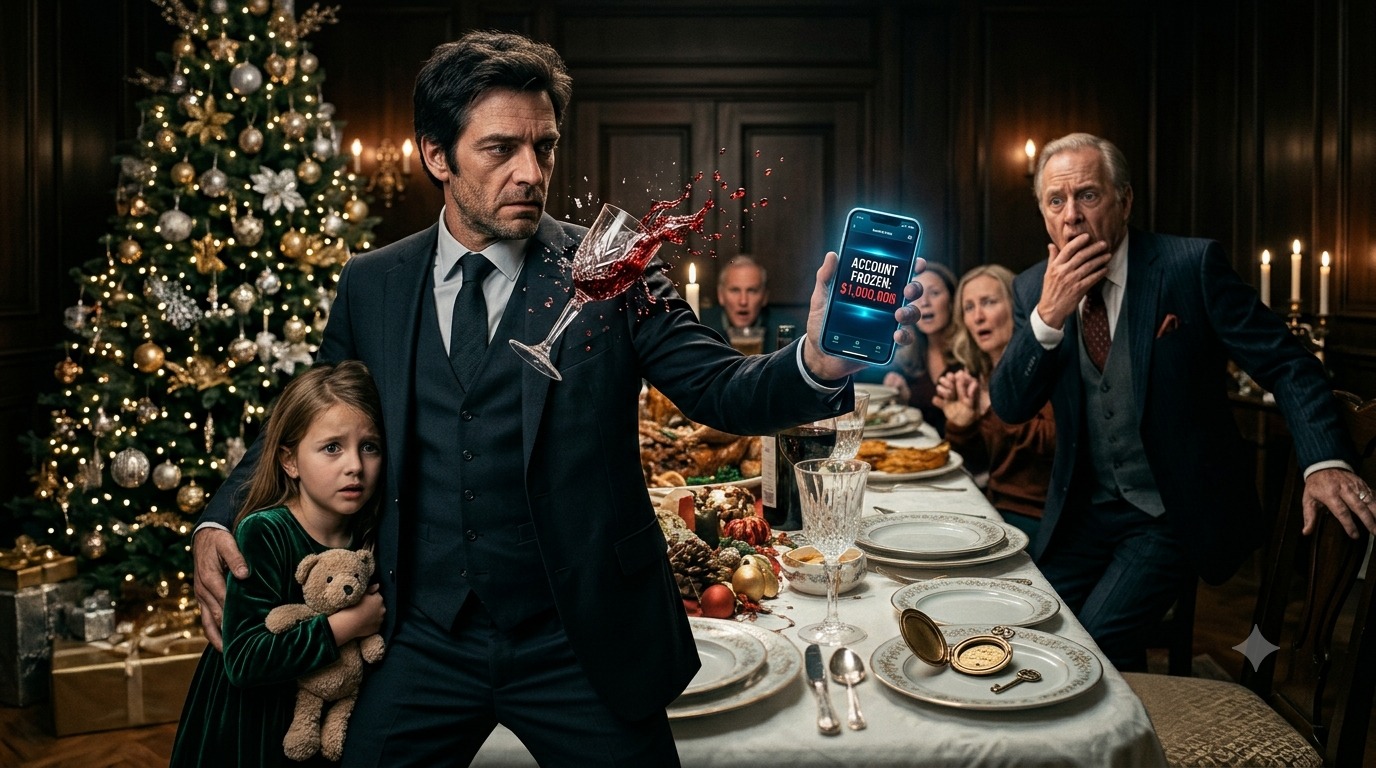


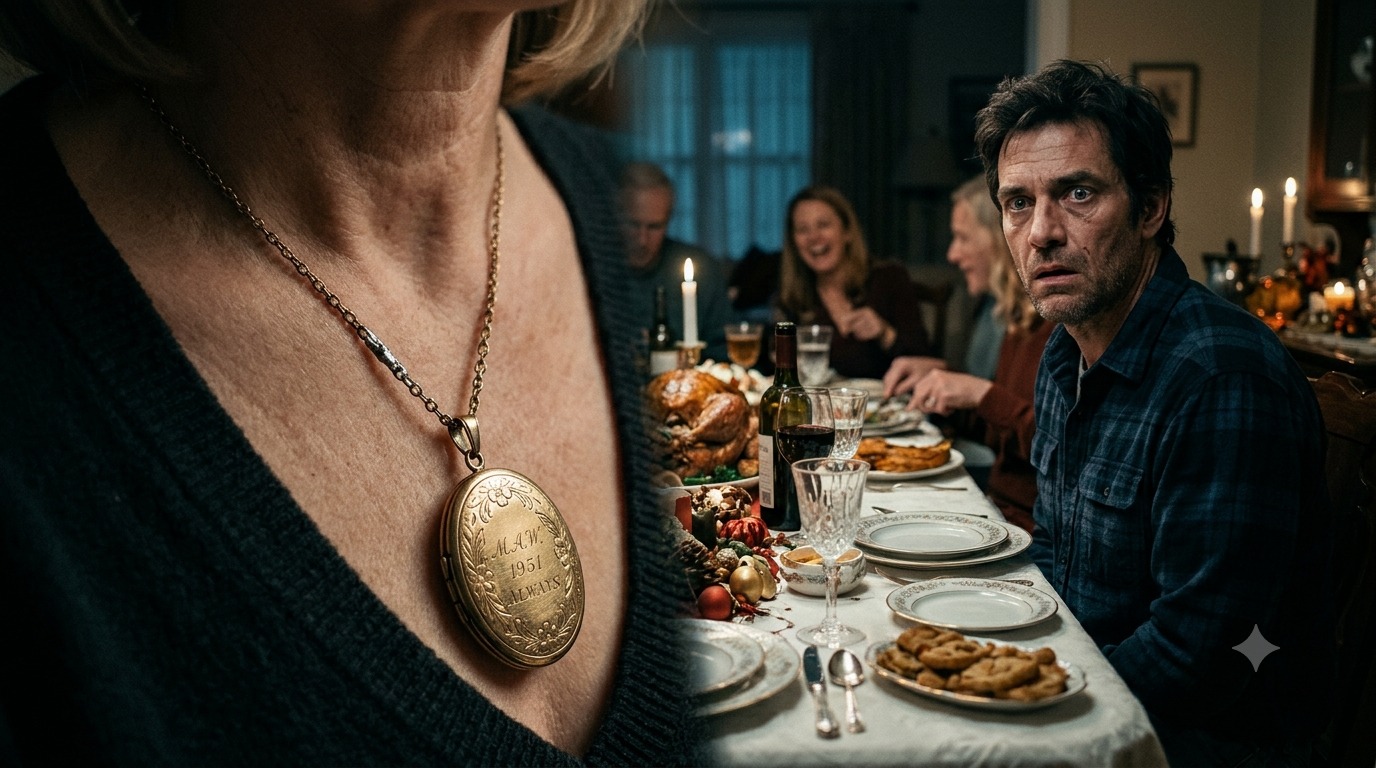
My brother’s new girlfriend came to Thanksgiving wearing my mother’s necklace—the exact one we watched them lower into the frozen earth nine months earlier.
I didn’t scream. I didn’t knock the crystal glasses off the linen tablecloth. I sat perfectly still, swallowed a bite of dry stuffing, walked quietly onto the front porch in my socks into the biting Iowa wind, and called the cemetery office.
The moment it happened, Candy was reaching across the table for the dinner rolls. The heavy pendant slipped out from beneath the ribbed collar of her cream-colored wool sweater, catching the yellow glow of the dining room chandelier. It was an oval locket, solid yellow gold, roughly the dimensions of a quarter but noticeably thicker. It turned lazily in the warm air, suspended by an eighteen-inch chain.
As it rotated, the back faced me. And etched into the scratched gold plate were two block letters and a date:
M & H, 1979.
I knew those letters before I ever learned how to read. When I was four years old, sitting on my mother’s lap in the third pew of St. Luke’s Methodist Church, my thumb would constantly trace those sharp, grooved ridges while the preacher droned on.
Candy, who had been dating my younger brother Colton for barely five months, pulled a roll from the wicker basket and settled back into her chair. The locket dropped flat against her chest.
My eyes didn’t stay on the oval casing. My eyes tracked up the chain.
About two inches up from the clasp on the left-hand side, there had to be one single link that didn’t match the rest. Paler. Grayish-silver against the warm vintage gold. A clumsy patch job that an overconfident twenty-five-year-old with a soldering iron had cobbled together on an oily garage workbench after work.
It was there. The pale silver bead sat right against her collarbone.
My mother was buried in that necklace. I stood in an ankle-deep snowstorm at Linwood Cemetery, high on the bluff overlooking the freezing Mississippi River, and watched the vault lid seal over her cherrywood casket on Friday, February 21st, 2025.
At the dinner table, the noise continued uninterrupted. My aunt was loudly explaining her newest cholesterol medication to anyone who would listen. Colton was hacking through a second turkey breast, violently debating the Iowa Hawkeyes’ offensive line with our cousin.
Candy beamed at me, chewing happily. “These rolls are heavenly, Dustin. Did you make them from scratch?”
“From a plastic bag,” I said. My voice sounded shockingly steady. It was the voice of a man answering a mundane question on an ordinary holiday.
I don’t remember eating another bite. The room became muffled, as if someone had stuffed wet wool into my ears. At some point, I pushed my chair back, excused myself for a breath of fresh air, stepped through the storm door onto the cold wood planks of the porch, and dialed the number for Linwood Cemetery.
I didn’t call 911. I didn’t drag Colton by his collar into the front yard. Because in that singular, terrifying second, only one question existed in the universe: How does a piece of metal sealed six feet under frozen Midwestern clay end up dangling over a basket of warm bread?
My name is Dustin Helms. I’m forty-one years old now. I was forty on that Thanksgiving.
For nineteen years, I’ve worked as a precision machinist at the John Deere tractor works in Dubuque, Iowa. That means my entire adult life has been dedicated to measuring cold steel, brass, and iron down to the ten-thousandth of an inch. When you spend two decades operating CNC mills and lathes, you develop an involuntary instinct for metal. You notice stress fractures, tool marks, heat discoloration, and improper welds before your conscious mind even registers them.
I live in a small, utilitarian brick house on the North End that I bought from my divorce attorney’s cousin back in 2018. No kids, no pets, just an organized shop in the detached two-car garage.
My brother, Colton, is six years younger. He has always been the baby of the family, even when he shot past me and hit six-foot-two. He’s quick-witted, handsome, charming, and perpetually irresponsible with his bank account. He sells certified pre-owned trucks at a dealership out on the highway. Some months he’s buying rounds for the whole tavern; other months he’s sending me sheepish text messages on the 10th asking if I can spot him two hundred bucks for groceries until his commission check clears.
He’d brought Candy into the picture around July. She was thirty-one, a receptionist at a pediatric dental clinic. She was sweet, slightly nervous around me because Colton had spent months warning her that his older brother was a humorless, no-nonsense blue-collar monk.
Our dad, Ansel Helms, passed away back in 2015. Massive heart attack while clearing the heavy wet snow off our front sidewalk—the most brutally typical Iowa way to die there is. Our mother, Marybel, lived alone in the old two-story clapboard house on Romberg Avenue for the next ten years. She spent her days playing euchre with her church circle, burning every single grilled cheese sandwich she ever attempted, and calling my landline every Sunday evening at six sharp to demand whether I was eating real vegetables or subsisting on frozen pizza.
The locket was the very first piece of jewelry Dad ever purchased for her. He bought it with the overtime money from his first full paycheck at the packing plant the summer they got engaged. He paid an old German jeweler downtown to engrave their initials: M & H, 1979.
Mom wore it every waking day of my life. She wore it when she planted tomatoes in the backyard; she wore it when she stood in the hospital recovery room holding baby Colton; she wore it in every Christmas photograph that sat on the mantle.
When I was twenty-five, the chain snagged on an antique brass cabinet pull in the kitchen and snapped. Mom sat at the kitchen table and cried like somebody had died in her arms. I puffed out my chest, told her I worked in a machine shop and could fix anything, and took it out to my garage. I didn’t have gold solder, so I clamped it in a vice, heated it with a pencil torch, and fused it with lead-free silver electronics solder. It held solid for fifteen years. But that tiny pale gray bead remained an unpolished blemish on the yellow link.
I offered to take it to a proper jeweler on Main Street to have it repaired correctly.
She swatted my hand away. “Don’t you dare touch it,” she told me firmly. “That’s my favorite link on the whole chain. That’s the link my boy made for me.”
Pancreatic cancer found her in late October of 2024. By the time the doctors opened the scans, the shadows had already spread across her liver. She deteriorated with terrifying speed.
One bitter night in January, during her home hospice care, I was sitting beside her rented hospital bed in the living room. The room was dark, save for the silent blue flicker of an old movie on the television. She woke up around ten, her breathing shallow and raspy. She took my wrist, guided her trembling fingers to the nape of her neck, and popped the clasp of the locket.
She opened the hinge. I had seen the inside of that locket maybe five times in my life; it was her personal sanctuary.
On the left side was a tiny circular portrait of my father at twenty-two, wearing a short-sleeved work shirt, squinting into the hot summer sun with a thick head of hair. On the right side was a grainy black-and-white picture of two little boys sitting on a wooden porch step: me at six, in a striped polo, holding an infant Colton across my knees like a sack of cornmeal, both of us sporting the identical, bowl haircut Mom used to cut using a kitchen bowl.
“I had to recut that right side three different times,” Mom whispered, smiling weakly. “First it was just your father and me at the county fair. Then when you came along, I trimmed your father out to put you in. Then Colton was born, and I had to cut both of you down with cuticle scissors so you’d fit together.”
“We look completely ridiculous, Ma,” I whispered back.
“You look like my whole world,” she said. She closed the gold lid with a faint click, pressed it against her frail breastbone, and gave a faint chuckle. “When the time comes, Dustin, make sure it’s shut tight. I don’t want your father winking at any other angels up there.”
In the second week of February, with the snow drifts stacked halfway up the front windows, she made us hold her hands and write down her final wishes. She wanted the navy blue dress she’d bought for Colton’s engagement that had fallen apart three years earlier. She wanted Amazing Grace, played at a brisk tempo.
And then she gripped our knuckles with surprising strength. “Bury me in your father’s locket. And my wedding ring. Don’t let anyone talk you into keeping them. I want your father to see that I kept my word until the end.”
Colton and I both swore on our lives.
She slipped away at 4:12 AM on Sunday, February 16th, 2025. She was sixty-eight years old.
Every family in our neighborhood used Hopper Funeral Home. It was an imposing colonial structure with stately white columns and manicured boxwoods on the corner of 14th and Main, operating under the proud neon sign: Serving Families Since 1974.
Mr. Richard Hopper had taken over the business from his father back in the early nineties. On Monday morning, Colton and I sat in his consultation parlor. The room was carpeted in plush, sound-dampening mauve wool, with a heavy mahogany desk, tissue boxes placed strategically on every mahogany side table, and a framed oil painting of a lighthouse guiding a ship through rough seas.
Mr. Hopper was in his late fifties, impeccably groomed, with a full mane of silver hair, rimless spectacles, and a bespoke navy wool suit paired with a silk tie patterned with microscopic gold anchors. He spoke in that low, velvety, practiced cadence that functions like Novocain during the rawest days of grief. He had handled my father’s funeral a decade ago; he remembered which hymns we sang; he knew my uncle’s name.
He filled out the standard state and mortuary intake forms by hand using an elegant black fountain pen.
When we reached Section 4—Disposition of Personal Effects and Jewelry—I repeated my mother’s exact words.
“The gold locket and her gold wedding band remain on her person,” I stated clearly. “They are to be interred with the deceased.”
Mr. Hopper looked up from the paper, his gray eyes radiating profound empathy. He made a deliberate checkmark in the box marked Remain with Deceased, then wrote out the description in crisp block letters: GOLD LOCKET W/ CHAIN. GOLD WEDDING BAND.
“Rest assured, boys,” he murmured, reaching across the desk to lightly pat my forearm. “Leave all of those details entirely in my hands. You two have carried more than enough weight this week.”
I signed the bottom authorization line. Colton signed right below me.
The evening visitation took place on Thursday, February 20th. Mom lay in a polished cherrywood casket nestled against cream-colored satin. The navy dress looked dignified. The locket lay squarely in the hollow of her throat. Her thin, worn wedding ring caught the low track lighting.
I stood beside her casket for an hour, watching dozens of retired cafeteria workers, church elders, and neighbors file past to pay their respects. Around seven o’clock, my aunt called my cell phone with a question about the luncheon menu, and I stepped out into the frosty parking lot to talk.
When I walked back into the viewing room ten minutes later, the crowd had migrated toward the coffee urn in the foyer.
Colton was standing alone beside the casket. His head was bowed, his tall frame trembling slightly, his right hand gripping the edge of the polished wood. He stayed like that for nearly ten minutes without moving. I deliberately remained in the doorway; I knew he needed space to say goodbye without his older brother watching him break.
At eight o’clock sharp, Mr. Hopper gently took me by the elbow. “It’s time to head home and find some rest, Dustin. My staff and I will perform the final preparations for tomorrow morning’s service.”
“Should we remove the jewelry tonight for safekeeping?” I asked, thinking of overnight security.
Mr. Hopper smiled warmly, shaking his head. “She is under my personal protection, Dustin. I will lock the vault and casket myself the moment the doors close.”
The burial took place the following morning under a driving horizontal blizzard off the river. By the time our car arrived at the funeral home at nine o’clock, the casket was already shut and latched, crowned with a dense spray of white carnations.
I remember experiencing a sharp pang of disappointment; I had hoped to hold her cold hand one last time. But Mr. Hopper hurried over, explaining apologetically that he had secured the casket early because the county road plows were running behind schedule and he wanted the motorcade to reach Linwood before the bluffs became impassable. It made perfect sense. Everything Mr. Hopper said always sounded reasonable, respectful, and seamless.
We buried her on the crest of the hill next to my father. The gale-force wind was howling so loudly that the pastor had to cup his hands and shout The Lord is my Shepherd. The backhoe operator waited in his cab while I tossed a frozen clod of earth onto the concrete vault.
That was the last time I was near my mother’s body.
So when that necklace swung out from Candy’s sweater nine months later, my mind didn’t question if it was a replica. My mind broke against the sheer impossibility of its return.
Sitting at the Thanksgiving table, every muscle in my body turned to granite. I forced air in through my nostrils, leaned casually on one elbow, and asked Candy in the most nonchalant voice I could muster: “That’s an unusual necklace, Candy. Where’d you come across it?”
Her face lit up with delight. She reached up, proudly smoothing the oval metal between her thumb and forefinger.
“Colton gave it to me for my thirty-first birthday last month!” she chirped, looking down at the gold. “Isn’t it gorgeous? It’s an authentic antique. He said it caught his eye because it reminded him of someone special.”
I shifted my gaze down the length of the table toward my brother. Colton was grinning at her—that wide, goofy, proud expression he always wears when a gift lands successfully. He caught my stare and gave me a playful double-eyebrow raise, as if to say: See that? I did good, didn’t I?
I looked back at the necklace. I searched for the link.
There it was. Two inches up. The rough bead of dull silver solder. The repair my mother had forbidden anyone to touch because her son had crafted it.
Candy noticed my intense gaze and misread it as admiration. “It actually opens up! Look!”
Before I could breathe, her manicured thumbnail pressed the tiny catch on the side. The spring snapped the gold shell open right above her plate of mashed potatoes.
Inside the left compartment, where my twenty-two-year-old father had squinted into the summer sun, was a tiny round photograph of Colton in a dealership polo shirt, roughly cut with scissors. On the right side, where two little boys with bowl haircuts had sat on a wooden porch, was a picture of Candy wearing oversized sunglasses on a pontoon boat.
“It was completely empty when Colton found it,” Candy explained happily, “so I trimmed down our favorite selfies to fit inside. Isn’t that romantic?”
“Yeah,” I managed to croak out. “Very romantic.”
My father. The little boys on the porch. Gone. Someone had taken a razor blade or a dental pick, pried my family’s memories out of the bezel, tossed them into an ashcan, and sold the hollowed gold shell to a stranger.
And then the cold realization spread outward from my gut, freezing the blood in my veins: Colton had been standing alone beside her open casket for ten uninterrupted minutes.
I spent the next twenty minutes sitting at that table while the holiday chatter washed around me like muddy river water.
When I finally went outside to the porch, the cemetery recording confirmed the office was closed until Friday morning. I left a broken, frantic voicemail for the groundskeeper.
After dinner wrapped up around ten-thirty, I watched Colton and Candy wash dishes together. The locket swayed over my stainless steel sink as she rinsed the plates. The moment their taillights disappeared down Romberg Avenue, I threw on my heavy chore coat, climbed into my four-wheel-drive pickup, and barreled toward Linwood Cemetery.
The wrought-iron front gates were chained shut for the holiday. I drove down the perimeter road to the north ravine, squeezed past the gap in the security fence where the limestone bluff dropped off, and hiked through the dark with snow crunching beneath my work boots.
I found their plot by the dim glow of my smartphone flashlight: ANSEL HELMS — MARYBEL HELMS.
I dropped to my knees in the dead grass. I held the light inches from the frozen earth, scouring the sod for fresh seams, sunken ground, spade incisions—anything to suggest grave robbers had come with picks and lanterns in the dead of night.
There was nothing. The sod was dense, weathered, and settled. The grass looked exactly as nine-month-old turf ought to look.
I rested my forehead against the cold granite marker. “Ma,” I whispered into the freezing wind, “what did he do to you?”
The river wind offered no reply.
I didn’t sleep that night. I paced the floor of my house, running through the cold arithmetic.
Colton had been desperately short on cash all through the winter of 2024. In January, he had borrowed six hundred dollars from me to stave off an eviction notice, paying back only two hundred. Then, come April, he had miraculously rolled into my driveway behind the wheel of a late-model Ford F-150 with heated leather seats, claiming he’d had a “monster sales month” at the lot.
Had my little brother—the boy I held on my lap on that porch step—reached into our dead mother’s casket while everyone else drank coffee in the hall? Had he slipped the locket into his jacket pocket, fenced it to cover his down payment, and then, months later, arrogantly bought it back from the display case because he thought an antique locket had no name?
The sheer filth of the thought made me physically sick. But once the suspicion took root, I couldn’t tear it out.
At 8:30 AM on Friday, my phone rang. It was Harold, the senior sexton at Linwood Cemetery.
“Mr. Helms, I got your message,” he said, his gravelly voice filled with concern. “You sounded beside yourself. Has something happened to Marybel’s headstone?”
“Harold,” I asked, gripping the counter until my knuckles turned white, “has my mother’s grave been opened since the morning of February 21st? For any reason whatsoever?”
I heard the rapid clacking of computer keys on the other end, followed by the rustling of heavy legal files.
“Marybel Helms,” Harold confirmed. “Section D, Lot 44. Mr. Helms, that vault hasn’t been disturbed. In the state of Iowa, opening an occupied grave requires a formal disinterment permit approved by the Department of Public Health and signed by both surviving kin. Nobody has touched your mother.”
My chest constricted. The necklace had never come up out of the dirt. Which meant it had never gone into the ground in the first place.
At one o’clock that afternoon, Colton swung by my house to retrieve the remaining Tupperware of turkey and pie.
“Hey, before you head out,” I said, keeping my eyes fixed on the garage floor, “help me steady that heavy tool chest against the back wall.”
He set the food container on the hood of my truck and followed me inside. The moment he crossed the threshold, I hit the electronic button. The heavy overhead garage door rattled shut, cutting off the daylight.
He turned around, surprised. “What’s up, man?”
“Where did you buy Candy’s necklace, Colton?”
His brow furrowed. “What? Oh, that place across the bridge. River Road Pawn over in East Dubuque. Why?”
“When did you buy it?”
“Late October. Right before her birthday. Why are you grilling me like a cop?”
“Did you look at the initials engraved on the back casing?”
“Yeah,” he scoffed, laughing uncomfortably. “M and H. I figured it stood for something cool. What is this, Dustin?”
“Those are Mom and Dad’s initials, Colton.”
Colton stopped smiling. He stared at me for three silent seconds, then shook his head. “Okay… that’s an eerie coincidence, but M and H could be a million people—”
“The chain has my silver solder on the fourth link,” I cut in, my voice dropping an octave. “The repair I made in this exact garage fifteen years ago.”
His face drained of all color. Then, his expression contorted into utter bewilderment. “What are you saying?”
“You were alone with her body for ten minutes at the viewing, Colton.”
The realization struck him like a physical blow. He staggered backward two steps, hitting the wooden workbench. The blood rushed back into his face, dark and furious.
“Are you… are you accusing me of robbing our mother’s corpse?!” he roared, his voice cracking into a scream. “You think I reached into her casket and stole her jewelry to pawn it?!”
“I’m asking where the damn necklace came from!”
“I bought it out of a glass display case for three hundred and forty bucks because it reminded me of her!” he shouted, tears of pure rage spilling over his eyelids. “I was alone with her because I couldn’t stop weeping, you bastard! Because I couldn’t bear to let all those church hypocrites see me losing my mind! You have always thought I was garbage! You’ve spent my whole life treating me like an irresponsible child who can’t be trusted with a dime!”
He grabbed a metal coffee can filled with assorted lag bolts and hurled it violently across the concrete floor. The bolts exploded against the wall like shrapnel.
Colton smashed his fist against the garage door button, ducked underneath the rising door before it had cleared five feet, threw himself into his truck, and tore down the gravel driveway, kicking up a storm of dust.
I stood alone among hundreds of scattered bolts. It took me forty minutes on my knees to pick up every single one. It gave my trembling hands something mechanical to do while I asked myself if I had just destroyed my only remaining family over a phantom.
On Saturday morning, I crossed the Julien Dubuque Bridge into Illinois.
River Road Pawn occupied a squat, weathered cinderblock bunker on the industrial strip of East Dubuque, wedged between a biker tavern and a smoke shop. The gravel lot was decorated with used zero-turn lawnmowers and chainsaws. Inside, the air smelled heavily of Hoppe’s No. 9 gun bore cleaner and stale diner coffee.
A burly man in his late fifties with a gray ponytail and wire-rimmed bifocals sat on a stool behind the reinforced glass counter, cleaning a lever-action Winchester rifle.
I stepped up to the counter, pulled a twenty-dollar bill from my wallet, and laid it flat on the glass.
“I’m not here to buy anything,” I said. “I’m trying to trace an antique gold locket sold out of your case in late October. An oval pendant with M and H engraved on the back.”
The man’s hands paused on the rifle receiver. His eyes moved up, assessing me with practiced, street-smart calculation.
“Your brother bought that,” the pawnbroker said flatly. “Tall kid. Sells pickup trucks. Paid three hundred and forty dollars cash.”
My heart hammered against my ribs. “I need to know who brought that piece into your store.”
He instantly pushed the twenty-dollar bill back across the glass toward me. “Can’t help you, friend. State and federal privacy laws. Every single transaction that crosses this counter gets logged into the regional law enforcement LEADS database—driver’s license, thumbprint, physical description. If you’re trying to find out who pawned your ex-wife’s jewelry, call a private investigator.”
“That locket belonged to my mother,” I said, my voice dead and cold. “We buried her in it at Linwood Cemetery nine months ago.”
The pawnbroker froze. He slowly set down his cleaning cloth, removed his reading glasses, and leaned his elbows onto the counter. The skepticism in his eyes vanished, replaced by a deep, unsettling gravity.
“Son,” he said in a hushed tone, “if what you’re telling me is true, you don’t need a pawnbroker. You need to walk into the Dubuque Police Department, find a detective, and bring them across this river before sundown.”
“Can you tell me anything at all?” I pleaded.
The man looked at the security camera mounted above his door, then leaned forward. “I can tell you one thing for free: that piece didn’t come from your brother.”
He refused to utter another syllable.
I drove back across the bridge with those words echoing through the cab of my truck.
That night, I sat at my kitchen table with the lights off, staring at the glow of my laptop screen. I pulled up the official website for Hopper Funeral Home.
There was the photo of the stately white columns. There was the mission statement: Our Family Caring for Yours Since 1974. And there was the portrait of Richard Hopper—silver hair, custom navy suit, gold anchor tie, hands folded gracefully over his lap, smiling that warm, soothing smile that had comforted me on the worst Monday of my life.
I stared at those manicured hands for a very long time.
He was the last living person to stand over my mother’s open casket before the lid was screwed down into the vault.
At 8:00 AM on Monday, December 1st, I took a personal day from the plant and walked into the Dubuque Law Enforcement Center on 9th Street.
After forty minutes in the lobby, Detective Simpson escorted me back to her workstation. She was a no-nonsense investigator in her mid-forties with a sharp gaze, short dark hair pulled into a tight knot, and an Iowa Hawkeyes mug sitting on a desk buried under case files.
I sat in the metal chair and laid it out sequentially: the dinner rolls, the locket, the soldered link, the cemetery records, the confrontation with Colton, and the pawn shop counter. I pulled out a glossy color printout of Mom from her church’s 2019 anniversary banquet, where the locket was clearly visible around her neck.
Detective Simpson listened without taking notes, her eyes fixed on my face.
“So the grave is sealed,” she summarized, “and the corpse’s jewelry is circulating through Jo Daviess County pawn shops. That leaves a very narrow window of custody.”
“My brother was in that room alone for ten minutes,” I forced myself to say.
“And the funeral staff had custody of that body for twelve hours,” she countered coolly.
She turned to her terminal and pulled up the inter-state pawn database system. “Every licensed pawn broker in Iowa and Illinois uploads serial numbers, descriptions, and seller identification daily. If it was pawned legally under a government ID, it’s sitting in this server.”
She entered the parameters: Locket, gold, oval, engraved M-H 1979.
For two minutes, the only sound was the clatter of her keyboard. Then she stopped. Her back straightened. She leaned closer to the monitor, reading a single line of data.
Without saying a word, she swiveled the screen toward me.
- Transaction ID: IL-JD-88219
- Item Description: 14k Yellow Gold Oval Locket w/ Chain, Engraved “M & H 1979”
- Date Acquired: March 4th, 2025
- Pawn Payout: $260.00
- Seller Name: HOPPER, RICHARD E.
- Seller Address: 1422 Main St, Dubuque, IA (Residential Suite Behind Mortuary)
- ID Verified: Iowa DL # ******419
I read the line four times.
March 4th. Exactly eleven days after we threw frozen dirt onto her vault.
Two hundred and sixty dollars.
My mother’s entire life—forty-six years of marriage, her husband’s first paycheck, the portrait of her babies on the porch—traded away for two crumpled hundred-dollar bills and three twenties.
“I am so sorry, Mr. Helms,” Detective Simpson said softly.
I don’t remember walking down the concrete steps of the police station. I remember sitting in my truck in the gravel lot, gripping the steering wheel until the leather groaned, staring at the brick facade.
I thought about Hopper touching my elbow in the parlor: Leave all of that to me, Dustin. I thought about him closing the casket early on Friday morning under the pretense of “beating the snowstorm.”
He didn’t close it to beat the storm. He closed it because my mother’s throat was bare.
I fired up the engine and sped straight to Colton’s apartment complex.
When he opened the door, wearing his dealership polo, his eyes were still guarded and bloodshot. Before he could speak, I grabbed him by the shoulders, pulled him against my chest, and held on with everything I had.
“It wasn’t you,” I choked out, tears burning my cheeks. “It was Hopper. The funeral director. He pawned it eleven days after the funeral for two hundred and sixty dollars. The police pulled the transaction record.”
Colton went limp against me. He collapsed onto the arm of his sofa, burying his face in his hands, his broad shoulders shaking violently.
“I bought it, Dustin,” he wept, his voice muffled by his fingers. “I walked into that dirty pawn shop, saw Mom’s locket sitting on black velvet, and my heart stopped. I didn’t look at the back because I was too stupid to understand! I just thought… I thought it looked like home. And I put it on Candy’s neck.”
We sat in that messy living room for an hour, two grown men who had buried their mother, discovering that the sanctuary of her grave had been desecrated before the first shovel of dirt was even turned.
That evening, Candy brought the locket to my house in a small velvet box. She had scrubbed the mascara from her face, her eyes red and raw, repeatedly apologizing as if she were somehow complicit.
I held the necklace in my palm. The metal was cold now. I ran my thumbnail over the silver solder link, then handed it over to Detective Simpson as state’s evidence.
The following morning, Detective Simpson interviewed the East Dubuque pawnbroker on the record. When she returned, she called me into the station.
“The pawnbroker remembers the sale vividly,” Simpson told me. “He said Hopper walked in wearing a tailored wool overcoat and an Italian silk tie, carrying the locket and a men’s vintage wristwatch in a black velvet pouch. Hopper claimed he was liquidating miscellaneous junk from an eccentric aunt’s estate. The pawnbroker gave him two-sixty for the locket and passed on the watch because the movement was shot.”
Simpson leaned back in her chair. “The broker told me: ‘I’ve run this shop for thirty years. Men in three-thousand-dollar cashmere coats don’t hawk trinkets for two hundred bucks unless they’re hiding a gambling habit, an addiction, or they got the goods for free.’ He suspected Hopper was skimming from estates, but without a victim, his hands were tied.”
On December 4th, Detective Simpson served an administrative subpoena at Hopper Funeral Home.
She told me Hopper remained eerily poised. He received her in the lighthouse parlor, poured black coffee from a silver service, and never once raised his voice.
When Simpson confronted him with the computerized pawn slip, Hopper smiled sorrowfully and offered a well-rehearsed defense: “Detective, in our industry, grieving families routinely instruct us to remove jewelry from the deceased prior to final closure. They often ask us to liquidate the pieces and donate the proceeds or dispose of them at our discretion. Grieving minds are fragile and clouded; Mr. Helms and his brother simply misremembered what they authorized.”
I was at the tractor plant when Simpson relayed that statement to me over the phone. The rage in my throat tasted like battery acid.
“I’m a machinist, Detective,” I told her. “I don’t misremember blueprints.”
I clocked out, drove home, and retrieved the green accordion folder marked Mom’s Estate.
Halfway down page two of the original mortuary contract from February 17th, under the heading Personal Effects, sat the proof:
Two checkboxes. One marked Return to Next of Kin. One marked Remain with Deceased.
The second box was checked in permanent black fountain ink. Next to it, written in Richard Hopper’s unmistakable, pristine calligraphy, were the words: GOLD LOCKET W/ CHAIN. GOLD WEDDING BAND.
Underneath were my signature and Colton’s.
When I slid the original yellow carbon copy across Detective Simpson’s desk, her jaw set into iron. “He documented his own felony.”
With the contract in hand, Simpson obtained a multi-jurisdictional warrant to audit the pawn records across three states for the preceding five years.
Two weeks before Christmas, she called me into a private conference room.
Pinned to the corkboard was a sprawling chronological timeline.
“Fourteen confirmed pieces so far, Dustin,” Simpson said, her voice hollow. “Sold across four different pawn shops in East Dubuque, Galena, and Platteville, Wisconsin, dating back to early 2021. Gold wedding rings, a men’s commemorative railroad watch, a confirmation crucifix, a 1968 high school class ring with a sapphire stone. Every single item traces back to a deceased person whose body was prepared in Hopper’s basement within two weeks prior to the transaction.”
“How many families?” I whispered.
“We’re working through the mortuary intake logs right now,” she said grimly.
The first victim Simpson contacted after us was an elderly widow living on Main Street. Her late husband, a decorated Korean War veteran, had requested to be laid to rest wearing his division’s engraved gold signet ring. Hopper had pawned it in Galena nine days after the military honors service for one hundred and eighty dollars. The ring had been melted down into bullion six months prior.
I met her at a diner on 4th Street. She was seventy-six years old, gripping a walker with arthritic hands.
“Forty-eight years of marriage,” she wept quietly into her paper napkin. “And I let that monster hold my hands at the hearse door and tell me he would watch over him.”
By mid-January, the local Cedar Rapids news station broke the investigation.
The image of Hopper Funeral Home—its white pillars illuminated beneath the winter snow—was broadcast across the tri-state area under the banner: MORTUARY EMBEZZLEMENT & GRAVE DESECRATION PROBE.
The following morning at the plant, men from the assembly line began quietly approaching my station.
“Dustin… my dad was buried through Hopper’s back in twenty-three,” a press operator muttered. “Mom put his Knights of Columbus ring on him. Should I call the precinct?”
Within three weeks, the police department’s specialized tip line logged over eighty calls from frantic families across Dubuque County.
The tragedy was that most of them would never receive closure. Half the items had been pawned under false receipts, melted down for scrap weight, or traded private-party. Dozens of elderly widows would spend their remaining years staring at the ceiling at 3:00 AM, wondering if their spouse’s casket held an empty hand.
In late February, I pulled into a Kwik Star station on Central Avenue to refuel my truck.
As I walked out from paying the cashier, a pristine silver Lexus sedan pulled up to the adjacent pump. The driver stepped out: cashmere overcoat, polished leather loafers, silver hair trimmed to perfection.
Richard Hopper.
He saw me. For a split second, his face went completely blank. Then, almost mechanically, his features shifted into that familiar, somber mask of professional condolence.
“Dustin,” he said smoothly, nodding his head. “I am so deeply sorry for the distress your family has been experiencing.”
My distress.
I didn’t make a conscious decision to move. My boots carried me across the asphalt until I was standing three feet from his chest.
“Where is her wedding ring?” I asked.
Hopper didn’t flinch. He carefully turned the fuel cap until it clicked. “I have been strictly advised by counsel not to discuss these matters, Dustin. I assure you—”
“Where is my mother’s wedding band, Hopper?” I stepped closer, my voice vibrating with decades of industrial rage. “A plain gold band. Worn down thin. A dent on the inside from a 1988 Buick door. You wrote it on the form with your own fountain pen. Where is it?!”
He replaced the nozzle into the pump cradle with absolute precision. He smoothed the lapels of his coat, looked down his patrician nose at me, and said:
“I pray you find peace, son.”
He climbed into his leather seat, locked the doors, and slid out onto Central Avenue.
I stood between the pumps, shaking so violently that I couldn’t insert my gas cap.
When I reported the encounter to Detective Simpson, she rubbed her temples. “Dustin, do not corner that man again. If you lay a hand on him, his defense team will claim harassment, poison the grand jury pool, and paint him as a persecuted community pillar. Let the law crush him.”
So I waited. And the waiting was poison.
Because every night, when the furnace kicked on in my quiet house, the identical question hammered inside my skull: Did he leave the ring on her finger, or did he slip that off, too?
There was only one way on earth to answer that question.
In the state of Iowa, disturbing an interred casket requires a formal disinterment permit approved by the district court and signed by every living immediate next of kin. A state health inspector and an independent, non-local mortician must supervise the procedure.
Colton and I sat at my kitchen table for three weeks, wrestling with the horror of the reality.
“She made us swear, Dustin,” Colton choked out one night over a cold cup of coffee. “She held our hands and begged us not to let anyone talk us out of burying her in them. We didn’t keep that promise. That bastard stole it from us. I want her to have what’s hers.”
On March 18th, we walked into the county registrar’s office and signed our names to the disinterment decree.
Two days later, the Iowa State Board of Mortuary Science issued an emergency summary revocation of Richard Hopper’s operating license. Driving past the mortuary that Friday, I saw the proud white neon sign—Serving Families Since 1974—turned dark for the first time in my life. A yellowed notice was taped inside the glass double doors: CLOSED BY ORDER OF STATE REGULATORY AUTHORITY.
The disinterment took place on a Tuesday morning in the second week of May 2026, at seven o’clock, long before the cemetery gates opened to the public.
The morning was gray, fifty degrees, with a damp, raw wind driving off the Mississippi. The ground smelled of wet shale and decaying leaf mulch.
A tracked backhoe stood idle near the headstones, accompanied by a small flatbed crane and four cemetery laborers wearing mud-splattered brown canvas coveralls. Detective Simpson stood near the tree line in a heavy nylon rain parka, holding a state evidence lockbox.
The independent mortician—a burly, soft-spoken director named Miller whom the state had dispatched from Cedar Rapids—shook our hands in silence.
I thought twenty years in a heavy machine shop had made me tough. I thought I knew how to control my nerve.
I was wrong.
When the teeth of the backhoe’s bucket bit into the green sod above my mother’s resting place, tearing through the roots with a sickening, wet crunch, a guttural sound tore out of my throat that I didn’t know a human could make. Colton lunged forward, grabbing my forearm with both hands, burying his forehead into my shoulder as the diesel engine roared.
It took forty-five minutes to clear the six feet of wet Mississippi bluff clay.
The bucket scraped against the ribbed concrete lid of the outer burial vault with a hollow, screeching ring. The workers descended into the trench with heavy nylon rigging straps, looping them beneath the concrete box. The crane winch groaned, lifting the massive vault lid up into the morning fog.
Inside, protected from the elements, sat the cherrywood casket.
The brass corners were still bright. The spray of white carnations on top had withered into brittle, black parchment.
Mr. Miller and two assistants hoisted the casket up to ground level, placing it onto an aluminum field bier set up beneath a white canvas pop-up tent.
Mr. Miller turned to us, his eyes somber. “Gentlemen, you do not have to be inside the tent for this. You have suffered enough.”
“We promised her,” I said. My voice was no longer human; it was gravel and iron.
Miller nodded slowly. He stepped inside the tent, produced a specialized long-reach mortuary casket key from his coat, inserted it into the locking socket at the foot of the lid, and turned it three times. The internal brass cams disengaged with a series of dull, metallic clicks.
He lifted the heavy cherrywood lid.
Colton and I stepped under the canvas.
The scent that drifted out was not decay—the hermetic seal had held—it was the dry, cold, chemical scent of high-index embalming fluid, old cedar, and wilted satin.
My mother lay there. Her face was sunken, the skin like gray parchment, but her hair was still neatly parted. She wore the navy dress.
Her neck was completely bare.
The ivory lace collar of the dress sat flat against her collarbone. There was no gold. There was no chain.
Miller gently lifted her left hand, which rested over her stomach.
The third finger was bare.
There was a distinct, pale, indented ring of tissue where forty-six years of marriage had pressed into the flesh—a ring mark that had outlived the gold itself.
He had taken both.
He had stood in that basement room on the night of February 20th, with my family grieving at home, unclasped the locket that held her children’s faces, twisted the wedding band off her cold finger, slipped them into his pocket, and closed the lid so the procession could leave on time.
Detective Simpson stepped forward, her digital camera flashing three times in the dim light of the tent, logging the bare neck and the bare finger into the criminal docket.
From his interior coat pocket, Colton pulled out the little white velvet box Candy had returned.
Inside was the gold locket. Before coming to the cemetery, Colton had taken it to an artisan jeweler in Cedar Rapids: Dad’s photo at twenty-two and the little boys with bowl haircuts had been painstakingly recreated from our family scrapbooks, scaled to size, and permanently set behind crystal bezels.
Beside it lay Dad’s original wedding band—which I had retrieved from my home safe that morning.
Colton looked at me, his face streaked with tears and clay. “Do it, Dustin.”
My hands, steady enough to calibrate a lathe to the micron, shook as I reached into the casket.
I leaned down and draped the heavy chain around my mother’s neck. I fastened the clasp. The pale silver solder link—the one her boy had made in his garage—settled into the hollow of her throat where it belonged.
Then, I took my father’s wedding band and slipped it gently onto her ring finger, sliding it over the pale indentation in her skin.
“We kept the promise, Ma,” I whispered into the satin. “Dad’s looking right at you.”
Miller closed the heavy cherrywood lid. The key turned three times in reverse.
By noon, the vault was sealed, the clay was packed back into the trench, and fresh green sod was laid over the wound in the earth.
Part 11: The Weight of Justice
Richard Hopper was arrested at his home on May 29th, 2026.
The state charged him with twelve counts of felony theft by deception, eight counts of corpse desecration, and three counts of wire fraud related to interstate transport of stolen property.
The county prosecutor’s office brought Colton and me in for the formal plea agreement conference in September. Hopper’s private defense attorney had spent four months trying to suppress the pawn shop evidence, but the handwritten carbon contract with Hopper’s own calligraphy and signature had obliterated their defense.
He entered a blind guilty plea to avoid a public jury trial.
The sentencing took place in the main courtroom of the Dubuque County Courthouse. The gallery was packed with over forty families—dozens of elderly widows, adult children clutching framed funeral programs, factory workers in clean work shirts.
Hopper sat at the defense table. His pristine navy suit was gone, replaced by an oversized orange county corrections jumpsuit. His hands, which had so gently touched my elbow in the lighthouse parlor, were secured to a heavy steel chain wrapped around his waist. He never turned around. He stared fixedly at the polished oak desk.
When my turn came for the victim impact statement, I walked up to the podium. I didn’t read from a prepared script. I looked at the back of his silver head.
“You built a business on the most sacred trust that exists in human civilization,” I said, my voice echoing through the vaulted courtroom. “When people are at their most broken, when they cannot breathe from the weight of grief, they handed their mothers, fathers, and children over to your care. You looked them in the eye, you promised to watch over them, and the second the door closed, you harvested their memories for pocket change.”
I leaned forward toward the microphone.
“You thought metal doesn’t speak. You thought because you put my mother under six feet of clay, the truth was buried forever. But a good weld holds. My mother’s locket found its way back across that river, onto my family’s table, and into this courtroom. You will die in a concrete cage, Mr. Hopper. And when your time comes, no one will care what’s left on your hands.”
The judge, a formidable woman who had presided over the district for twenty years, handed down the maximum statutory sentence: Twenty-eight years in the Iowa State Penitentiary at Anamosa, with no eligibility for parole until seventy percent of the term was served.
That Thanksgiving, one year after Candy wore the necklace to dinner, our family gathered at my brick house on the North End.
Colton and Candy had gotten engaged in October. She wasn’t wearing an antique locket; she wore a simple, modest diamond solitaire that my brother had worked eighty hours of overtime to purchase with his own honest commissions.
At four in the afternoon, Colton and I drove my truck up to Linwood Cemetery.
The autumn trees along the river bluffs were ablaze with crimson and gold. The air was crisp, clean, and still.
We walked to Section D, Lot 44. The grass over Marybel Helms’s grave was thick, dark green, and seamless now, blending perfectly into the surrounding hill.
Colton knelt down, brushed a dry oak leaf off the gray granite headstone, and patted the cold stone.
“Happy Thanksgiving, Ma,” he said softly.
I stood beside my brother, looking out over the wide, dark ribbon of the Mississippi River rolling south toward the heartland. For the first time in two agonizing years, my hands were entirely still.
The structure was finally sound. The crack was healed. And deep beneath the quiet Iowa earth, where the cold could never reach them, my mother and father were finally resting in peace—holding on to everything they had ever built.