

At 8:17 on a Tuesday night in late April, my mother accidentally texted me a screenshot that completely dismantled the architecture of my family.
It was never intended for my eyes. It was meant for my aunt.
I knew that with absolute certainty because the image captured an active iMessage group thread titled “Kayla & Evan Wedding Weekend Bash.” And down at the bottom of the conversation window, hovering in a crisp blue bubble, my mother had typed: Do you think Nora knows she’s the only one not in here?
My name is Nora Vance. I stood in my kitchen in Portland, Maine, holding my phone with both hands, staring at the glowing glass until the backlight timed out and went black against my palms.
I tapped the screen awake again. I enlarged the image.
There were forty-three participants listed at the top of that thread.
My parents were there. My younger brother, Lucas, and the girlfriend he had been dating for barely five months were there. My estranged uncle from Scottsdale, Arizona—a man who had not attended a single family function since my grandmother’s funeral in 2018—was there. My cousin Tyler and the woman he was currently in the middle of a vicious, contested divorce with were both in the chat. Even Aunt Denise’s former sister-in-law, a woman who had famously hurled a deviled egg across a brunch buffet at Easter seven years ago, had been assigned a plus-one.
Every single branch of our family tree had been gathered into the room.
Except me.
Three gray animated dots appeared beneath my mother’s contact name. They pulsed rhythmically, then vanished. Then they reappeared, hesitated, and vanished a second time.
Finally, a short, panicked text came through: That was not meant for you, Nora.
I dialed her number immediately. She picked up on the second ring, exhaling my name the way a person murmurs a silent prayer after they hear their front bumper crumple against an oak tree.
“Nora…”
“Am I invited to Kayla’s wedding, Mom?”
The silence on the line wasn’t the silence of confusion. It wasn’t the startled pause of an innocent misunderstanding. It was the dense, suffocating silence of complicity.
My cousin Kayla and I had grown up exactly twelve minutes apart in the wealthy suburbs west of Boston. We had spent our summers crammed into the creaky cedar bunk beds at our grandparents’ lake cottage on Winnipesaukee. We had shared a fake driver’s license during our sophomore year of college. We had spent an entire Thanksgiving evening huddled inside a walk-in laundry room eating cold stuffing out of a Pyrex dish because Aunt Denise was trying to force the cousins to perform an acoustic Broadway medley for the living room.
Kayla was not a distant relative I saw twice a decade at milestone anniversaries. She was the person who held my hand when my college boyfriend broke my heart. She was my closest friend.
Her wedding was six weeks away.
My mother let out a long, ragged sigh into the receiver. “I really think Denise is the one who needs to explain this to you, honey.”
That was how I knew the truth was ugly. In our family, whenever my mother directed me toward her older sister Denise, it meant the execution had already taken place, and she simply didn’t want the blood on her Sunday dress.
I ended the call and dialed Aunt Denise. She answered with that bright, performative cheerfulness she reserved for country club hostesses and luxury retail clerks.
“Hi, sweetheart!”
“Hi, Denise,” I said, my voice completely stripped of melody. “I just discovered that every single person in our extended family is invited to Kayla and Evan’s wedding weekend, except for me.”
The musical lilt vanished from her throat in an instant.
“Nora,” she warned, her tone dropping into a hard, defensive cadence. “Do not do this.”
“Do what?”
“Do not turn this into a spectacle.”
A dry, incredulous laugh broke from my chest. “Denise, I am the singular living relative excluded from my own cousin’s wedding. The spectacle was manufactured the moment you made that guest list.”
“Kayla deserves a peaceful wedding day,” Denise snapped.
There it was.
The hammer dropped. The ghost from Christmas had finally caught up with me.
I leaned back against the laminate counter of my kitchen, watching the cold, gray Atlantic rain streak down the windowpane. “So this is retribution for what I saw in your garage?”
Aunt Denise’s voice turned to granite. “This is happening because you suffer from a chronic inability to mind your own business, Nora. You have always inserted yourself into private dynamics where you do not belong.”
“Evan was kissing another woman, Denise. He had his hands in her hair.”
“Stop making every family event about yourself!” she hissed into the phone, her voice rising with furious authority. “You are getting married in October, aren’t you? You will have your own precious little day in the spotlight! Let my daughter have hers!”
“I am not asking for her day!” I shouted back, the composure I had maintained finally cracking. “I am asking why forty-two other people are permitted to watch her walk down the aisle, and I am treated like a convicted criminal! Did Kayla actually tell you she didn’t want me there?”
A hesitation lingered on the line. It was microscopic—barely a quarter of a second—the kind of pause most people would miss entirely.
To me, it was as loud as a gunshot.
“Denise,” I demanded. “Did Kayla look you in the eye and say she didn’t want me at her wedding?”
My aunt inhaled sharply. “I am not litigating this with you any further, Nora. Have a good evening.”
The line went dead.
Part 2: The Garage in Wellesley
Six months earlier, on Christmas night, I had walked into Aunt Denise’s detached three-car garage looking for a bottle of diet tonic water.
Her estate in Wellesley was packed with over thirty relatives. The living room roared with the sound of an NFL playoff game; children were stampeding across the second-floor bedrooms; Kayla was gathered around the granite kitchen island showing my mother and three aunts color swatches for table linens.
Evan—her fiancé of fourteen months, a smooth-talking regional medical device salesman with blinding white teeth and an expensive haircut—had stepped away from the party twenty minutes prior, claiming he had an urgent quarterly sales call.
Sophie Reed had also vanished.
Sophie had been Kayla’s college roommate at Boston College. She was the maid of honor. She was slender, effortlessly stylish, and possessed a breathless, doe-eyed innocence that my family routinely praised as “exquisite.”
I didn’t suspect a thing. I was simply thirsty.
I pushed through the heavy fire door leading from the mudroom into the garage. The primary fluorescent shop lights were turned off, but the amber gooseneck work lamp clamped above the metal tool bench was switched on, casting long, sharp shadows across the concrete floor.
Between Aunt Denise’s silver Lexus SUV and a towering metal rack stacked high with plastic bins of holiday tinsel, two people were pressed against the vehicle’s passenger door.
Evan. And Sophie.
His left hand was buried deep in the nape of Sophie’s chestnut curls. Her silk blouse was pulled crooked, her arms wrapped tightly around his neck, her back pinned against the glass of the tinted rear window.
They were kissing.
It wasn’t an ambiguous angle. It wasn’t an affectionate holiday embrace between prospective in-laws. It was desperate, voracious, and undeniable.
I stood paralyzed on the concrete steps, the brass knob still cold in my palm.
Sophie’s eyes flew open. She saw me standing in the doorway under the amber lamp.
With a frantic, terrified shriek, she shoved Evan away with both hands. Evan stumbled sideways, his lower back colliding hard with the Lexus’s side-view mirror with a sharp plastic crack.
“Nora!” Sophie gasped, her hands flying to her mouth, her chest heaving as if she had just surfaced from underwater.
Evan stood there in his cashmere holiday sweater. And then, he performed the one action I will carry in my memory until the day I die:
He raised the back of his hand, casually wiped a streak of Sophie’s berry-colored lip gloss from his mouth, looked me dead in the face, and said: “Nora… look, this isn’t what it looks like.”
There are moments in life when a lie is so breathtakingly stupid that it functions as a direct insult to human consciousness.
“Really, Evan?” I whispered, my teeth grinding together. “Then you have about sixty seconds to come up with a work of extraordinary fiction.”
I turned on my heel, marched back through the mudroom, bypassed the roaring laughter of the living room, and climbed the carpeted stairs to Kayla’s childhood bedroom.
I didn’t make a scene in front of the uncles. I didn’t announce it over the punch bowl. I closed the bedroom door behind me, looked my cousin in the eyes, and told her precisely what I had witnessed between the SUV and the workbench.
Her face drained of color until her lips looked almost gray. She asked me three times if I was certain.
“Kayla,” I told her gently, taking her freezing hands into mine. “His hands were in her hair. Her back was against the car. I saw him wipe her lipstick off his mouth.”
Twenty minutes later, the bedroom door opened. Evan and Sophie entered the room together.
Their synchronized narrative was already pristine. According to Evan, Sophie had broken down in tears in the garage over a devastating holiday breakup with her long-term ex-boyfriend. She had leaned on Evan for emotional support, misread his comfort, and lunged forward to kiss him in a state of emotional hysteria. Evan claimed he was in the exact process of pushing her away when I barged in and jumped to conclusions.
Sophie stood in the corner, sobbing convincingly into a tissue, whispering: “Kayla, I am so sorry… I was so confused… I would never hurt you…”
“Nobody was pushing anyone away, Kayla,” I said flatly. “She was pinned against the car.”
That was the precise moment the bedroom door flew open with concussive force.
Aunt Denise stepped into the room. She didn’t ask a single clarifying question. She didn’t examine Sophie’s smeared makeup or Evan’s nervous posture. She fixed her cold, calculating eyes squarely on me.
“Enough,” Denise commanded, her voice slicing through the crying. “That is quite enough out of you, Nora.”
By New Year’s Eve, the myth had solidified across the extended family grapevine. In Denise’s carefully managed version of reality, poor Evan had been the innocent victim of a friend’s temporary emotional lapse, and Nora—cynical, hypercritical, perpetually suspicious Nora—had blown an innocent gesture completely out of proportion, nearly destroying her cousin’s engagement out of sheer, subconscious jealousy.
I refused to issue an apology to Evan.
Apparently, my refusal to validate their lie was an unforgivable act of treason.
Part 3: The Ocean and the Vote
The morning after my confrontation with Aunt Denise, my phone buzzed on the nightstand.
It was a text from Kayla—our first communication in nearly five months: I heard you found out about the guest list. I’m so sorry it happened this way.
I sat on the edge of the mattress in my apartment, staring at the message.
From the bathroom, the sound of running water stopped. Ben Carter stepped out into the bedroom, a white towel draped over his broad shoulders, wearing his work flannel. Ben was a marine systems electrician at the commercial docks in Portland Harbor. He was thirty-four, measured, calm, and possessed a deep, unshakeable allergic reaction to unnecessary drama. If two people began screaming at a tavern, Ben was the man who quietly located the exit and made sure everyone’s coats were accounted for.
He noticed my posture immediately. He sat down beside me on the mattress, taking my left hand into his calloused fingers.
“What happened, Nora?”
I handed him the phone. Ben scrolled through the text, his jaw setting slightly as he read the words.
“What do you want to say to her?” he asked quietly.
“I have no idea,” I admitted, my eyes burning with unshed tears.
“Then don’t type a single letter yet,” Ben said, kissing the side of my forehead. “Never react on someone else’s timetable.”
I waited twelve hours. I let the anger cool until only the clean, sharp bone of reality remained. That evening, I texted Kayla back: I never wanted to ruin your wedding, Kayla. I told you what I saw in that garage because I loved you too much to watch you walk into a life built on a foundation of sand. I genuinely hope your wedding day is everything you want it to be.
She never replied.
Six weeks later, on a radiant Saturday in early June, my entire family attended the wedding of Kayla and Evan.
The ceremony was held at an oceanfront Vanderbilt-era estate north of Boston. The lawn was carpeted with thousands of white hydrangeas; a string quartet played Vivaldi from a cedar arbor; an open bar served signature craft cocktails named after the bride’s rescue terriers.
I knew every detail because my family documented the entire affair in real-time.
My brother Lucas sent me an accidental selfie of himself adjusting his black-tie tuxedo in a brass hotel mirror before realizing the horror of his mistake and frantically deleting the image thirty seconds later.
Then, at 4:42 PM, Aunt Denise uploaded the master photograph to her public Facebook and Instagram profiles.
The image captured the entire Brooks-Vance clan gathered beneath a massive, wisteria-choked stone archway. My mother stood on the far left, looking stunning in an ice-blue silk gown I had personally helped her select at a boutique in Newburyport three months earlier. My brother stood right behind her. Cousins, aunts, great-uncles, and step-relatives filled out three elevated rows on the terrace.
Below the photograph, Aunt Denise had penned an eleven-word caption:
“Surrounded by pure grace. Nothing matters more in this life than family.”
I sat at my small kitchen table in Maine, staring at those forty-two faces until the pixels blurred.
Ben walked out of the kitchen, carrying two plates of grilled sourdough bread and sharp cheddar cheese. He set the plates down, took my phone out of my hand, placed it face-down on the wooden table, and gently pulled me up by my wrists.
“Come outside,” he said.
“Ben, I’m thirty-two years old. I’m not a crying toddler.”
“I know you’re not,” he answered calmly, pressing a glass of crisp pinot grigio into my hand. “Toddlers don’t get twenty-dollar wine. Move your feet.”
He led me down the back fire escape to the small patch of common lawn behind our brick apartment building. We set up two rusted aluminum lawn chairs while the gulls wheeled and screamed over the roofs of the harbor warehouses. It wasn’t an estate. There was no string quartet. The air smelled of low tide, diesel fuel from the ferry docks, and summer salt.
It was the most grounding place on earth.
“I feel so pathetic, Ben,” I whispered, staring down into my wine. “I am a grown woman weeping because I was uninvited from a party.”
Ben leaned back, his work boots crossed in the grass. “You aren’t weeping over a party, Nora. You’re grieving because forty-two people took a silent vote and decided it was more convenient to erase you than to confront a liar.”
His words hit me right between the ribs.
He was completely right. The rejection wasn’t a clerical oversight; it was a referendum on my integrity. The family had weighed Evan’s comfortable deceit against my uncomfortable honesty, and they had cast their ballots for the lie.
Three days after the wedding, a dark sedan pulled into the alley behind our apartment.
My mother walked up our stairs carrying a paper bag containing two fresh blueberry muffins and a cardboard cup of black coffee. She sat at my kitchen table, her eyes swollen and lined with profound exhaustion.
“I should not have gone, Nora,” she said, her voice barely louder than a whisper.
“Why did you?”
“I told myself I was doing it for Kayla,” my mother confessed, staring into her coffee. “I told myself a cousin’s wedding shouldn’t be derailed by an argument between sisters. But the moment the photographer asked us to squeeze together beneath that arch, I looked at the empty space beside your brother, and I felt sick to my stomach. We didn’t protect Kayla. We just made things easy for Denise.”
That afternoon was the first step in rebuilding something honest between my mother and me. She stopped defending Denise’s narrative. She stopped making excuses for the family’s cowardice.
Our own wedding was scheduled for late October.
From the beginning, Ben and I had rejected the idea of a massive commercial gala. We didn’t want a guest list that required a color-coded spreadsheet, and we certainly didn’t want a room filled with people who judged love by the cost of the floral centerpieces.
We booked a historic, weathered-shingle oceanfront inn perched on the rocky bluffs of Cape Elizabeth, Maine. The lawn sat directly above the Atlantic breakers, and the interior dining room could comfortably seat forty-eight people if everyone was willing to pull their chairs in close.
Our final guest list totaled exactly thirty-nine people: close friends from college, Ben’s shipyard crew, my parents, my brother, and two beloved former neighbors.
Aunt Denise was not invited.
And after weeks of agonizing internal debate, I chose not to invite Kayla either. That second exclusion felt like an open wound, but I couldn’t risk turning our sacred vows into an emotional battlefield.
Then, twelve days before our wedding date, my phone rang.
The caller ID displayed a number I hadn’t answered in nearly ten months: Kayla.
Part 4: The Old iPad
I stared at the vibrating phone on my desk for three full rings. My finger hovered over the red decline button. Then, something inside me—some stubborn, lingering memory of cold nights on Lake Winnipesaukee—forced me to swipe green.
“Hello?”
A sharp, ragged intake of breath sounded through the speaker. “Nora?”
“Yeah. I’m here, Kayla.”
A dam broke. My cousin began to sob with such violent, suffocating intensity that she couldn’t form words for thirty seconds.
“Kayla, breathe,” I said, standing up from my drafting table. “What’s happened? Are you okay?”
“He… he never stopped, Nora,” she choked out, her voice disintegrating. “It wasn’t a mistake in the garage. It was never a mistake.”
The story spilled out like poison from a severed artery.
Three days prior, Kayla had been looking for a recipe on an old iPad mini synced to their household iCloud storage. A secondary messaging thread had popped up—an unlinked WhatsApp profile that Evan had forgotten to log out of.
The messages spanned eleven continuous months.
Dozens of explicit photographs. Hotel booking confirmations in Providence, Portsmouth, and Newport. Romantic weekend itineraries. And most devastatingly of all: an encrypted exchange between Evan and Sophie Reed sent at 2:15 AM on the morning of Kayla’s rehearsal dinner, discussing an intimate rendezvous inside a private hospitality suite.
My stomach plummeted into an abyss. “Kayla… I am so, so sorry.”
“That isn’t even the worst part,” Kayla gasped, her weeping turning into a hollow, bitter laugh.
She had confronted Sophie first at a coffee shop in Newton. Trapped by the digital forensics, Sophie had completely broken down.
And in her panic, Sophie had confessed the ultimate betrayal:
Three days before Kayla walked down the aisle under that wisteria arch, Sophie had experienced a crisis of conscience. She had driven to Aunt Denise’s house in Wellesley, collapsed on her living room sofa, and admitted the entire eleven-month affair with Evan.
My aunt had known.
Denise had known before the rehearsal dinner. She had known before my mother put on that ice-blue silk dress. She had known before forty-two family members raised their champagne flutes to toast the couple’s eternal fidelity.
“What did Denise do when Sophie told her?” I asked, my voice trembling with cold rage.
“She told Sophie to shut her mouth and never speak a word of it until after the honeymoon,” Kayla wept. “She told Sophie that the caterer and venue deposits were fifty thousand dollars and completely non-refundable. She said that our flights to Italy were booked. She told Sophie that marriages survive rough patches all the time, and that once Evan had a wife and a mortgage, he would settle down and stop straying.”
I sank back into my chair, my knuckles white against the desk. “She sold your life for a deposit.”
“And do you want to know why you were banned from the wedding, Nora?” Kayla asked, the tears turning into pure venom. “Mom didn’t keep you away because she thought you were lying. She kept you away because she knew you were the only person in this family with the guts to keep digging. She was terrified that if you came to the rehearsal dinner, you’d see them together again and blow the whole expensive production apart.”
The entire timeline shifted.
For nearly a year, I had internalized their gaslighting. I had questioned whether I was too cynical, too aggressive, too quick to pass judgment on others. But I hadn’t been excluded because I was flawed.
I had been excluded because I was the only person in that house who possessed eyes that refused to look away from the rot.
“I asked Mom about your invitation two months before the wedding,” Kayla whispered. “Mom told me that you had personally refused to come because you were bitter and didn’t support our happiness.”
A single, humorless laugh escaped my mouth. “And she told me that you explicitly forbade me from stepping foot on the property.”
A heavy, devastated silence fell between us.
“Oh my God,” Kayla breathed. “She played us against each other.”
We met the following afternoon at a quiet bakery in Portsmouth, New Hampshire—the exact midpoint between our homes.
Kayla looked hollowed out. She had lost at least fifteen pounds; dark, bruised circles shadowed her eyes, and her left ring finger was starkly, beautifully bare. She had already signed a lease on an apartment across town and retained a ruthless divorce litigator in downtown Boston.
We sat over two mugs of black coffee for three hours, crying, cursing, and slowly piecing together the wreckage of our youth.
As we stood up to leave, Kayla hesitated by the doorway, clutching her trench coat around herself.
“Can I ask you something impossible, Nora?” she whispered, her chin quivering. “Can I come to your wedding?”
I looked at her, startled.
“I know I don’t deserve a seat,” she hurried to add, her eyes pleading. “I know it’s too late. I can sit in the very back row behind the caterer’s tent. I can slip away the second the vows are over. I just… I can’t bear the thought that the last wedding associated with our family will be the one where you were left out in the cold.”
I didn’t answer right away. Real forgiveness is not a Hallmark card; it is messy, complicated, and requires dismantling your own defenses.
“Give me twenty-four hours to talk with Ben,” I told her honestly.
That evening, Ben and I walked along the Eastern Promenade in Portland. The salt air was freezing, the autumn leaves swirling along the gravel path as the Casco Bay ferry churned the dark water below.
“If I let her come,” I asked Ben, watching the ferry’s navigation lights, “does that mean I’m telling her that what she did to me was acceptable?”
Ben shoved his hands deep into his canvas work jacket. “Do you think what she did was acceptable?”
“No.”
“Then you aren’t saying that,” Ben replied gently. “You’re simply giving her the opportunity to make the right choice this time.”
I called Kayla that night and told her there was a chair waiting for her on the lawn.
Part 5: The Ambush at the Inn
On the morning of Saturday, October 24th, 2026, the weather forecast for coastal Maine predicted mild autumn sunshine.
The Atlantic Ocean had entirely different plans.
By noon, a ferocious nor’easter was clawing its way up the New England coastline. Gale-force gusts rattled the historic cedar shingles of the inn, whipping the waves into frothing walls of white foam that hammered against the dark granite cliffs fifty feet below the lawn. By three in the afternoon, the sky had bruised into a dramatic, slate-silver canopy.
Melissa, our unflappable wedding coordinator, hurried into the bridal suite upstairs.
“Nora, the radar is looking rough,” she said, holding her clipboard. “We can easily transition the altar into the library downstairs beside the stone fireplace. It will be intimate and dry.”
I stood by the second-story window, looking down at the wide expanse of sea grass, the salt spray misting the glass.
“Let’s hold the lawn as long as humanly possible,” I told her with a smile. “A little salt water never killed a Vance.”
By 4:15 PM, I was sitting in my ivory silk dressing robe while my mother carefully secured an antique comb into my hair. My gown hung from the wardrobe door: a minimalist, long-sleeved ivory crepe design with a dramatic open back and zero beadwork. It had cost $1,480—less than what Aunt Denise had spent on her daughter’s floral boutonnieres.
My mother was just fastening my late grandmother’s vintage pearl bracelet around my left wrist when three sharp, erratic knocks sounded at the bedroom door.
Melissa slipped inside, her expression unusually tense.
“Nora,” she said in a hushed, cautious tone. “Your aunt is in the lobby.”
My mother’s hands froze on my wrist. “Denise?”
I stood up, the silk robe billowing around my legs. “What is she doing here?”
“She’s down at the reception desk, and she’s causing a major scene,” Melissa said grimly. “I can have the inn’s security escort her off the property immediately.”
Before I could answer, the muffled sound of heated shouting drifted up the central stairwell.
One voice belonged to Aunt Denise—sharp, piercing, and indignant.
The other voice belonged to Kayla.
I didn’t bother grabbing a sweater. I pushed past Melissa, marched down the second-floor hallway, and descended the grand oak staircase in my dressing robe, hair half-pinned, the grandmother’s pearl bracelet dangling loose on my wrist.
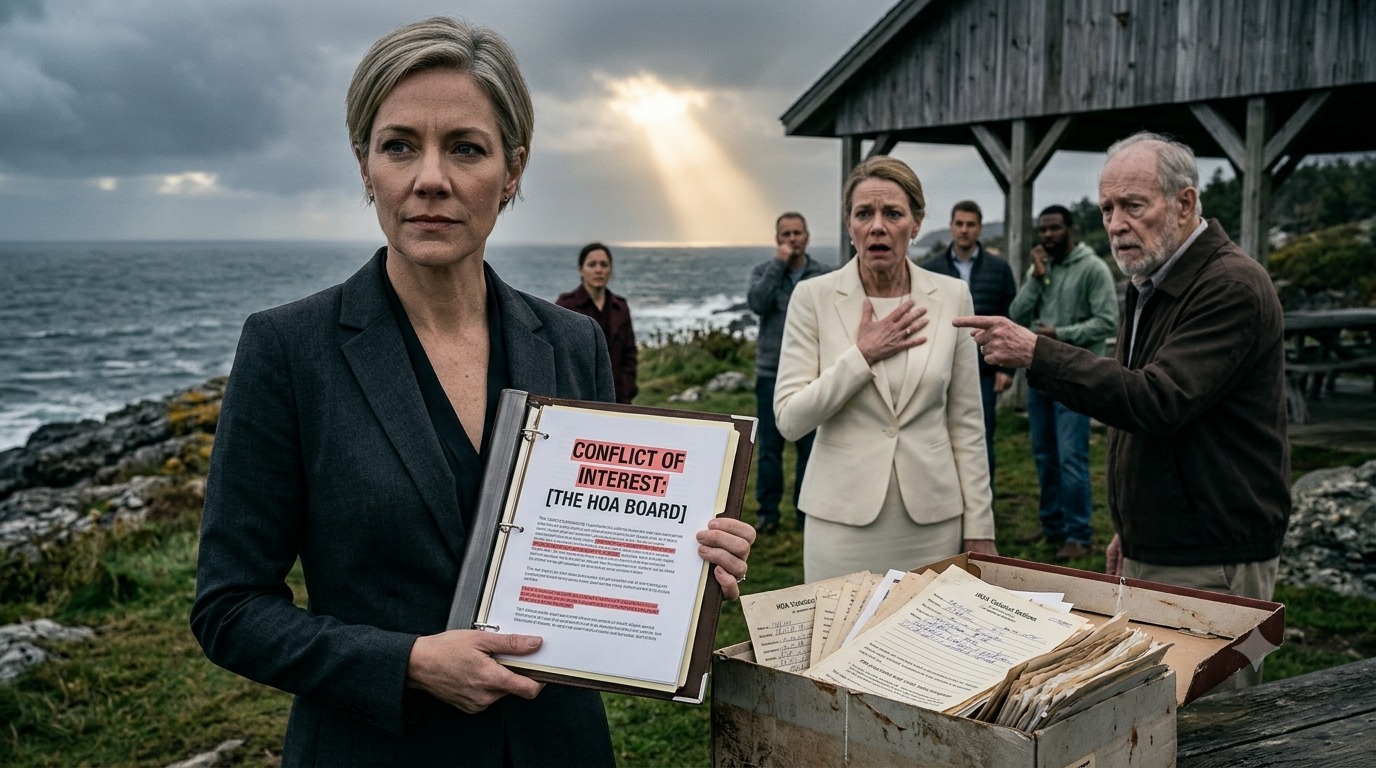
In the center of the wood-paneled lobby, beneath a brass ship’s chandelier, Aunt Denise stood in a tailored camel cashmere coat, her designer umbrella dripping rainwater onto the oriental rug. She was grabbing Kayla’s wrist with furious maternal authority.
“You are packing your bag and getting into my car this instant!” Denise hissed, her voice vibrating with manic urgency. “You are not participating in this sickening little theater!”
Kayla yanked her arm free, her face flushed crimson. “Let go of me, Mom! I am thirty years old! I am here to support my cousin!”
“You are using Nora to spite me!” Denise spat, her teeth bared. “You are airing this family’s private laundry in front of strangers!”
I let out a loud, mocking laugh from the bottom step of the staircase.
Both women whirled around.
Aunt Denise’s eyes raked over my unfinished hair and my dressing robe with withering disdain. “Nora. I apologize for arriving unannounced, but this situation has spiraled entirely out of control. I came to retrieve my daughter before she makes a humiliating spectacle of herself.”
Some people go their entire lives without learning a single lesson from the wreckage they leave behind. Aunt Denise was the poster child for that disease.
I crossed the lobby floor, stopping three feet from her umbrella.
“You need to turn around and leave this property, Denise,” I said, my voice dead and cold.
Denise blinked, stunned that her presence hadn’t immediately forced compliance. “I am Kayla’s mother! She is emotionally compromised! She is in the middle of a delicate marital separation, and you are using her pain to manufacture some vindictive public statement against me!”
“My wedding has nothing to do with you,” I replied, the words dropping like stones into deep water.
A flicker of memory crossed her eyes. Perhaps she remembered using those exact words to silence me on the phone six months ago.
“You have no concept of what I sacrificed to protect this family,” Denise whispered, leaning forward, trying to regain high ground. “Everything I did was to shield Kayla from public humiliation.”
That was when Kayla stepped between us, her hands shaking as she pulled her smartphone from her purse.
“I have the complete digital records, Mom,” Kayla said clearly.
Denise went completely rigid.
Kayla held the screen directly in front of her mother’s face. “Sophie gave me the export of your iMessage threads. Every single message. You instructing Sophie to delete her call logs. You telling her that the deposit on the ballroom was worth more than my self-respect. You explicitly ordering her not to tell me the truth because you didn’t want the family to look pathetic in front of your country club friends.”
The silence in the lobby was total. The only sound was the fierce coastal rain hammering against the panoramic glass windows.
Aunt Denise’s patrician posture began to cave. The carefully curated mask of the noble matriarch shattered into jagged fragments.
Behind me, the sound of soft footsteps approached.
My mother stepped off the staircase. She walked across the lobby, bypassing Denise entirely, and positioned herself directly at my right shoulder. She placed a warm, firm hand on my arm.
“Denise,” my mother said quietly. “Get in your car and drive back to Boston.”
Aunt Denise stared at her own sister, her eyes wide with shock. “Estelle? You’re choosing this? You’re choosing to tear this family in half?”
My mother didn’t blink. “No, Denise. I’m choosing to stop helping you pretend you aren’t the one holding the scissors.”
That was the true climax of the war.
It wasn’t Evan’s infidelity. It wasn’t the forty-three people in the group chat. It was my mother finally stepping into the daylight beside me, refusing to force her daughter to be smaller just so her sister could feel grand.
Aunt Denise let out a sharp, trembling scoff, pulled her cashmere collar up around her neck, turned on her designer heels, and walked out into the driving nor’easter.
She didn’t slam the heavy oak door. She closed it with a soft, pathetic click.
And that quiet click felt like an absolute liberation.
Part 6: The Rain on the Headland
Thirty minutes later, the coastal squall intensified into a full Atlantic downpour.
Melissa found me in the bridal suite as I finished fastening the pearl buttons down the sleeves of my gown. “Nora, we have to call it. The rain is blowing sideways. The chairs on the lawn are soaked.”
I walked over to the bay window.
Down on the covered veranda below, Ben was standing in his dark charcoal three-piece suit, leaning against the railing with his hands in his pockets, watching the slate-gray waves crash against the rocks. He looked up, caught my eye through the glass, and grinned—that wide, easy, unbothered smile that always made the world feel entirely manageable.
I turned back to Melissa.
“Pass out the clear golf umbrellas,” I said. “And tell the guests to bring their coats. We’re getting married on the grass.”
It was completely unorthodox, wild, and utterly magnificent.
The thirty-nine guests sat on the lawn wrapped in heavy wool stadium blankets, holding transparent domes over their heads while the coastal wind roared off the water. The Atlantic was churning with primeval fury, gray-green and crested with white foam.
Kayla sat in the second row, seated directly beside my brother Lucas, wearing a simple burgundy trench coat, her face clear and calm.
My mother walked me down the aisle.
Halfway across the lawn, a sudden gust of sea wind ripped my fingertip veil clean out of my hair, sending it sailing across the cliffs like a white seabird. I didn’t cry. I threw my head back and laughed until my stomach ached, and every single person under those thirty-nine umbrellas laughed with me.
When I reached the altar, Ben took my freezing hands into his warm, dry grip.
“You still sure about this, Vance?” he whispered over the sound of the surf.
“Too late to run, Carter,” I whispered back.
We spoke our vows into the teeth of an Atlantic gale, the rain drumming steadily against the canopy of clear plastic above us.
And then, precisely as our officiant raised his hands to pronounce us husband and wife, the heavy ceiling of storm clouds tore open along the western horizon.
A solitary, blinding spear of late-afternoon October sunlight broke through the silver fog, striking the surface of the ocean directly behind the altar. For sixty seconds, the churning dark water turned into an expanse of hammered, molten silver.
A collective, involuntary gasp rippled through our thirty-nine guests.
Our wedding photographer, an exceptionally talented documentary artist named Lena Ortiz, didn’t miss a beat. Her shutter fired in rapid, rhythmic bursts.
She captured the veil flying out over the sea. She captured Ben pulling me into a fierce, breathless kiss while the rain beaded on his wool lapels. She captured the silver light exploding across the waves.
And she captured one other frame that none of us knew existed until seven days later.
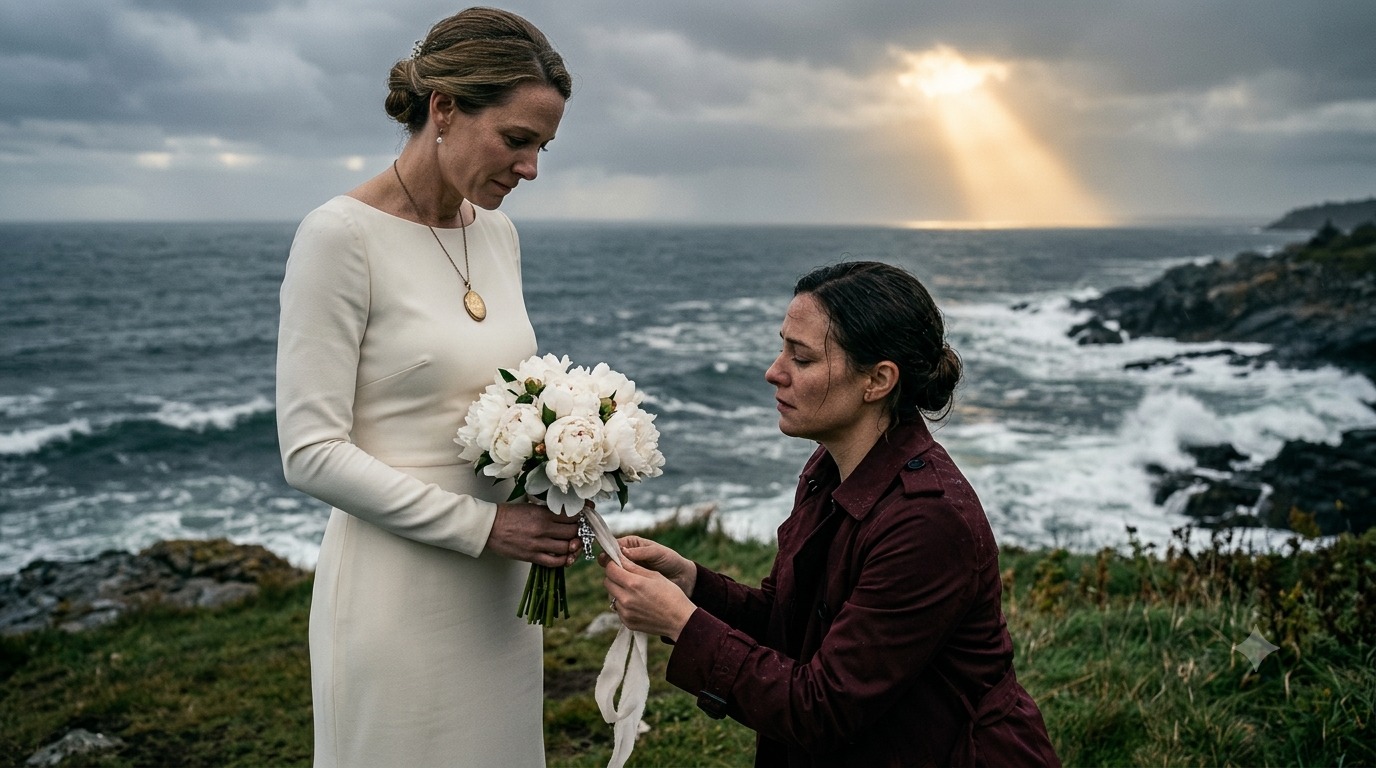
Ten minutes before the ceremony, while the rain was just beginning, I had slipped out through the side doors in my robe to check on the seating. A sudden gust had sheared one of the trailing silk ribbons loose from my white peony bouquet.
Kayla had dropped to her knees in the wet grass, ignoring the mud soaking through her trousers, carefully catching the ribbon and tying it back around the stems.
In Lena’s lens, I was looking down at my cousin with quiet reverence. Kayla was looking up at me, her eyes clear and unprotected.
Behind us, the dark Atlantic rolled under a slate sky. Neither of us was smiling for the camera. But the frame radiated an overwhelming, haunting resonance—a portrait of two women who had survived a generational shipwreck, kneeling in the rain, fixing what had been broken.
Part 7: The Viral Horizon
The preview gallery arrived in my inbox the following Monday afternoon.
I was sitting at my desk at the design firm in Portland. I opened the link, scrolled through the first five frames, and began to weep so openly that my office manager rushed in with a box of tissues. When I showed the gallery to Ben that evening, he wiped his eyes with his sleeve and insisted that his laptop screen’s blue-light filter was malfunctioning.
On Wednesday, Lena called me from her studio.
“Nora,” she said, her voice buzzing with excitement. “I’m submitting three frames to a feature editorial for New England Bride, but I want to share a sneak-peek on my Instagram account first. Would you mind if I posted the shot of you and Kayla with the bouquet?”
Lena had been in the lobby when Aunt Denise staged her ambush; she knew the skeleton of the story.
“You can post it, Lena,” I told her. “Just promise me you won’t mention any names, or affairs, or family drama. I don’t want a circus.”
Lena kept her word. That evening, she uploaded the photograph of Kayla kneeling in the rain, accompanied by a simple, profound caption:
“This bride was once the only member of her family deliberately excluded from a wedding to protect an expensive lie.
Five months later, standing on a storm-swept bluff in Maine, she held an open chair for the very cousin who had been turned against her.
Sometimes healing a family looks less like an angry confrontation, and more like setting an extra plate for someone who finally learned how to tell the truth.”
I went to bed that night expecting the post to gather fifty or sixty likes from Lena’s local followers.
By Friday morning, the internet had caught fire.
A prominent national lifestyle curator shared the post to their two million followers on Instagram. From there, it jumped to TikTok and Facebook. Within forty-eight hours, the photograph had been viewed over six million times across three platforms.
The comment sections became an emotional confessional for tens of thousands of strangers: people sharing their own stories of being scapegoated by narcissistic families; people recounting the agonizing pain of weddings weaponized as instruments of social exclusion; daughters talking about mothers who valued high-society appearances over their children’s safety.
My modest, thirty-nine-person coastal wedding had become a global symbol of moral vindication.
On Saturday afternoon, my phone pinged with a text message from a number I had deleted months ago.
Aunt Denise.
You have turned this entire family into public monsters, she wrote. I hope you are satisfied with yourself.
I read the words twice, feeling nothing but a profound, detached pity.
I typed back a simple response: I never posted your name, Denise. I never posted Evan’s name. No one in that comment section knows who you are.
Her reply was instantaneous: People in Wellesley know! My friends from the club are calling me!
I stared at the screen, took a slow sip of water, and typed my final message:
Then perhaps they recognized the behavior.
I blocked the number permanently.
Two days later, Kayla sent me a screenshot of an email Aunt Denise had sent to her personal account, demanding that she issue a public statement defending the family’s honor, claiming that “private family disputes must remain private.”
Kayla had replied with seven words:
“Privacy is not the same as secrecy, Mom.”
I sat in my living room, reading that sentence, and felt a surge of pride so fierce it caught in my throat. Kayla hadn’t chosen me over her mother; she had chosen her own soul over a generational masquerade.
Today, one year has passed since the nor’easter on Cape Elizabeth.
Kayla’s divorce from Evan was finalized three months ago. She sold the engagement ring, moved into a bright, sunlit loft in Salem, and started graduate school in counseling. Sophie Reed moved to Chicago after being quietly dropped by their entire collegiate social circle.
My relationship with Aunt Denise is completely dead. And I sleep peacefully every single night knowing it will stay that way.
The photograph framed above the fireplace in our Portland apartment is not the one that went viral with six million views.
It is not the cinematic shot of Ben and me kissing beneath the silver beam of sunlight.
It is a quiet, candid picture that Lena snapped after the dinner had cleared out, around ten o’clock that night.
Ben and I are sitting on the wet wooden stairs leading down to the rocky beach. My satin shoes are kicked off in the grass; his tie is undone and tucked into his pocket. I am eating a massive slice of almond wedding cake with my bare hands because the kitchen had already packed away the silverware.
Through the lit window in the background, you can see my mother laughing as my brother spins her across the wooden floorboards. And in the far corner of the frame, slightly out of focus, Kayla is sitting at a table with two of Ben’s shipyard buddies, her head thrown back in pure, unburdened laughter.
Everyone in that frame is there because they wanted to be there.
Everyone in that frame chose honesty over comfort.
For a very long time, I believed that being left off that forty-three-person guest list meant I had been cast out into the cold.
What I understand now is that exclusion is often an unintended act of grace. It pulls back the curtain on the people who were never truly in your corner. It shows you exactly where the perimeter of your life belongs.
And once you realize that, you never have to beg for a seat at the wrong table ever again.