

Chapter 1: Thanksgiving at Havensport Road
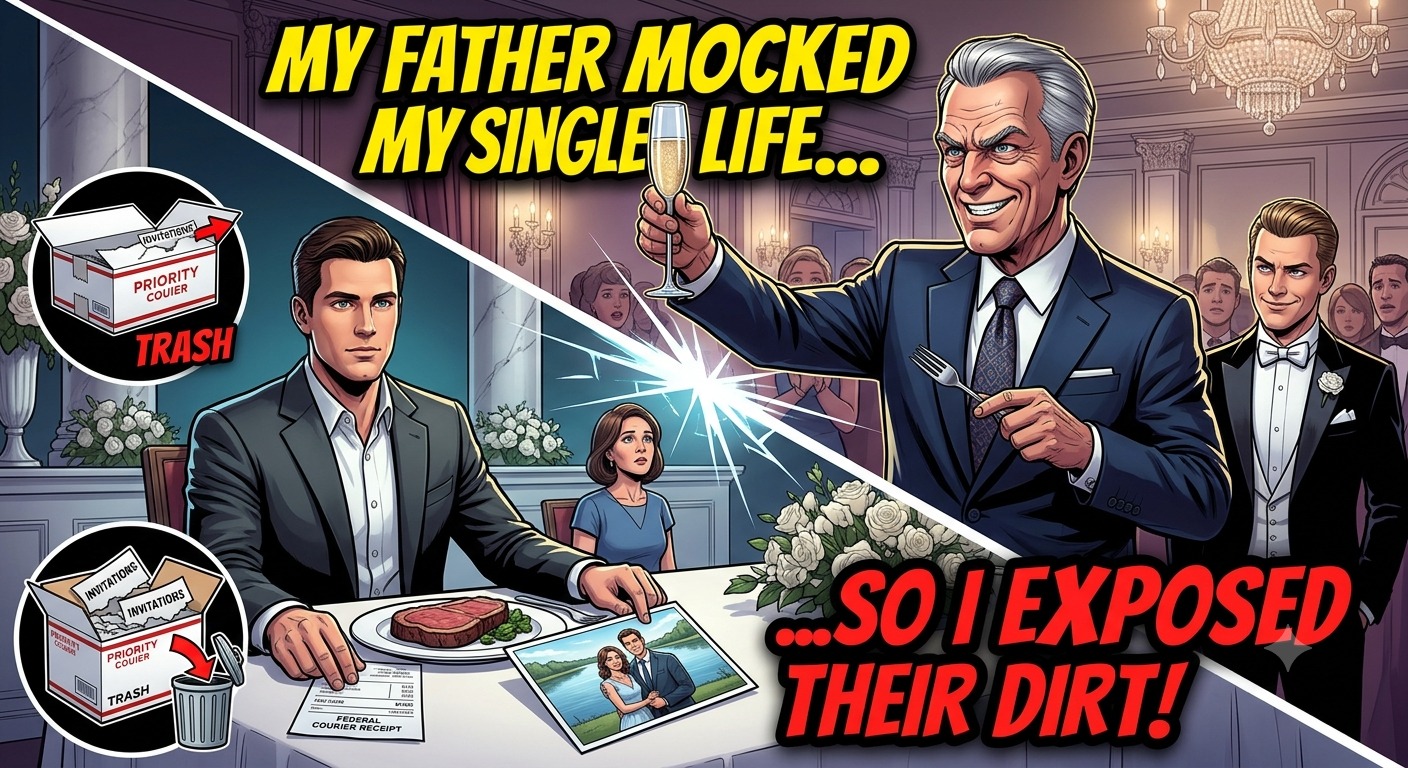
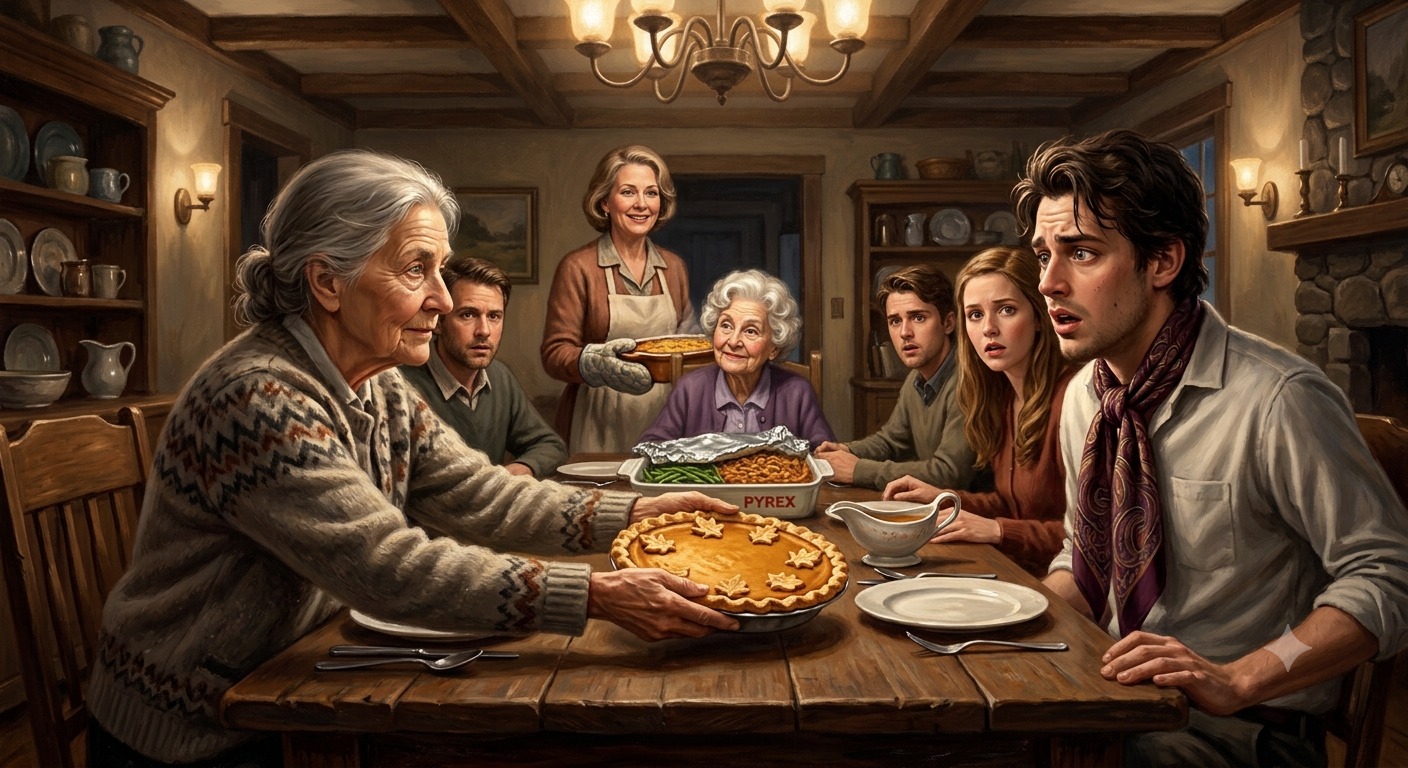
Dante pushed Grandma Ruth’s pumpkin pie away with two fingers, like it had touched something dirty.
“Americans don’t understand dessert,” he said, leaning back as if he had just delivered an undeniable truth of human existence. “You can’t help it. You wasn’t born Italian.”
The dining room table went instantly silent. The only sound was the low, rhythmic hum of the refrigerator in the corner and the ticking of the grandfather clock near the hallway.
Grandma Ruth’s pumpkin pie was not just a dessert. It had won first place at the Fairfield County Fair six consecutive times. The ribbons—faded navy silk with gold foil lettering that had grown muted after forty years of kitchen steam—hung in a neat frame over her stove. My grandfather, Walt, had built that wooden frame himself out of reclaimed barn wood before he passed away.
Grandma Ruth said nothing. She picked up her cloth napkin, folded it neatly into a square, and then folded it again into a smaller square. Her hands, worn rough from eight decades of garden soil, pie crusts, and family life, were completely steady.
My sister, Jenna, laughed. It was not a nervous laugh. She laughed like he had just recited a beautiful, romantic poem.
“Isn’t he funny?” Jenna said, looking around the table, her eyes shining with an eagerness that made my stomach turn. “He’s so passionate about food.”
“Passionate,” my father repeated.
My father, Tom Callahan, fixes furnaces and air conditioners for a living. He has worked with his hands since he was sixteen years old, and he only repeats words when he is holding back something heavy. He sat at the foot of the table in his Sunday flannel, his calloused thumbs rubbing the edge of his water glass.
Dante leaned back further in Grandpa Walt’s chair. Nobody had told him it was Grandpa Walt’s chair. Since Grandpa died eighteen months ago, the high-backed oak chair at the head of the table had remained empty. Mom hadn’t moved it. Dad hadn’t sat in it. Dante had walked straight into the dining room two hours ago, pulled it out without asking, and dropped himself into it like a king taking a throne. Nobody had wanted to start a fight at the beginning of the holiday, but now his presence in that chair felt like a deliberate insult.
He had been in my parents’ home for exactly two hours and twenty minutes. I knew because I had checked the digital clock on the oven every time he opened his mouth. I had checked it eleven times.
Here is what he had insulted so far:
First, the turkey. He had chewed a piece of breast meat with exaggerated slowness, swallowed with difficulty, and announced that in Florence, meat was never roasted until it lost its soul. In Italy, they understood moisture.
Second, the mashed potatoes. “Box,” he had pronounced, tapping his fork against the rim of his plate. “Only Americans eat potatoes from a box.”
“Those potatoes are not from a box, Dante,” my mother, Linda, had said. Her voice had been thin, trembling at the edges. She had spent five hours in the kitchen before any of us arrived. “I peeled ten pounds of Yukon Golds this morning.”
“Of course, Linda,” Dante had replied, smiling at her the way an adult smiles at a toddler who has brought them a picture drawn in crayon. “They taste like a box. It is not your fault. It is culture.”
Third, my father’s profession. When Dad asked him what he did for work—a simple, polite question meant to open a bridge—Dante had waved his hand vaguely. “I am between opportunities,” he had said. “American companies do not respect the Italian way of commerce. They want spreadsheets. They do not understand legacy.”
Between opportunities. Meanwhile, he had consumed four buttered rolls. I had counted those too.
“My family has a villa in Tuscany,” Dante went on now, resting his elbows on the linen tablecloth—another rule of Grandma’s house he casually broke. “Eleven bedrooms. High ceilings. Our ancestors were Roman senators. Our family vineyard provides wine directly to the Vatican. The Pope drinks our vintage.”
He reached out and picked up my dad’s bottle of Budweiser with two fingers, holding it the way a person might hold a drowned rodent.
“You people drink beer like cavemen,” he murmured with a light chuckle.
Across the table, my cousin Hayley sat with her hands tucked tightly into her lap. Hayley was twenty-two and had spent the previous spring semester studying abroad in Rome. She had come home enchanted by the city, carefully practicing her pronunciation of everyday words so she wouldn’t sound like a tourist.
Earlier in the evening, Dante had pronounced focaccia as “fo-KACK-ee-uh.” Hayley had tried, politely, to bridge the gap.
“I think it’s pronounced fo-KAH-chee-uh,” she had said softly, giving him a warm smile. “That’s how everyone said it when I was living near the Campo de’ Fiori. I can show you the bakery I went to every morning.”
Dante had barely looked at her. He had waved his hand dismissively. “That is tourist Italian. A street slang. My family speaks the pure, high Tuscan dialect. You would not understand.”
Hayley’s face had flushed bright red, the color climbing from her sweater collar all the way to her hairline. She had bitten her lip and stared down at her plate for the rest of the meal.
“Hayley,” Jenna had whispered across the table, leaning in. “Don’t correct him. It’s a cultural thing.”
A cultural thing. I almost laughed out loud.
I looked over at Grandma Ruth. She was seventy-nine years old. She had buried her husband of fifty-three years two springs ago. She had raised three children in this county, worked twenty years at the local library, and stayed calm through a hospice nurse, a sudden tornado warning that took the roof off the barn, and my uncle’s disastrous second wedding. She remained completely still now, but her pale blue eyes had gone flat and distant. She was looking at Dante’s face the way a scholar looks at a word printed in a language they cannot decipher.
Something cold and sharp settled in my chest.
“Nora,” Dad said, his voice quiet, breaking the heavy stillness. “Pass the gravy.”
“Here you go, Dad,” I said, handing the boat across. My hand was as steady as Grandma’s.
Dante immediately started criticizing the stuffing, complaining about the use of sage instead of wild thyme. I stopped listening to the individual words. I smiled directly at him. I even nodded at one of his assertions about Mediterranean olive oil.
Under the edge of the tablecloth, I unlocked my phone, opened my notes app, and typed three words with my right thumb:
Villa. Pope. Senators.
Then I added a fourth entry:
Between opportunities.
Across the table, Jenna caught my eye. She was glowing, flushed with what she clearly believed was romantic pride. She leaned forward and silently mouthed two words to me across the mashed potatoes:
Be nice.
I smiled even wider at her.
“Always,” I said aloud.
Chapter 2: The Investigator’s Eye
To understand why I didn’t cause a scene right then and there, you have to understand who I am, and who my sister was to me.
My name is Nora Callahan. I was twenty-six years old that Thanksgiving. I live in a modest one-bedroom apartment in Grandview Heights, just outside downtown Columbus, Ohio, and I pay $1,150 a month for it. I work as a fraud investigator for a mid-sized regional property and casualty insurance firm. I make $58,000 a year.
My job is not romantic. I don’t carry a badge, and I don’t chase suspects down dark alleys. I read paper for a living. I read medical charts, repair shop invoices, water damage reports, fire department logs, and recorded statements. People who commit fraud almost always lie in predictable ways. They overcomplicate simple narratives to create confusion, they offer unprompted details to seem credible, and they rely on emotional appeals when their documentation falls short. After four years on the job, I could smell a fabricated claim off a printed page from three cubicles away.
I did not smell fraud on Dante when Jenna first brought him up. I want to be entirely honest about that. At first, I smelled something else: my sister’s relief. And I was desperate not to ruin it.
Our family comes from Lancaster, Ohio—a town of forty thousand people nestled about thirty-five minutes southeast of Columbus. It’s the kind of town where people keep their trucks for fifteen years, buy their hardware from local stores, and go to the same church every Sunday morning.
My father, Tom, is fifty-eight. He operates Callahan Heating & Cooling out of a white 2011 Ford Econoline van with rusted wheel wells. My mother, Linda, is fifty-six and works as the main administrative secretary at Lancaster High School, which means she knows the personal histories, heartbreaks, and trouble records of nearly every family in town, yet she has never repeated a word of gossip in her life.
And then there was Jenna. Jenna was twenty-nine—three years older than me. She works as an intensive care unit nurse at Fairfield Medical Center, putting in grueling twelve-hour night shifts.
Growing up, Jenna was the sun around which our family orbited. She was bright, beautiful, and effortlessly kind. She was the person who taught me how to ride a bicycle without training wheels down Havensport Road. She taught me how to drive a manual transmission in the empty parking lot behind the Kroger on a rainy Tuesday evening. When I was fifteen and sat crying inside a locked bathroom stall at school over some forgotten teenage tragedy, Jenna had driven over from her college classes, sat on the cold tile floor outside the stall door in her pajamas, and stayed there until I came out.
She was the golden child of our household. I was completely fine with that—most days.
I will admit something now that I never said out loud for years: a small part of me had always been jealous of her. Not of her looks or her academic records, but of how easily love seemed to flow toward her. When Jenna walked into a room, people naturally turned toward her. They wanted to be near her light.
I didn’t have that charm. I had to earn every scrap of attention through utility. I became the girl who read the small print on warranties, the one who remembered dates and account numbers, the one who fixed broken household appliances, the one who pointed out the logical flaws in arguments. I took pride in being right.
That was my blind spot. I liked being right a little too much, and it often made me come across as cold or cynical.
Now, about the land.
When Grandpa Walt was diagnosed with late-stage pancreatic cancer, Jenna used all her accrued paid time off to nurse him. Every Sunday afternoon between his chemotherapy treatments, when his strength permitted, he would ask her to drive him to the far back edge of our family property.
Behind Grandma Ruth’s farmhouse lay twelve acres of undeveloped land—a quiet mix of dense oak woods, open wildflower meadow, and a clear, shallow creek that ran over smooth limestone slabs. Grandpa called it “the Back Twelve.” He and Jenna would sit side by side on aluminum lawn chairs near the water, saying nothing for hours at a time, just watching the red-tailed hawks circle over the trees.
When Grandpa’s will was read after his passing in March 2023, he left the Back Twelve exclusively to Jenna.
The main house and the surrounding two acres went to Grandma Ruth. The heating business, the shop tools, and the service van went to Dad. I was given Grandpa’s wristwatch—a silver Timex with a worn leather strap—which I still wear every day. The Back Twelve went to Jenna alone, recorded cleanly in her name at the county courthouse. At the time of the probate valuation, the county assessed the property at $96,000.
Then came the spring of 2024.
A large commercial residential developer called Brightwater Homes began purchasing land along Route 33 to construct a high-density suburban subdivision. Suddenly, twelve acres of untouched timber with water access right off the highway corridor became extraordinarily valuable.
In early April, Brightwater sent a formal acquisition letter offering $410,000 for the Back Twelve.
A representative from the firm came out to the farmhouse later that week. I happened to be there for Sunday dinner. He was a slick young man in his late twenties wearing a tailored blue quarter-zip sweater, polished leather shoes, and carrying a leather-bound clipboard. He called Grandma “ma’am” four times before he even crossed the threshold. He spoke in rapid, corporate terms about “market momentum,” “unlocking equity,” and “time-limited capital opportunities.”
Grandma Ruth sat in her rocking chair by the screen door, listening quietly to his entire presentation without interrupting once.
When he finally paused to let her sign the interest disclosure, she stood up, walked to the kitchen counter, wrapped a thick slice of warm banana bread in aluminum foil, and pressed it into his hands.
“That land belongs to my granddaughter Jenna,” Grandma Ruth said gently, “and she isn’t selling it.”
The young man tried to argue, but Grandma simply held open the screen door until he stepped outside. He left a glossy business card on the porch rail. Grandma picked it up, carried it inside, and placed it inside her green metal recipe tin—the dented one on the pantry shelf where every coupon, tax receipt, dried flower, and church program eventually went to live. Grandma Ruth never threw away anything handed to her with a smile.
Chapter 3: Patterns of the Past
To understand how Dante managed to get his hooks into my sister, you also have to understand Brent Kessler.
When Jenna was twenty-one and attending Ohio University, she fell deeply in love with Brent. He was twenty-three, charming, handsome, and possessed a smooth, persuasive way of speaking that instantly made older adults lower their guard. He talked incessantly about his plans to launch a commercial landscaping enterprise.
All he needed, he claimed, was a reliable heavy-duty truck to transport equipment. He asked Jenna to co-sign a auto loan for $4,200 to purchase a used Ford Ranger.
“It’s just for a few weeks until my first commercial municipal contract pays out,” he told her softly in front of our family.
I was eighteen at the time. I listened to his story, and I immediately felt a cold twitch in my stomach. The narrative had holes in it. He claimed to have a binding service contract with the city of Athens, but when I asked him simple questions about the contract terms, the name of the municipal department head changed twice in the span of ten minutes.
I pulled Jenna into her bedroom later that night. “Ask him to show you the signed contract,” I told her plainly. “If it’s real, he’ll have a copy. If he makes excuses, don’t put your name on that loan.”
Jenna looked at me as if I had struck her across the face. “You just can’t stand seeing me happy,” she spat out. “You always have to analyze everything until it’s ruined.”
She co-signed the loan the next morning.
Three months later, Brent stopped making payments. A month after that, he stopped returning her calls entirely. The bank began calling Jenna at all hours, threatening to damage her credit score and report the delinquency.
My father quietly stepped in, wrote a check for the remaining $3,100 balance out of his business account to clear her name, and told her never to speak of it again.
But the damage between Jenna and me was done. She didn’t speak to me for five months. She didn’t text me back on my nineteen birthday. When I saw her at family dinners, she treated me like a stranger who had violated her trust.
I learned a painful lesson that year: when Jenna loved someone, her loyalty was absolute and blind. Any critique of her partner was perceived not as a helpful warning, but as a direct attack on her intelligence and emotional capacity. The more logical evidence you brought against her partner, the tighter she circled the wagons to protect them.
So when Dante entered her life years later, I stayed silent.
Jenna met him on May 17th at an upscale wine bar in the Short North district of Columbus. She called me the next morning at 7:40 AM, right after finishing a brutal twelve-hour shift in the ICU. I could hear the rare, light tremble of genuine excitement in her voice.
“He’s Italian, Nora,” she said, her voice dropping to an awed whisper. “Like, actually from Florence. He has this gorgeous accent.”
“What does he do?” I asked, sitting up in bed, trying to keep my voice flat.
“He imports specialty olive oil and boutique wines,” she replied. “He owns an import firm called Moretti Provisions. He’s expanding into the Midwest.”
“Does the company have a public filing or a website?” I asked instinctively.
There was a long, heavy silence on the line.
“Nora,” Jenna said, her voice instantly dropping two octaves, turning cold and guarded. “Don’t. Just… don’t do this.”
“Okay,” I said, catching myself. “I’m sorry. Tell me more about him.”
I let it go. I want it recorded that I let it go.
She kept Dante away from our parents and me for the entire summer. Every time I asked if he was coming to a Sunday dinner, she offered smooth excuses: he was traveling to New York for customs inspections, he was managing international shipments, he was shy about meeting large families because his own background was “complicated.”
In September, Dante moved into Jenna’s two-bedroom apartment in Clintonville. Jenna took over the entirety of the $1,850 monthly lease payment. When my mother asked about it during a phone call in October, Jenna casually mentioned that Dante was temporarily waiting on a large commercial wire transfer from his European distribution partners to clear international regulatory compliance.
“Well, that’s completely understandable, honey,” Mom had said warmly.
I said nothing.
I knew how lonely Jenna had been since Grandpa Walt died. She had thrown herself into night shifts, taking on overtime, coming home to an empty apartment, and crying quietly in her car before walking inside. She desperately wanted a story with a happy ending.
Then, the week before Thanksgiving, Jenna called me.
“He’s coming to Thanksgiving dinner,” she announced, her tone a mix of excitement and defensiveness. “Finally. Please, Nora… please just be normal.”
“I am always normal,” I replied gently.
“You’re normal like a police detective is normal,” she said.
I laughed. She laughed too. For three seconds, the old warmth between us lit up the line. It was the last time we shared a genuine laugh for a very long time.
Chapter 4: The Escalate and the Escalation
The morning after Thanksgiving, Friday, November 28th, my phone rang at 7:12 AM.
I picked it up on the second ring. “Hello?”
“You sat there with that face,” Jenna said immediately. No greeting. Her voice was raw, thin, and raspy from lack of sleep.
“What face, Jenna?”
“That face,” she hissed. “The prosecutor face. The one where you sit back, say nothing, and decide somebody is guilty of existing.”
I heard her draw in a long, shaky breath over the speaker.
“Hayley cried in her car all the way home,” Jenna continued, her voice rising. “Mom is so stressed she can barely talk, and Dante is completely devastated. Devastated, Nora. He feels like your entire family treated him like an uncultured intruder.”
I held the phone away from my ear, staring up at the white drywall ceiling of my apartment.
“Jenna,” I said as calmly as I could. “He told Mom that her potatoes tasted like cardboard from a box. He told Dad that he drinks beer like a caveman. He literally pushed Grandma Ruth’s fair-ribbon pie away like it was toxic.”
“It was a joke, Nora!” Jenna snapped. “It’s dry Italian humor! They banter like that in Florence! He was trying to bond with everyone!”
“It wasn’t a joke.”
“You always do this!” she yelled, her emotional control cracking completely. “You take one sentence, one gesture, and you build an entire criminal indictment out of it!”
While she was speaking, my phone buzzed with an incoming text notification. I pulled the device away from my face and checked the screen. It was a message from an unfamiliar phone number with a 614 area code:
Nora. Dante here. Jenna gave me your digits.
I feel we got off on the wrong foot yesterday. I was merely joking during dinner. You Americans take every statement so literally!
I never maligned your grandmother’s pie; I simply noted it represents a different culinary tradition. Let us start fresh, Cara. No hard feelings.
I read the text twice. My fingers moved automatically. I opened my notes app, pulled up the timestamped log I had created under the dining room table the night before, and took a screenshot. I took a screenshot of his text message. I placed them side by side in a single image.
I texted him back directly:
You said: ‘Americans don’t understand dessert. You can’t help it. You weren’t born Italian.’ I have six witnesses sitting at that table.
His reply came back within thirty seconds:
I think you are misremembering the context, Nora. It was a chaotic, loud table. Perhaps you were stressed by the holiday preparations. Please do not twist my words. It causes Jenna immense emotional distress when you create conflict.
There it was. The classic manipulative pivot.
He didn’t genuinely deny what he had said; he denied my capacity to remember it accurately. He reframed his toxicity as my cognitive failure, and then he positioned my sister’s emotional pain as a direct consequence of my cruelty.
I did not text him back. Instead, I forwarded the entire screenshot thread to my personal email address, created a dedicated folder, and titled the subject line: Dante – Day One.
I didn’t realize then that I would eventually need to document twelve days.
Chapter 5: The Gaslight Campaign
By Saturday afternoon, Dante’s counter-offensive was in full swing.
My mother called me at 2:00 PM. Linda Callahan is a woman who prides herself on maintaining equilibrium. In thirty years of administrative work at the high school, she had handled angry parents, difficult school boards, and emergency situations with absolute grace. But her voice on the phone was wet and quavering.
“Dante called me last night, Nora,” she said quietly. “At nine o’clock.”
“What did he want, Mom?”
“He was crying,” she murmured. “He was actually sobbing on the phone. He told me that his family in Italy completely disowned him when he decided to move to America to pursue his commercial dreams. He said he hasn’t had a genuine family holiday dinner in over four years.”
I sat down hard on my kitchen stool. “Mom…”
“He said our table was the first home environment that felt warm to him in years,” she went on, sniffing. “He said he was so nervous about making a good impression that he overcompensated and said foolish things. He apologized to me, Nora. Properly. He said he felt like a low-class outsider trying to fit in with good people.”
“Mom,” I said, trying to keep my voice steady. “Four days ago, he sat at your table and told us his family served private reserve wine to the Pope. Now he’s an disowned orphan?”
“I don’t know, Nora,” she said softly. “He just sounded so desperately lonely. Maybe… maybe we were a little hard on him. He’s in a foreign country.”
I closed my eyes. He had bypassed me entirely and targeted my mother’s boundless capacity for maternal sympathy. Within forty-eight hours, he had transformed himself from an arrogant bully into a victim of our family’s hostility.
That evening, I called Grandma Ruth’s landline. She answered on the fourth ring.
“Grandma?”
“I’m tired, Nora,” she said, her voice raspy over the copper wire. “I didn’t sleep well last night.”
“Is everything okay?”
“That boy’s face keeps bothering me,” she said.
“Dante?”
“There’s something about his eyes when he smiles,” she murmured. I heard the slow tick-tick-tick of the pendulum clock in her kitchen through the receiver. “I know that face from somewhere, Nora. I can’t place the year, but I know it. It’ll come to me at three in the morning. It always does.”
I made a note in my file: Grandma recognizes his face. Origin unknown.
On Monday, December 1st, Jenna called me during her lunch break at the hospital. Her tone was carefully modulated, stripped of the anger from Friday, replaced by a cold, formal caution.
“I’m calling you because I don’t want you to hear this from Mom,” she said. “And because I need you to promise me you won’t turn into Detective Nora.”
My pulse spiked. “What happened?”
“I loaned Dante some money this morning.”
My stomach dropped into a hollow pit. “How much, Jenna?”
“Six thousand five hundred dollars.”
I slammed my hand against the kitchen counter to keep from screaming. “Jenna…”
“It’s for a legitimate customs hold!” she said defensively, her voice rising to block my response. “His commercial shipment of three hundred liters of extra virgin olive oil from Lucca is being held at the port authority in Newark. If he doesn’t pay the release fee by Wednesday, the customs agents will seize and auction the cargo! It’s purely temporary. He’s transferring the money back to my account the second the shipment clears.”
“Did he show you the customs entry summary?” I asked, keeping my tone dead level through sheer willpower. “Did he show you the bill of lading, the import declaration, or a carrier tracking number?”
“He’s emailing the paperwork tonight,” she snapped. “And this—this right here—is exactly what he said you would do.”
I froze. “What did he say?”
“He told me you would try to frame this as a scam,” she said, her voice trembling with a mixture of sadness and betrayal. “He told me you’ve been secretly jealous of me your entire life. He said you can’t stand seeing me build a real life with someone special because you feel left behind.”
The room seemed to lose all air.
It was a surgical strike. Months ago, during a late-night conversation after a glass of wine, I had confessed to Jenna that I had sometimes felt envious of how effortlessly people loved her when we were teenagers. It was a vulnerable, embarrassing confession I had offered to build emotional intimacy with my sister.
And Dante had taken that confession, polished it into a weapon, and deployed it to neutralize any logical warning I might ever give her.
“Is it true, Nora?” Jenna whispered. “Are you doing this because you resent me?”
“No,” I said, my throat tight. “Jenna, no. I love you.”
“Then let me live my life,” she said, and hung up the phone.
Chapter 6: The Feast of Paper Plates
On Thursday, December 4th, Dante sent a formal group text inviting my parents and me to a “reconciliation dinner” at Jenna’s apartment in Clintonville.
I knew it was a trap, but in my line of work, if a suspect invites you to inspect their operational headquarters, you accept every single time.
I arrived at 7:00 PM sharply. The small apartment smelled strongly of boiling starch and synthetic air freshener.
Dante opened the door wearing a dark silk scarf wrapped loosely around his neck, despite the fact that it was sixty-one degrees outside and the apartment’s thermostat was cranked up to seventy-four.
“Welcome to my humble home,” he said smoothly, sweeping his arm wide.
The dining setup was staggering in its cheapness. Set upon a folding card table covered with a plain white bedsheet were four plain white paper plates—the flimsy kind with ridged edges that bend under the weight of wet food. Next to each plate lay a single plastic fork.
The meal was served in courses:
Course one was a large glass bowl of overcooked, lukewarm spaghetti tossed in a bright red sauce. I didn’t need to guess the origin of the sauce; I could see the empty glass jar sitting at the top of the open kitchen trash can two feet away. It was a standard jar of store-brand marinara sauce from the Kroger on Olentangy River Road—retail price $3.29.
Course two consisted of hard breadsticks served inside a crinkly plastic sleeve. Dante held them up with flair. “Grissini,” he announced dramatically. “Hand-shipped from my family’s bakery outside Florence.” A bright yellow clearance sticker in the corner of the bag clearly read: $2.99 – Giant Eagle.
Course three was a salad of iceberg lettuce topped with bottled ranch dressing poured in an uneven spiral. “My great-grandmother’s Tuscan herbs recipe,” Dante whispered, closing his eyes as if overcome by emotional nostalgia.
“Remarkable,” I said cheerfully, taking a deliberate bite of the jarred spaghetti. “So authentic.”
Halfway through the meal, Dante turned his attention toward my father.
“Tom,” he said, leaning across the card table with an air of conspiratorial confidence. “Jenna was telling me about the land your late father left her. The property behind your mother’s house?”
Dad stopped chewing his breadstick. “The Back Twelve?”
“Yes,” Dante said, smiling smoothly. “She mentioned that a commercial development group made a formal cash offer. Four hundred thousand dollars?”
“Four hundred and ten thousand,” Dad corrected automatically, then immediately caught himself, his brow furrowing.
“Four hundred and ten thousand!” Dante whistled softly, shaking his head. “That is an astonishing sum of money for undeveloped woods. Holding land is foolish in this economy. Selling immediately is the only rational business strategy.”
“It’s not our decision to make,” Dad said, his voice dropping into a hard register. “The land belongs to Jenna.”
“Of course, of course,” Dante agreed quickly, patting Jenna’s hand. “And the legal deed… it is held entirely in her name alone? No co-owners? No trust restrictions?”
“Just Jenna,” Dad said slowly. “Why do you ask?”
“I am a businessman, Tom,” Dante said, opening his hands wide. “I analyze asset efficiency. It is merely a habit.” He raised his plastic cup of tap water. “To clean land titles and clear opportunities.”
Nobody raised a cup to join him.
Ten minutes later, Dante’s mobile phone buzzed on the card table. He glanced at the screen, stood up abruptly, and cleared his throat.
“Excuse me,” he said, stepping toward the narrow hallway. “An urgent call from Italy. The family estate manager.”
He pulled the hallway door almost shut, but the latch didn’t catch. He stepped three feet down the carpeted hall.
I stood up silently under the pretense of reaching for the paper napkin roll on the counter. I leaned my ear toward the door frame.
When Dante spoke, his voice was entirely different. The soft, rhythmic Italian cadence was completely gone. The elongated vowels had vanished. In their place was a flat, nasal, midwestern drawl—the unmistakable accent of someone raised within fifty miles of Interstate 71.
“Yeah, I told you I’ve got it handled,” Dante muttered into the phone, his voice low and sharp. “Stop calling me on this line. Give me till the 12th. She’s going to sign the release. Just keep the buyer on the hook.”
A second later, the line disconnected.
I slipped back into my chair just as the door opened. Dante walked back into the room, his shoulders relaxed, his soft Italian accent slipping back over his words like a coat he had just picked up off a hook.
“Ah,” he sighed, sitting down. “The time differences with Europe are so difficult to manage.”
I looked down at my paper napkin. Under the edge of my plate, I wrote down four words:
Give me till 12th.
At the end of the evening, as my parents were putting on their coats near the front door, Jenna pulled me into her bedroom. Her eyes were wide, filled with an intense, frantic energy.
“He’s going to ask me, Nora,” she whispered, grabbing my wrists. “He told me he wants to talk to Dad this weekend about getting Grandpa’s blessing… and he asked about Grandma’s old engagement ring.”
“Jenna…”
“So I need you to do this for me,” she pleaded, her fingers tightening on my hands. “I need you to either be happy for me or be quiet. If you can’t support this, I need you to stay away until you can.”
I looked at my sister—the girl who had sat on a cold tile floor in her pajamas when I was fifteen.
“Ask him one question, Jenna,” I said softly. “Just one. Ask him the name of the specific municipality where his family’s villa is located. If he grew up visiting it, he can answer in two seconds.”
“Stop it!” she hissed, tears welling in her eyes. “Please don’t make me choose between my family and my future!”
“I am not asking you to leave him,” I said. “I am asking you to look.”
“I did look!” she cried quietly. “I Googled him! There are no bad records! There’s nothing!”
“That’s the point, Jenna,” I said. “A thirty-four-year-old international businessman doesn’t have zero footprint. Silence on paper is a red flag.”
She took a step back, severing our touch. “Go home, Nora.”
Chapter 7: The Paper Trail
I got home to my apartment in Grandview Heights at 9:45 PM. I didn’t take off my coat. I made a pot of black coffee, sat down at my kitchen table, opened my laptop, and went to work.
When you investigate a suspect, you don’t start with what they tell you; you start with what they left behind.
Step 1: Digital Presence
Dante’s primary social media account was an Instagram profile under the handle @dante_moretti_official. It had 212 followers and featured eighteen photos—mostly photos of espresso cups, luxury watch displays taken through store windows, and a few selfies wearing linen jackets.
I checked the upload history. The very first photo had been posted on November 12, 2022. Before that date, the account did not exist. There were no tagged photos from childhood, no high school classmates, no old family holiday photos. A man in his mid-thirties with zero digital history prior to twenty-four months ago is not an aristocrat; he is a man who scrubbed a previous identity.
Step 2: Corporate Filings
I logged onto the Ohio Secretary of State business portal. It’s a free public database. I searched for Moretti Provisions LLC.
The record hit immediately.
The entity had been filed on August 29th of the current year—exactly eleven weeks after Jenna met him at the wine bar. The registered agent address was not a commercial office in Italy or downtown Columbus; it was Box #214 at a commercial UPS Store franchise on Schrock Road in Westerville, Ohio.
I paid the $5 fee to download the original PDF filing document.
I zoomed in on the signature line at the bottom of the Articles of Organization. The document required the signature of the primary organizer. The handwriting was a hasty, slanted scrawl:
- Harper
Not Dante Moretti. K. Harper.
Step 3: The Villa Property
During her initial romance, Jenna had shown me a photo Dante had sent her of his family’s Tuscan estate—a gorgeous Mediterranean villa with whitewashed stone walls, terracotta roof tiles, a swimming pool overlooking rolling hills, and rows of cypress trees.
I took the image file Jenna had texted me in June, ran a reverse-image search through three search engines, and hit a direct match within four seconds.
The photo was a stock marketing graphic for a commercial vacation rental property located in Montalcino, Italy, listed on Airbnb and VRBO under the title Villa Il Poggiolo. It could be rented by anyone for $308 a night.
I scrolled through the public guest reviews for Villa Il Poggiolo. In July 2023, a review had been posted by a verified user named “Kyle H.”:
“Great stay! Spent three nights here with my buddies. The local hosts were so kind and the wine was fantastic. Would definitely come again. — Kyle H., USA”
Step 4: Locating Kyle Harper
I pulled up public record databases and cross-referenced “Kyle Harper” with Columbus, Ohio. The query returned thirty-eight individuals.
I cross-referenced those names with the physical features visible in Dante’s photos—specifically his jawline and a distinct scar through his left eyebrow.
On page four of the social media results, I found a public Facebook profile belonging to a Kyle Thomas Harper, age thirty-three, originally from Parma, Ohio (a suburb of Cleveland), currently residing in Columbus.
The privacy settings on the account were completely open. It was the profile of a man who had never considered that someone would audit his past.
There were photos of him graduating from Parma Senior High School. Photos of him working at an auto body shop. Photos of him at a sci-fi convention.
And tagged in almost every photo over a ten-year period was an elderly woman named Dot Harper.
Dot’s profile picture showed a tiny woman with short white curls wearing a bright purple cardigan. She had left comments on dozens of Kyle’s posts:
- “So proud of you, Kylie Bear! Call your Nana!”
- “Looking handsome, Kyle! Don’t forget to eat your vegetables!”
- “Love you more than green bean casserole!”
Public records showed Dot Harper resided on Elm Street in Cleveland, Ohio.
It was 1:40 AM.
I realized that showing Jenna a stack of printed internet documents would not be enough. She would claim I forged them, or that Dante was being framed. To break a psychological delusion, a person needs an undeniable physical collision with the truth. They need to see it in a room, surrounded by people who love them.
I opened Facebook Messenger and drafted a direct message to Dot Harper.
Dear Mrs. Harper,
My name is Nora Callahan. I am the younger sister of a woman who is currently dating your grandson, Kyle. We are hosting a special family Sunday dinner in Lancaster this weekend, and we would be so honored to have you join us as our surprise guest. I would love to learn more about your family traditions.
I hit send.
I expected to wait until morning for a response. But four minutes later, my phone chimed:
Oh, honey, how sweet! Kyle has a girlfriend? He hasn’t brought a girl home in years! What traditions do you mean? We don’t have many fancy ones. Kyle watched mob movies all through high school and decided he was Italian, but we’re mostly Scottish and German! I always thought he’d grow out of that phase. I’d love to come! Can I bring my famous green bean casserole?
I stared at the glowing screen, my heart hammering against my ribs.
That would be wonderful, Dot, I wrote back. We will see you Sunday at 5:00 PM.
Chapter 8: The Confrontation
On Friday morning, I called my father.
“Dad,” I said quietly. “I need you to do something for me. Don’t ask me questions yet. Just trust me.”
“What is it, Nora?”
“Invite Dante and Jenna to Sunday dinner at the house. Tell him you want to clear the air and talk about the future.”
Dad paused for a long moment. I could hear the heavy scrape of his work boots against his shop floor. “Is this going to hurt your sister?”
“It’s going to stop her from being destroyed,” I said.
Dad didn’t hesitate further. “I’ll call her now.”
Dante accepted the invitation within thirty minutes. Jenna texted me, overjoyed, believing my father was preparing to give his formal blessing for their engagement.
Sunday, December 7th, arrived gray, freezing, and overcast.
We gathered at Grandma Ruth’s farmhouse on Havensport Road. Mom had cooked a heavy pot roast with carrots and potatoes. Grandma Ruth sat in her designated seat at the table, her hands folded over her apron, her expression unreadable.
Jenna arrived at 4:45 PM wearing a emerald green dress—the exact dress Dante had once praised. Dante arrived five minutes later, wearing a freshly pressed wool coat and his signature dark silk scarf.
He walked into the dining room with absolute confidence, taking the seat near the head of the table. He immediately took control of the conversation, lecturing my father on the proper temperature for serving Chianti and explaining the concept of terroir as if he had invented the word himself.
At 5:20 PM, the front doorbell chimed.
“I’ll get it,” I said, stepping quietly out of the dining room.
I opened the front door. Standing on the porch was a tiny woman in a purple winter coat. She held a warm Pyrex dish wrapped in aluminum foil, her nose red from the Ohio wind.
“Hello, sweetie,” she said sweetly. “I’m Dot.”
“Hi, Dot,” I whispered, holding the door wide. “I’m Nora. Thank you for making the drive from Cleveland.”
“Oh, it was no trouble at all, dear!” she said, wiping her boots on the welcome mat.
She stepped into the hallway. The dining room was twelve feet away. Dante’s voice was carrying clearly through the archway:
“…and so the vintage must be stored in the subterranean volcanic vaults of our estate, or the acidity is completely ruined…”
Dot stopped in the doorway. She set her casserole dish down on the hallway bench. She put one hand against the doorframe, peered into the brightly lit dining room, and focused directly on the man sitting at the table.
Her entire face lit up with joyful surprise.
“Kylie Bear!” she called out loudly. “Look at you!”
The silence that fell over the dining room was instant and total.
Dante went white—not pale, but the stark, bloodless gray of a bedsheet. His hand froze in mid-air holding his water glass. The dark silk scarf around his neck suddenly looked absurd, like a theater costume worn by a child playing dress-up.
“Nana?” he whispered. His voice was small, choked.
Jenna’s head turned with excruciating slowness. She looked at Dot. She looked at the green bean casserole. She looked back at Dante.
“Nana?” Jenna repeated, her voice blank. “From… Italy?”
Dot let out a bright, merry laugh that echoed through the farmhouse. “Italy? Oh, honey, I have never left Ohio in my life! Parma born and raised!”
Dante shot out of his chair so fast that it tipped backward, hitting the hardwood floor with a heavy, echoing CRACK. Nobody moved to pick it up.
“She’s confused!” Dante stammered, his arms flailing. The smooth Tuscan accent completely shattered, replaced by the frantic, high-pitched midwestern whine of a panicked teenager. “She’s… she’s my cousin’s grandmother! She has severe dementia! It’s a medical condition!”
Dot blinked at him. She was not angry; she was simply puzzled, looking at him with the gentle concern a grandmother offers a child caught in a silly fib.
“Sweetie,” Dot said softly. “I only have one grandson. It’s you. Kyle Thomas Harper.”
She reached into her purse, pulled out her reading glasses, put them on, and tapped her smartphone screen.
“Look here, dear,” Dot said, stepping up to Jenna and turning the screen toward her. “This is Kyle at his graduation from Parma High. Look at that sweet little cap!”
The photo showed a younger, pudgier Dante wearing a dark red graduation gown in front of a modest suburban house with beige siding and a basketball hoop in the driveway.
“And here he is at the comic book convention!” Dot continued cheerfully, swiping her thumb. “He went as Mario! Wasn’t he just adorable?”
The next image showed Dante wearing a red felt hat, denim overalls, and a thick stick-on fake mustache, grinning wildly while holding a plastic mushroom.
Dante lunged across the table toward his grandmother. “Nana, stop! Give me that phone!”
Dot snatched the phone back, her expression hardening with sudden maternal authority. “Kyle Thomas Harper! Don’t you grab at me!”
Kyle Thomas Harper stood frozen in Grandma Ruth’s dining room, surrounded by our family, stripped bare.
Dot sighed, swiped one last time, and held the phone up for the entire table to see.
The image showed two middle-aged people holding giant ribbon-cutting scissors under a banner that read: HARPER FAMILY HARDWARE – EST. 1987.
“Those are your parents, sweetie,” Dot said proudly to Jenna. “They run the hardware store up in Parma. Look at Kyle back there stocking the paint cans. He was fourteen!”
Jenna stood up. Her chair scraped back with a shrill screech.
She stared at the man she had lived with for three months. When she spoke, her voice wasn’t loud. It was terrifyingly flat—the voice she used in the ICU when a patient’s vital signs dropped to zero.
“Kyle,” she said. “Who are you?”
“Jenna, please,” he stammered, holding his hands out, his palms sweating. “I can explain… I can explain everything…”
“Explain the villa,” she said.
“It’s… it’s a rental,” he muttered, looking down at the carpet. “My buddy and I stayed there once…”
“Explain the wine for the Pope,” she demanded.
His mouth opened. No sound came out.
I leaned forward over my plate of pot roast, keeping my tone light and conversational. “Hey, Kyle,” I said. “How’s that pure Tuscan dialect doing?”
And then Grandma Ruth spoke.
She had not said a single word since the front doorbell rang. She sat completely upright in her chair, her hands resting calmly on the white tablecloth. Her voice was thin, but sharp as a polished razor.
“Young man,” Grandma Ruth said. “You ate my pumpkin pie, and then you told me I was uneducated.”
She reached over to the sideboard where Mom had set out a second pumpkin pie for dessert. Grandma Ruth picked up the pie server, cut a perfect, clean slice with an unshakeable hand, placed it on a china plate, and slid it smoothly across the table toward Dot Harper.
“Would you like a slice, dear?” Grandma asked gently. “It won six ribbons at the fair.”
Dot sat down in an empty chair, took a forkful of pie, and chewed thoughtfully. Her eyes lit up. “Oh, my goodness! Ruth, this is absolute heaven!”
“I’ll send you home with the recipe,” Grandma Ruth said softly.
Kyle Harper stood in the center of the room. His scarf was crooked. His posture was slumped.
“I just wanted to feel special,” he whispered. It was the only honest sentence he had spoken in six months.
“Six months,” Jenna said, her voice finally breaking into a sob. “I defended you to everyone. I stood in my apartment and argued with my own sister for you. I lent you six thousand dollars of my hard-earned money! I loved you!”
“Jenna…”
“No,” she said, cutting him off with a quiet, lethal finality. “You didn’t want me to love you. You wanted me to love a character you made up. Get out of my grandmother’s house.”
For five seconds, nobody moved.
Then Dot Harper stood up, walked over, and gently slid her arm through her grandson’s elbow. She patted his sleeve the way you pat a young child who has fallen down on the playground.
“Come along, Kylie Bear,” Dot said softly. “You’ve done enough damage for one night.”
She led him down the hallway. He went without a word, staring at the floorboards. The heavy front door clicked shut behind them.
For a full minute, the dining room was completely silent.
Then my mother let out a short, startled bark of a laugh, clapping both hands over her mouth in shock.
My father’s shoulders began to shake. Cousin Hayley doubled over her plate. Even Grandma Ruth’s lips twitched into a quiet, satisfied smile.
And then Jenna—standing there in her green dress with tears ruining her mascara—let out a sound that was half-sob, half-hysterical laugh.
The entire family broke into a wave of cathartic, release-filled laughter that echoed off the old wallpaper.
Chapter 9: The Final Trap
I thought the ordeal was over. I truly believed we had reached the end of the story.
Then my phone buzzed on the tablecloth.
It was a text message from Dot Harper, sent from her car in the driveway while Kyle was sitting in the passenger seat:
Thank you for dinner, Nora. You are a good sister. But please, make sure Jenna doesn’t sign anything Kyle sent her today. Kyle didn’t pick Jenna by accident. He found out about her land months ago through a real estate listing forum.
I read the message once. My blood ran cold.
“Jenna,” I said sharply.
She didn’t hear me. She was looking down at her own phone, which had buzzed at the exact same moment.
Her face went completely gray. The laughter drained out of her features like water drawn down a drain.
“Jenna?” I stepped around the table.
She turned her screen toward me.
It was an automated notification for a new email received at 5:27 PM—seven minutes ago, while Kyle was walking down the front steps with his grandmother.
The sender line read: Dante Moretti.
The subject line read: URGENT: Sign before Friday deadline.
“Don’t touch it,” I said, snatching the phone from her hand.
“Read it,” Dad said, standing up from his chair. His voice was heavy, terrifying. “Read it out loud, Nora.”
I opened the email. I stood under the dining room chandelier and read every word:
“Jenna, my love. I know what you must think after tonight’s misunderstanding. Please do nothing until we speak privately. Whatever my grandmother told you, my business vision is real, and so are my feelings for you. The formal operational partnership agreement drafted by my corporate attorney is attached. The notary public can only meet us this Friday, December 12th, at 4:00 PM. If this document is not executed by then, we forfeit the commercial platform we built together. Forgive me. — Dante”
Attached to the email was a 12-page PDF document titled: CONTRIBUTION AND ASSIGNMENT AGREEMENT.
I opened the document on the screen. I put on my professional investigator voice—flat, cold, devoid of emotion.
“The contracting parties are listed as Jenna Marie Callahan, designated as ‘Contributor,’ and Moretti Provisions LLC, designated as ‘Company,'” I read aloud.
I scrolled directly past the boiler-plate legal preamble to the back of the document, searching for the schedules.
“Schedule A: Description of Contributed Property,” I recited. “Parcel located in Walnut Township, Fairfield County, Ohio. Total acreage: 12.04 acres. County Parcel ID #44-091-0234. Boundaries marked by Rush Creek, incorporating all timber, mineral, and water rights, as recorded in the probate estate of Walter Callahan.”
Dad stood completely still. “That’s the Back Twelve.”
“It’s not a business loan agreement,” I said, looking up at my sister. “It’s an absolute land transfer deed. He structured it as a ‘capital contribution.’ If you signed this, you would legally transfer full ownership of the Back Twelve to Moretti Provisions LLC. In exchange, you would receive a 40% non-voting membership interest in an LLC that has zero assets, managed exclusively by a man who doesn’t exist.”
“He told me… he told me it was collateral for the olive oil shipment,” Jenna whispered, her voice barely audible. “He said the bank needed proof of real estate backing for two weeks.”
“Section 6,” I continued reading, scrolling down. “‘The Manager of the Company shall possess sole, unappealable authority to sell, mortgage, encumber, or liquidate any contributed asset without the consent of non-voting members.’ And Dante Moretti—or Kyle Harper—is designated as the sole Manager.”
The room was silent.
“‘Give me till the 12th,'” I said softly to myself.
Jenna looked up, her eyes wide and blank. “What?”
“The night of his ‘Tuscan feast’ at your apartment,” I said, looking her in the eyes. “When he stepped into the hallway to take that phone call. He wasn’t talking to his family in Italy. He was talking to a land speculator or a buyer. He said: ‘I’ve got it handled. Give me till the 12th. She’s going to sign.’”
My sister covered her face with both hands. She didn’t cry. She sat down heavily in her chair, staring at the floorboards.
“He was never going to marry me,” she whispered. “He just wanted Grandpa’s land.”
Grandma Ruth stood up. She set her napkin on the table, pulled off her apron, and laid it neatly over the back of her chair.
“Tom,” Grandma said, her voice ringing clear through the room. “Take me to the farmhouse.”
“Mom, it’s almost seven o’clock,” Dad said.
“I need my tin,” Grandma Ruth said.
Chapter 10: The Green Tin
Twenty-five minutes later, we were all gathered in Grandma Ruth’s small kitchen on Havensport Road under the pale yellow light of the overhead fixture.
Dad, Mom, Jenna, and I stood around the linoleum counter. Grandma Ruth was wearing her floral house slippers.
She reached up to the high pantry shelf, pulled down the dented green metal recipe tin with the faded roosters on the lid, and set it squarely in the middle of the kitchen table.
“It came to me at three o’clock on Friday morning,” Grandma Ruth said calmly. “I woke up, and I could smell banana bread.”
She opened the lid. Inside lay decades of family memory—handwritten index cards stained with vanilla extract, newspaper clippings of local high school sports, church bulletins, dried palm fronds from Easter Sundays, and old coupons.
Grandma Ruth reached into the corner of the tin and pulled out a small, stiff piece of cardstock.
It was the business card left on the porch rail eight months ago by the young representative from Brightwater Homes—the developer offering $410,000 for the Back Twelve.
She turned the card over. On the back, in faint pencil, was a handwritten name and phone number that the representative had scribbled down as an alternative contact:
Land Acquisition Scout: Kyle Harper (Contractor)
I took the card from her hand.
Kyle Harper hadn’t stumbled into Jenna’s life by romantic chance at a Short North wine bar.
When Brightwater Homes had sought to acquire the Back Twelve in April, they had hired local freelance land scouts to research property owners and approach families. Kyle Harper had been one of those contract scouts. When Grandma Ruth had turned down the initial $410,000 offer and handed him a slice of banana bread, Kyle hadn’t given up.
He had looked at a twenty-nine-year-old ICU nurse who owned $400,000 worth of unencumbered land, researched her vulnerabilities, invented a sophisticated foreign persona, and executed a six-month romance scam designed to trick her into signing over the title.
The room fell into a heavy, quiet stillness as the full depth of his plot sank in.
Jenna looked at the business card in my hand, then looked at me. The final layer of her delusion didn’t just break; it evaporated.
“Nora,” she said softly, her voice trembling. “What do we do now?”
I looked at my sister. I looked at my father’s rough, hard-working hands. I looked at Grandma Ruth’s calm, steady eyes.
I unlocked my phone, opened my email app, and pulled up the full case file I had built over the last twelve days—the screenshots, the Secretary of State filings, the reverse-image searches, the text messages, and the fraudulent land contribution contract.
“First,” I said, a small, cold smile touching my lips, “we forward this complete documentation package to the Economic Crimes Division of the Fairfield County Prosecutor’s Office and the Ohio Attorney General’s Fraud Unit.”
“And second?” Dad asked, his voice low and growling.
“Second,” I said, turning to Jenna, “you text him back one final message.”
“What should I say?” she asked.
I handed her phone back to her.
“Tell him,” I said, “that Americans might not understand Italian dessert… but Callahan women know exactly how to handle a thief.”
Chapter 11: Epilogue
Kyle Thomas Harper was arrested three weeks later at a coffee shop in Dublin, Ohio, while attempting to execute a similar real estate investment scheme against a recently widowed woman from Delaware County.
Because he had used interstate wire communications to transmit fraudulent contractual documents involving property values exceeding $100,000, the case was picked up by state fraud prosecutors. He eventually pleaded guilty to counts of attempted grand theft, wire fraud, and forgery, receiving a four-year sentence at the Southeastern Correctional Institution.
Dot Harper sent our family a handwritten Christmas card later that month, thanking us for treating her with kindness during a terrible evening, along with her official recipe for green bean casserole. Grandma Ruth sent her a tin of homemade cookies and the fair-ribbon pumpkin pie recipe in return.
The Back Twelve remains untouched.
If you drive down Havensport Road on a Sunday afternoon in early summer, you can see twelve acres of tall oak trees, wild meadow flowers, and clear creek water running over smooth limestone slabs.
Jenna still works her night shifts at Fairfield Medical Center. She took six months off from dating, went to therapy, and spent her free afternoons sitting on an aluminum lawn chair by the creek.
Last month, Jenna bought a small, used pickup truck. She didn’t need a co-signer.
And every Thanksgiving, without exception, two pumpkin pies sit on the sideboard in Grandma Ruth’s dining room. Nobody ever compares them to anything else in the world—because in our family, we know exactly what real value looks like.