

The moment I pushed through the heavy, brass-trimmed double doors of Courtroom 3B, my own son was laughing at me.
“Look who finally decided to show up,” Liam said, leaning back in his leather swivel chair, crossing his ankles with an arrogant, dismissive smirk that had never belonged on the face of the little boy I raised.
Beside him at the plaintiff’s table, Chloe let out a sharp, melodic laugh—the kind of practiced, high-society chuckle designed to cut straight through human bone. She smoothed down the lapels of her cream designer blazer, admiring her manicured nails.
I stood frozen in the center aisle, drenched to the skin. Rainwater dripped steadily from the hem of my charcoal wool jacket onto the polished linoleum floor, forming a small, dark puddle around my heels. My hands were stiff from the freezing October gale, trembling with exhaustion and something far heavier than winter dampness.
Twenty minutes earlier, I had been kneeling in muddy gravel along the shoulder of a flooded highway, wrenching rusted lug nuts off a stranger’s wheel, never imagining that an act of basic human decency would cost me the opening minutes of the most humiliating battle of my life.
“Perhaps the court shouldn’t waste its time waiting on someone who can’t even manage to arrive on time,” Chloe added. Her voice was pure honey laced with arsenic, pitched loud enough to carry past the oak bar to the court reporter and the bailiff.
Heat surged into my cheeks, my pulse hammering violently against my ribs.
I was sixty years old. I had served twenty-five honorable years in the United States Marine Corps. I had led logistics convoys through sandstorms, slept in mud, buried my husband Robert, and raised our boy through silent deployments and broken phone lines across three continents. I had sacrificed birthdays, anniversaries, and pieces of my own soul for this country.
And now, that same boy sat across an oak aisle, flanked by high-priced counsel, convinced he was about to strip me of my home, my modest pension, and whatever dignity I had left in the world.
Then, the heavy walnut chamber door beside the bench creaked open.
A tall, distinguished silhouette stepped through the threshold, leaning with measured grace on a polished dark-wood cane.
My breath caught violently in my throat. My heart lurched so hard I thought my chest would split.
I knew that face. I knew that heavy tweed overcoat, still damp around the shoulders.
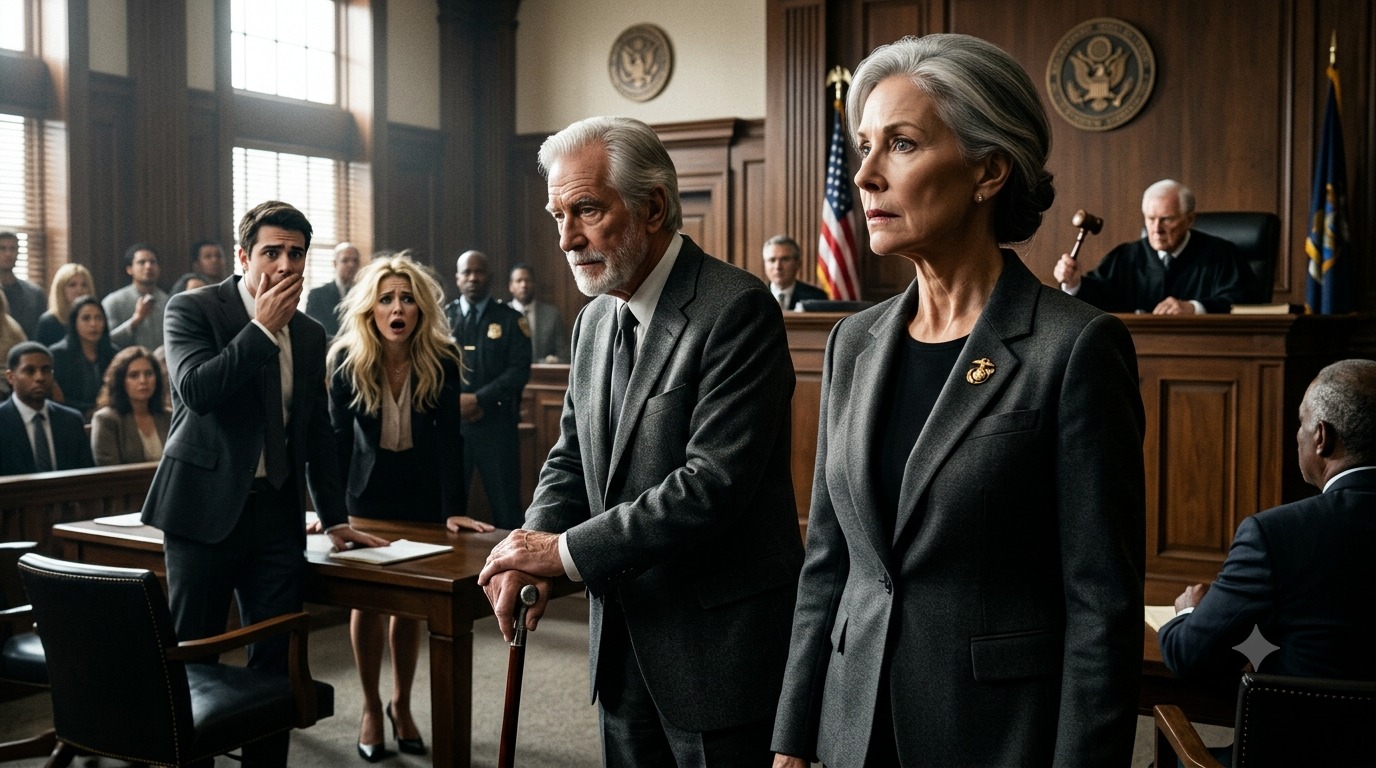
He moved across the well of the courtroom with an unmistakable, quiet authority that silenced the whispered conversation between Liam and his attorney. He didn’t look toward the bench. He turned his eyes directly toward me, a slow, respectful smile softening his weathered features.
“You’re a hard woman to properly thank, Major Miller,” he said, his resonant baritone filling every quiet corner of the stunned courtroom.
Liam’s arrogant smirk didn’t just fade—it vanished so abruptly it looked like someone had struck him across the mouth. Beside him, Chloe’s manicured fingers dug into the edge of the mahogany table, her knuckles bleaching bone-white as sudden, uncontrollable panic flared behind her designer eyeliner.
What neither of them understood in that frozen second was that this silver-haired stranger held far more institutional authority within these limestone walls than their private retainers could ever buy.
And what they understood even less was that the fraudulent legal instrument they believed would leave me homeless was about to detonate in their hands.
My name is Eleanor Miller.
To understand how a retired Marine officer ended up soaked, shamed, and fighting for her life against her only child, you have to go back three weeks to a quiet, overcast Tuesday morning in our house in suburban Columbus, Ohio.
I stood before the bathroom mirror, my fingers shaking as I tried to pin the small brass Marine Corps Eagle, Globe, and Anchor emblem onto the lapel of my charcoal blazer. The reflection looking back was an unfamiliar terrain: silver-streaked hair pulled into a tight bun, deep lines etched around the eyes, and the hollow fatigue of a woman carrying a grief too heavy to put down.
Today, my son was dragging me into a court of law.
I dropped the pin twice. The small brass clutch clattered against the porcelain sink with a sharp, hollow ring. I rested my forehead against the cool glass of the mirror, closing my eyes, feeling my lungs strain against my ribs.
“Pull it together, Eleanor,” I whispered to the empty room. “You survived twenty-five years in uniform. You survived Fallujah. You can survive one morning across from your son.”
I had enlisted at twenty years old—a wide-eyed girl from a rural farming county who believed in duty, service, and something larger than herself. Over two and a half decades, I rose through the ranks from corporal to major, earning commendations and leaving pieces of my youth scattered across military outposts from Okinawa to Camp Lejeune.
My husband, Robert, had been the mortar that held our life together. He was a high school history teacher with a laugh that could warm an entire house. Whenever my deployment orders arrived, he never complained. He would kiss my temple, take the duffel bag from my hands, and say: “I’ll keep the porch light burning, Major. You just come home in one piece.”
Liam was only seven when I shipped out for my first long-term overseas tour.
I still carried the physical memory of that morning: his small fists clutching the coarse fabric of my desert cammies, his hot tears soaking into my collar, his little voice breaking into sobs. “Mom, please don’t go! Please stay home!”
I had knelt in the driveway, brushed the blonde bangs from his forehead, and promised him I would always return with a souvenir from across the sea. Sometimes I brought back carved wooden trucks or foreign coins.
Too often, all I had to offer was an apology for another missed Little League championship.
Our single-story brick ranch on a quiet cul-de-sac held every single breath of the family Robert and I had built. The pantry doorframe was marked with faint pencil notches tracking Liam’s growth from three feet tall to six-foot-one. The kitchen floor had one cracked ceramic tile near the sink that Robert had always promised to replace every spring, but never got around to before the cancer took him six years ago.
After Robert was buried at the national cemetery, that house stopped being mere real estate. It was the sanctuary where I could still smell his pipe tobacco in the den; it was the hall where his laughter still echoed when the wind rattled the storm sashes.
Liam understood that once. He used to sit on the back deck with me, watching the cardinals, reminiscing about his father.
Everything curdled after he married Chloe.
Chloe was a corporate marketing coordinator who moved through life wrapped in scented lotions, silk scarves, and an insatiable appetite for social status. At holiday gatherings, she was all smiles and air-kisses, but the moment Liam stepped out of the room, her mask slipped into something sharp and predatory.
“You really don’t need all this square footage anymore, Eleanor,” she had told me one afternoon, turning her untouched cup of Earl Grey tea in her hands. “Liam and I are drowning under his startup debts and our rent. A house with this much equity could solve our entire financial future.”
“I manage my home just fine, Chloe,” I had replied evenly.
Her smile had thinned into an ugly, cold line. “You always have to make everything so difficult, don’t you?”
I had never hesitated to support them. When the shingles blew off their rental property, I wired four thousand dollars without asking for an invoice. When their central air conditioning failed during a brutal ninety-five-degree heatwave, I handed Liam my debit card and told him to handle it. He was my child. I loved him with every fiber of my being, and I never believed a mother needed a promissory note to protect her son.
That illusion died on a rain-swept Thursday night three weeks before the trial.
Liam had knocked on my back door, his jaw set like concrete, carrying a thick manila legal folder under his arm. He wouldn’t take off his wet jacket. He wouldn’t accept a cup of coffee.
He slid a multi-page document across the kitchen table.
“Mom, I need you to sign this,” he said, his voice clipped, avoiding my gaze. “It’s a quitclaim deed. It just formalizes what we talked about—transferring the house title into my name so Chloe and I can secure an equity line of credit.”
I looked down at the header: STATUTORY QUITCLAIM DEED AND WAIVER OF LIFE ESTATE.
My stomach dropped into an icy abyss.
“Liam… I never agreed to sign my home away,” I said, my voice shaking despite my best efforts. “I told you that when I pass, this house belongs to you. But I am sixty years old. I live here. This is your father’s legacy.”
Liam slammed his hand against the table. “You said family comes first! We are drowning, Mom! We need capital right now! Why do you always hold everything over my head?!”
“I love you more than my own life, Liam,” I said, standing tall, looking him in the eyes. “But I will not sign away the roof over my head while I am still drawing breath.”
His face contorted with a mixture of rage and childish spite. He snatched the papers off the table with such violence that the corner tore, and stormed out into the night, slamming the heavy wooden door hard enough to shake the porcelain plates in the hutch.
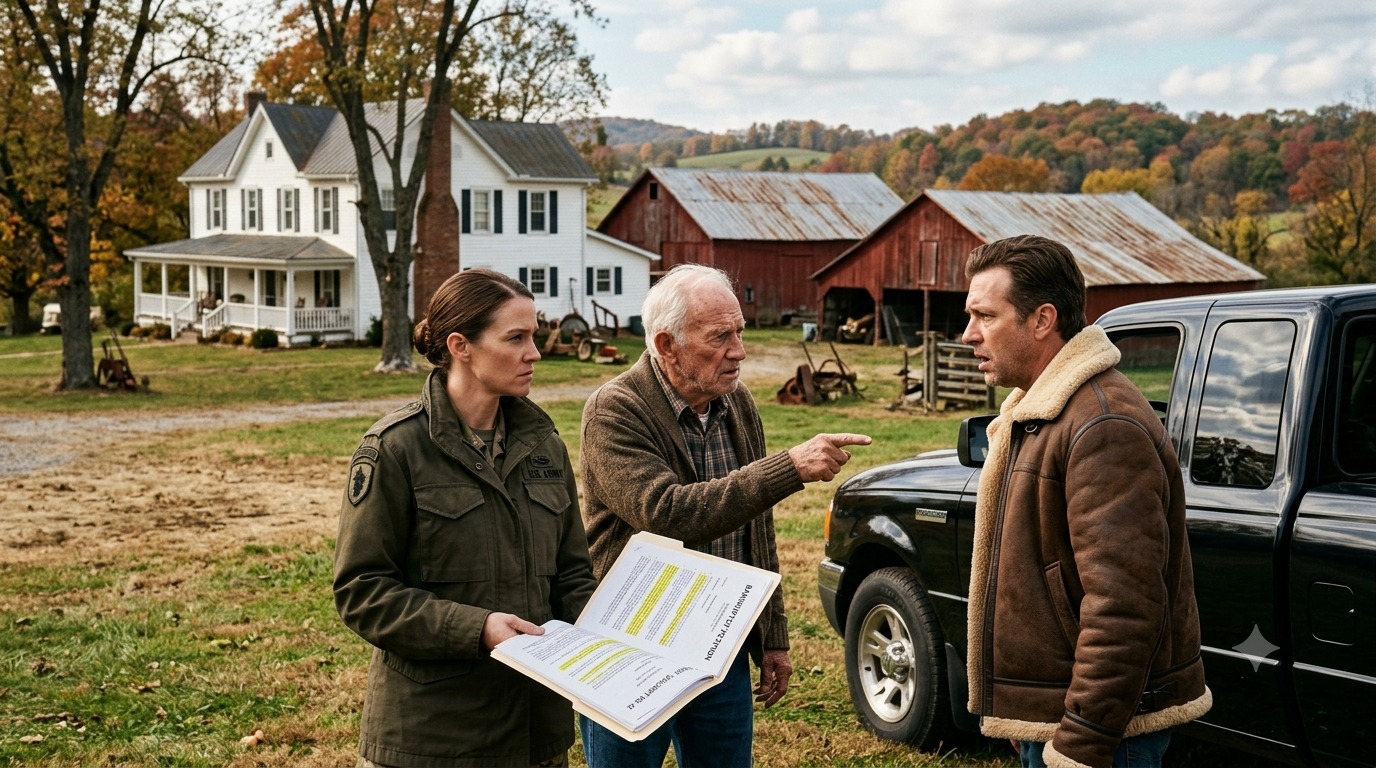
Ten days later, a uniformed county deputy served me with a civil summons on my front porch.
Clipped to the complaint was a photocopy of a document titled: IRREVOCABLE DECLARATION OF PROPERTY INTEREST AND CONVEYANCE.
At the bottom of the second page, written in faded black ink, was what looked unmistakably like my own signature.
My knees had stopped shaking by the time I sat across from Marcus Sterling in his narrow, book-lined office near the Franklin County Municipal Complex.
Marcus was fifty-eight, with wire-rimmed glasses, a receding hairline, and the quiet, immovable gravity of an attorney who had spent thirty years watching human families rip each other to shreds over money. He tapped a yellow legal pad with his ballpoint pen.
“Eleanor, listen to me very carefully,” Marcus said, his voice low and deliberate. “A courtroom is not a family living room. Judges do not weigh parental sacrifice, and they do not rule on broken hearts. They rule on statutory evidence and paper trails. In that room, your son is not your boy. He is the Plaintiff.”
A physical ache tightened in my throat. “He’s my baby, Marcus.”
Marcus’s expression softened, just an inch. “I know he is. And that is precisely why you cannot let your grief take the wheel tomorrow morning. If you break down, if you plead with him, his lawyer will paint you as a confused, deteriorating elderly woman who regrets a valid transfer. Let the facts speak. Let me fight. Can you give me that discipline?”
I swallowed hard, feeling the phantom weight of my dress blues on my shoulders. “I can do that, Counselor.”
The next morning broke under a merciless, driving Midwestern squall. The sky was the color of a wet slate shingle, and cold autumn rain lashed against my windshield in violent, blinding sheets as I navigated the morning commute toward downtown Columbus.
My hands gripped the steering wheel at ten-and-two, my knuckles aching. Every nerve in my body was firing.
Then, right around Mile Marker 14 on the elevated interstate overpass, I saw them.
A champagne-colored Buick sedan had pulled onto the narrow emergency shoulder, its hazard lights blinking dimly through the gray curtain of water.
Standing outside in the ankle-deep slush was an elderly gentleman in a wool driving cap, holding a black umbrella that had already been violently inverted by the wind. In the passenger seat, an elderly woman sat with her hands pressed against the glass, her face pale with distress.
I glanced down at the dashboard clock: 8:42 AM.
The preliminary docket call was scheduled for 9:00 AM sharp. If I pulled over, if I stepped out of this car, I would almost certainly walk into Courtroom 3B late. Judge Harrison was notorious across the district for his zero-tolerance policy on tardiness.
If I drove past, I would leave two vulnerable human beings stranded in thirty-eight-degree freezing rain on a dangerous highway shoulder.
My mind didn’t deliberate for more than three seconds. Twenty-five years of military conditioning does not allow you to drive past casualties on the road.
I engaged my turn signal, steered my sedan across the rumble strips, and pulled in directly behind their hazard lights.
I threw my car into park, snatched my heavy rain trench from the passenger seat, and stepped out into the storm. The wind cut through my suit like needles.
“Sir! Are you folks alright?!” I shouted over the roar of passing eighteen-wheelers.
The elderly man turned toward me, his face glistening with rain, his expression caught between mortification and profound relief. He was clutching his left knee, leaning heavily against the car’s rear quarter-panel.
“We’re fine, young lady,” he gasped, shivering violently. “Just a shredded sidewall and an old knee replacement that decided to give up on me right when I reached for the spare tire.”
From inside the car, his wife rolled down the window an inch. “Arthur, stop being so stubborn and let the woman help! You can’t even stand on that leg!”
I immediately took charge. I helped the woman, whose name was Margaret, out of their cold car and settled her into the heated passenger seat of my running sedan. Then, I turned back to the man.
He was trying to lift the jack out of the trunk, his breath coming in wheezing gasps, his knee trembling under his weight.
“Sir, please,” I said gently, taking the heavy steel jack from his fingers and guiding him toward my car door. “Step inside where it’s warm. Let someone else carry the load this morning. You’ve done your share.”
He looked at me in the gray light, his eyes sharp and perceptive behind water-speckled glasses. He noted my upright posture, the squared line of my shoulders, and the way I instinctively positioned my body to shield him from the traffic spray.
“You carry yourself like someone who has worn a uniform,” he observed, his voice steady despite the cold. “Am I right? Marine Corps?”
“Twenty-five years,” I answered, pulling the lug wrench from the spare tire well. “Major, retired.”
A warm, unmistakable spark of respect illuminated his features. “That’s a long time to give to this nation, Major.”
I didn’t tell him where I was going. I didn’t tell him that twenty minutes from now, my own flesh and blood would be trying to take my life’s work away in a sterile chamber downtown. I knelt in the cold, oily slush, placed the hydraulic jack beneath the Buick’s frame, and loosened the five lug nuts with steady, rhythmic torque.
When the commercial roadside service truck arrived seven minutes later—having responded to the priority dispatch coordinates I called in—I handed the operator the wrench, verified that Arthur and Margaret were safe, and sprinted back to my car.
I threw my soaking trench coat into the backseat, dried my face with a paper towel, and accelerated into the torrential rain, my heart thumping against my ribs like an artillery barrage.
By the time I pushed through the metal detectors at the courthouse, took the elevator to the third floor, and slipped through the oak doors of Courtroom 3B, the digital wall clock read 9:18 AM.
The room was already in session.
Liam looked up first, his eyes narrowing into that smug, theatrical sneer. Beside him, Chloe had her hand over her mouth, laughing with open, vicious contempt.
“Look who finally decided to show up,” Liam muttered.
“Perhaps the court shouldn’t wait on someone who can’t even manage to arrive on time,” Chloe purred, ensuring her venom reached the bench.
I slid into the oak chair beside Marcus Sterling, my fingers shaking as I smoothed down my soaking lapels. Marcus leaned in, his face tight with professional stress. “Where on earth were you, Eleanor? Judge Harrison was thirty seconds from issuing a default notice.”
Before I could whisper an explanation, the side chamber door swung wide.
Arthur Pendleton stepped into the well of the courtroom.
He wasn’t wearing his wet driving cap. He had hung up his damp overcoat, revealing a tailored charcoal three-piece suit, an antique gold pocket-watch chain glinting against his vest. He walked with a polished cherrywood cane, his silver hair neatly brushed back, moving with the quiet, effortless dignity of a man who owned the very ground beneath his shoes.
He bypassed the plaintiff’s table entirely. He walked directly to where I sat, stopped three feet from my chair, and extended a warm, dry hand.
“Major Miller,” Arthur said, his voice carrying clearly across the vaulted room. “I never got the chance to properly thank you on the highway this morning.”
The silence that followed was suffocating.
Liam’s mouth fell slack. His smug, arrogant posture completely dissolved, his eyes darting frantically between me and this distinguished gentleman. Across the table, Chloe froze mid-smirk, her manicured fingers gripping the edge of the wood until the blood drained completely from her fingertips.
Arthur turned slightly toward the gallery, nodding politely to the bailiff and the court reporter, who both sat up straighter in their chairs.
“For the record,” Arthur said, his tone perfectly conversational yet razor-sharp, “my name is Arthur Pendleton. I serve as the Chief Senior Mediator and Administrative Master for the Franklin County Judicial District. I happened to be commuting to this building forty minutes ago when my vehicle suffered a catastrophic blowout on the interstate. Major Miller knelt in freezing water to assist my wife and me, ensuring our safety before she even thought of her own schedule.”
Arthur turned his gaze toward Liam. It was not an angry look; it was a slow, calculating, icy assessment that made my son visibly shrink into his chair.
“Not everyone in this world possesses the character to put strangers before their own comfort,” Arthur added softly.
Chloe’s chest rose and fell in rapid, shallow breaths. The smug confidence that had radiated from their table had completely evaporated, replaced by cold, creeping dread.
Before anyone could speak, the bailiff’s voice boomed: “All rise for the Honorable Judge Robert Harrison!”
Everyone stood. Judge Harrison entered with long, purposeful strides—a man with silver hair, an unreadable granite jaw, and eyes that had seen every species of human dishonesty. He settled into the high leather chair, arranged his docket files, and looked down over his half-moon reading glasses.
“Be seated,” the judge said. “Before we hear opening arguments in Miller v. Miller, let me make one principle unequivocally clear: This court functions strictly upon verified evidence and established property statutes. Personal sentiment, family grievances, and domestic drama carry zero weight in my chambers. Counsel, proceed.”
Liam’s lawyer, Gregory Collins—a slick, aggressive civil litigator who smelled of expensive cologne—rose to his feet, adjusting his silk tie.
“Your Honor,” Collins began, gesturing toward a thick accordion folder on his desk, “this is a straightforward case of executed intent. Over the past four years, my client, Liam Miller, has made substantial, verified capital contributions toward the real property located at 814 Maple Hollow Road. We have itemized receipts for roofing restoration, high-efficiency HVAC installation, and routine plumbing maintenance totaling nearly twenty-two thousand dollars.”
Collins picked up a single sheet of paper and held it high.
“These financial contributions, when paired with the signed and notarized Declaration of Property Interest executed by the defendant, establish a binding equitable covenant. My client is simply seeking the formalization of the ownership transfer that his mother legally agreed to.”
Collins walked to the bench and handed the photocopy to the bailiff.
My throat closed up. My heart hammered against the small USMC pin on my jacket.
Marcus Sterling rose beside me. His voice was calm, measured, and stripped of theatrical excess.
“Your Honor, financial assistance between family members is an act of domestic support, not a conveyance of fee-simple title under Ohio law. Under the Ohio Statute of Frauds—Section 1335.05 of the Revised Code—any lawful transfer of real estate must be substantiated by an unambiguous, formal written instrument. Replacing a roof on your mother’s home does not deed you her bedroom.”
“Objection!” Collins snapped, his face reddening. “The written declaration clearly speaks for itself!”
“Does it, Counsel?” Marcus countered smoothly, turning his back on Collins and addressing the bench directly. “Your Honor, the defense notes that the plaintiff has submitted only a secondary photocopy of this alleged declaration. We formally request that the plaintiff produce the original, physical instrument for immediate inspection by this court.”
Judge Harrison’s eyes narrowed into two sharp points of steel. He peered over the bench, looking straight at Collins.
“Counsel. Where is the original physical document?”
Collins hesitated, a subtle bead of sweat forming at his hairline. He glanced back toward his table. “Your Honor, my client currently possesses a verified duplicate, but the original is in the safekeeping of—”
“That is not what I asked you, Mr. Collins,” Judge Harrison cut in, his voice dropping an octave, carrying the weight of a guillotine blade. “Is the original physical document present in this courthouse today? Yes or no?”
Liam’s face drained of every drop of blood. He squirmed uncomfortably in his seat, looked down at his shoes, and mumbled: “I… I believe my wife has it in her purse.”
Chloe’s head whipped around toward him so fast her gold earrings jangled violently in the silence.
“Liam!” she hissed under her breath, her eyes wide with unbridled fury.
The courtroom held its breath.
Marcus didn’t give them room to recover. He took two steps forward toward the bench.
“Your Honor, given the grave discrepancies on the face of this photocopy, and given the suspicious circumstances surrounding the alleged execution, the defense formally petitions this court to order an immediate, comprehensive forensic document examination by an independent state-certified forensic document analyst. We request full ink spectrometry, paper fiber dating, and indentation analysis to determine whether the typed text was placed onto that page before or after the application of my client’s signature.”
Judge Harrison looked down at Collins. “Does the plaintiff object to an independent scientific verification of their primary exhibit?”
Collins’s mouth opened, then closed. He looked like a man who had walked onto what he thought was solid ice, only to feel the surface spider-web beneath his boots.
“Your Honor… we submit that the document is authentic on its face and that a costly forensic delay is unnecessary—”
“The court strongly disagrees,” Judge Harrison announced, slamming his palm flat against his desk. “When a plaintiff seeks to divest an elderly widow of her homestead based upon a contested two-page agreement, this court will not operate on faith. I am ordering the immediate impoundment of the original document into the custody of the clerk of court. It will be transferred under chain-of-custody to the State Forensic Document Laboratory for chemical ink dating and physical line-sequence analysis.”
He lifted the heavy wooden gavel and brought it down with a thunderous, concussive crack:
BANG.
“This matter is continued for thirty days pending the receipt of the certified forensic findings. Court is adjourned.”
The three weeks that followed were the longest days of my sixty years on earth.
In the military, when you are under fire, adrenaline takes over; you have tasks, coordinates, orders, and brothers on your flank. But waiting for a forensic laboratory report in an empty house is a different species of combat. The silence in the kitchen pressed against my eardrums like deep water.
Every evening, I sat at the wooden table beneath Robert’s framed portrait, running my thumb over the brass frame.
“I don’t know where I went wrong with him, Robert,” I whispered into the quiet shadows. “I gave him every single piece of myself that I had left.”
Marcus called every four or five days, his tone steady and professional: “The state lab is working through their backlog, Eleanor. These spectrometry tests require multi-stage chemical extraction. Be patient. Science doesn’t have an emotional agenda.”
Across town, in the rented townhouse Liam shared with Chloe, a catastrophic unraveling was already underway.
I wouldn’t learn the full, devastating reality until much later, when Liam finally broke down and laid the pieces bare. But the cracks had begun the very afternoon the preliminary report landed on Gregory Collins’s desk.
The state laboratory’s preliminary finding was concise, devastating, and indisputable:
FORENSIC ANALYSIS SUMMARY:
- Line-intersection microscopy confirms that the commercial toner used to produce the typed contractual covenants was applied ON TOP OF the blue ballpoint ink of the signature, establishing secondary mechanical placement.
- Chemical degradation analysis of the blue ink identifies the signature formulation as an older pilot-formula compound manufactured exclusively prior to 2019.
- The physical signature is an authentic, non-traced execution by Eleanor Miller, applied to the paper approximately six to seven years prior to the creation of the printed text.
That night, Liam sat at their kitchen counter, staring down at the certified memorandum his lawyer had couriered over. The legal jargon was complex, but the physical reality was as clear as daylight:
My signature had been on that paper long before the lawsuit had ever been typed.
“Chloe,” Liam said, his voice flat, dangerously quiet. “Look at this.”
Chloe glanced at the paper, scoffed, and tossed her hair over her shoulder. “Lawyers generate those technical reports all the time, Liam. It doesn’t mean anything. We just need Collins to challenge their methodology.”
“Don’t lie to me!” Liam suddenly roared, slamming his fist onto the laminate counter with such violent force that a coffee mug overturned, spilling dark liquid across the report.
Chloe stepped back, startled by the sudden fury in her husband’s eyes.
Liam stood up, his tall frame trembling, his face flushed crimson with raw, humiliating realization.
“You told me Mom signed this agreement during the probate settlement after Dad died!” Liam shouted, tears of pure rage burning his eyes. “You told me she signed it blank at the title company for convenience and that you kept it safe in the filing cabinet! Where did you get that paper, Chloe?!”
Chloe’s eyes darted toward the hallway closet, her composure fracturing. “Liam, please, just lower your voice—”
“Where did you get it?!”
“It was in your father’s old military estate box!” she finally shrieked, backing against the refrigerator, her breathing jagged and shallow. “There was a blank sheet of heavy legal bond in the back of his insurance binder with your mother’s signature at the bottom from when they were executing their overseas healthcare directives in 2018! It was just sitting there doing nothing!”
Liam stared at his wife as if looking at a demon wearing human skin.
“You took a blank sheet of paper my mother signed for my dying father… and you ran it through a laser printer to steal her house?”
Chloe burst into theatrical, frantic tears, reaching out with her manicured hands to grasp his forearms. “We were drowning, Liam! The collection agencies were calling three times a day! My boutique franchise failed, your salary barely covers the car payments, and she’s an old woman living alone in a four-bedroom house with three hundred thousand dollars in equity! I did it for us! I did it for our future!”
Liam looked down at her hands, feeling a deep, suffocating nausea rise from the pit of his stomach.
“You didn’t do this for us,” he whispered, pulling his arms away as if her skin were coated in lye. “You turned me into a monster. You made me look at the woman who bled for me my entire life and see an enemy.”
He grabbed his car keys and his leather jacket, shoved past her, and slammed the front door behind him.
He drove aimlessly through the rain for two hours, the headlights illuminating the dark Ohio backroads, weeping until he couldn’t see the yellow lines. Every deployment, every time his mother had knelt in the driveway to wipe his tears, every check she had quietly written to bail him out of his adult failures—every single memory struck his chest like a fragment of shrapnel.
At 10:45 PM, my telephone rang on the kitchen wall.
I picked up the handset. “Hello?”
A choked, ragged sob sounded through the receiver.
“Mom…?”
My heart seized. “Liam? Where are you? Are you hurt?”
“Mom, please…” he wept, his voice sounding like that terrified seven-year-old boy clinging to my combat boots. “Please don’t hang up the phone. Please just let me hear your voice.”
I sank onto the wooden kitchen chair, my knuckles white against the receiver, tears welling in my own eyes.
“I’m here, Liam,” I whispered softly into the dark house. “I’m listening.”
The final evidentiary hearing convened on a crisp, cloudless Friday morning.
I wore my charcoal wool suit once more. Before leaving the house, I carefully pinned the small brass Marine Corps emblem onto my left lapel. My hands were completely steady.
When Marcus and I walked through the doors of Courtroom 3B, Liam was already seated at the plaintiff’s table. He sat entirely alone. He wore an ill-fitting navy suit, his head bowed, his hands clamped tightly between his knees.
Chloe sat twelve feet away in the second row of the public gallery, her arms crossed like iron bands across her chest, staring fixedly at the floorboards, refusing to look in her husband’s direction.
At the side of the courtroom, Arthur Pendleton sat in his assigned administrative chair, his polished cherrywood cane resting against his knee, watching the proceedings with the calm, watchful eyes of a guardian.
The bailiff called the room to order. Judge Robert Harrison ascended the bench, holding a thick, blue-backed dossier bearing the embossed gold seal of the State Forensic Laboratory.
He settled his reading glasses onto his nose and looked down over the rim.
“The court has received the certified forensic analysis regarding Plaintiff’s Exhibit A,” Judge Harrison announced, his baritone ringing with judicial finality. “The findings of the state document examiner are unequivocal: The typed covenants purporting to convey a life-estate waiver and fee-simple transfer were mechanically printed onto the medium years after the application of Eleanor Miller’s signature.”
Judge Harrison shifted his piercing gaze toward Gregory Collins.
“Counsel, how does the plaintiff wish to proceed?”
Collins rose slowly, his swagger entirely absent, his face pale and sunken.
“Your Honor… in light of the state laboratory’s definitive findings, my client formally moves to withdraw Exhibit A and petitions this court for a voluntary dismissal of all claims with prejudice.”
“Withdrawing fraudulent evidence does not sanitize a crime committed against this court, Mr. Collins,” Judge Harrison snapped, his voice slicing through the quiet room like a razor.
The judge swiveled his gaze toward the gallery, locking his eyes onto Chloe.
“The submission of a forged, altered, or fraudulent document to a court of record is a felony of the third degree under the Ohio Revised Code. It is an assault upon the integrity of the judicial system itself.”
Chloe shot up from her bench, her face contorting with wild, desperate panic.
“This is a witch hunt!” she shrieked, her voice bouncing shrilly off the plaster ceiling. “I was only trying to protect our family’s assets! Liam knew about every single document! He agreed to the equity strategy! He wanted that house just as much as I did!”
Liam stood up so violently his wooden chair screeched backward across the linoleum.
He whirled around, his face dark with fury and utter shame.
“That is an absolute lie!” Liam shouted, tears cutting paths down his flushed cheeks. “I trusted you! You found that blank paper in my dead father’s war chest and you used my grief to turn me against my own mother! You lied to me every single day for six months!”
BANG! BANG! BANG!
Judge Harrison brought his heavy walnut gavel down three times with terrifying force.
“Silence!” the judge roared. “One more outburst from either of you and I will have the bailiff place you both in custody for contempt!”
He leaned over the bench, fixing Chloe with an icy, unblinking glare.
“Mrs. Miller, this court is immediately referring this matter, along with the complete forensic dossier and transmittal logs, to the Office of the Franklin County Prosecuting Attorney for formal grand jury review on charges of felony forgery, uttering a forged instrument, and attempted grand larceny.”
Chloe gasped, the color draining from her skin until she looked like paper. Her knees gave out, and she collapsed back onto the oak bench, covering her face with her shaking, manicured hands, sobbing in ragged, terrified gasps.
Judge Harrison turned his attention to my table.
“As to the underlying civil complaint,” the judge ruled, his voice returning to a steady, rhythmic cadence, “this court finds zero legal basis supporting any transfer of ownership. Inter-familial financial assistance rendered toward property repairs is presumed by law to be a gratuitous domestic contribution in the absence of an explicit, valid commercial agreement. Title to the real property at 814 Maple Hollow Road remains vested solely, exclusively, and unencumbered in the defendant, Eleanor Miller. This case is dismissed with prejudice. We are adjourned.”
BANG.
The final strike of the gavel echoed through the chamber like the discharge of a distant rifle.
Relief hit me with such sudden, crushing intensity that my vision blurred. I pressed both palms flat against the defense table, bowing my head, feeling my heart pound against my ribs as hot tears of release spilled over my cheeks.
Marcus Sterling placed a warm, steady hand on my shoulder. “It’s over, Eleanor. Your home is safe.”
As the courtroom emptied, I walked slowly through the center swinging gate into the marble rotunda outside.
Arthur Pendleton was waiting near the bronze elevator doors, his overcoat draped over his arm. He extended his hand, his eyes crinkling with quiet warmth.
“Semper Fidelis, Major Miller,” Arthur murmured.
I took his hand in a firm, soldier’s grip. “Thank you, Mr. Pendleton. For everything.”
“You didn’t need my help, Eleanor,” he said with a soft smile. “The truth has a way of shoring up its own foundation. But it was an absolute privilege to watch an honest soldier hold the line.”
Down at the far end of the marble corridor, framed against the tall arched windows overlooking the Columbus skyline, Liam stood alone.
His shoulders were hunched, his hands shoved deep into his pockets, his forehead pressed against the cold glass.
I stopped five feet behind him. The sound of my low heels against the stone floor caused him to turn slowly.
When his eyes met mine, his entire face crumpled. He looked like the little boy who used to wake up from nightmares, terrified that the world was too big and too dark to navigate alone.
“Mom…” he choked out, his voice barely a rasp.
I didn’t step back. But I didn’t rush forward either.
“Liam.”
He took two trembling, uncoordinated steps toward me, tears streaming freely down his neck, soaking his collar.
“I don’t expect you to forgive me,” he wept, his chest heaving with dry, painful gasps. “I don’t even know how to look at myself in the mirror. I let her poison my head. I was so bitter about the deployments, so angry about every missed baseball game and every quiet holiday, that when she told me you were holding out on me… I wanted to believe her. I wanted a reason to be furious at you.”
He dropped to his knees right there on the cold marble floor of the courthouse, burying his face in his hands.
“I am so sorry, Mom,” he sobbed into his fingers. “I am so, so sorry for what I did to you.”
My own chest ached with a pain so sharp it took my breath away.
I looked down at my son—a grown man, broken, stripped of every hollow excuse and fraudulent defense.
I stepped forward, dropped to my knees beside him on the stone floor, and wrapped my arms around his shaking shoulders.
I held him tight against my chest, feeling his tears soak through the fabric of my charcoal suit, right over the brass USMC emblem.
“I hear you, Liam,” I whispered into his hair, my own tears falling freely into his collar. “I hear you, baby. We have a long, hard road ahead of us. But I hear you.”
Four months later, a bright, crisp Sunday morning broke over central Ohio.
I sat in a vinyl corner booth at Rosie’s Diner on North High Street, the comforting aroma of sizzling bacon, black coffee, and toasted rye bread wrapping around me like a familiar quilt.
Outside the window, a clean blue sedan pulled into the parking stall.
Liam stepped out. He was dressed in clean canvas work trousers, sturdy steel-toed boots, and a heavy flannel shirt. He walked with a purposeful, steady stride, his shoulders squared, looking healthier and clearer than I had seen him in half a decade.
He slid into the booth across from me, a genuine, unburdened smile lighting up his face.
“Morning, Mom,” he said, sliding his work gloves onto the edge of the table.
“Morning, son,” I smiled back, pouring hot coffee from the glass pot into his ceramic mug.
The fallout from that October morning had been swift and absolute.
The county prosecutor had formally indicted Chloe Miller on two counts of felony document fraud and one count of attempted grand theft. Faced with the state forensic laboratory’s digital line-sequence evidence, her defense counsel had negotiated a plea agreement resulting in three years of supervised probation, significant restitution fines, and a permanent felony record.
Liam had filed for an uncontested divorce within forty-eight hours of the hearing. He had surrendered their luxury apartment, moved into a modest one-bedroom attic flat above a print shop, and taken a second job working thirty hours a week as a nighttime freight handler at a local distribution hub.
He had never once asked me for a single dollar to assist with his legal fees. And I had never offered.
Instead, every two weeks like clockwork, an electronic transfer landed in my checking account: $350.00 — ROOF/HVAC REPAYMENT.
Dollar by careful, sweat-stained dollar, he was methodically reimbursing every single dime I had ever spent bailing out his household during those volatile years.
Liam picked up his coffee mug, took a sip, and smiled across the table.
“Sent over payment number nine yesterday, Mom,” he mentioned casually, buttering his wheat toast. “If I pick up an extra weekend shift next month, I should have the roofing balance completely settled before the daffodils come up in your front garden.”
I looked at him across the table, seeing the quiet, honest pride glowing behind his eyes.
“You don’t have to push yourself so hard, Liam,” I told him softly.
Liam paused, his fork resting against his plate. He reached across the table, laying his rough, calloused hand gently over mine.
“Yes, I do, Major,” he said, his voice soft, steady, and filled with a reverence that had been missing for far too long. “Some debts aren’t about the money. Some debts are about learning how to be a man your father would have been proud to shake hands with.”
I turned my hand over, wrapping my fingers around his, feeling the steady, honest warmth of his grip.
Outside the diner window, the autumn clouds parted over Columbus, letting in a long, golden ray of morning sun that lit up the street.
The house on Maple Hollow Road was quiet, but it was no longer empty. The porch light was still burning. And for the first time in six long years, I knew with absolute, unshakeable certainty that my family was finally home.