

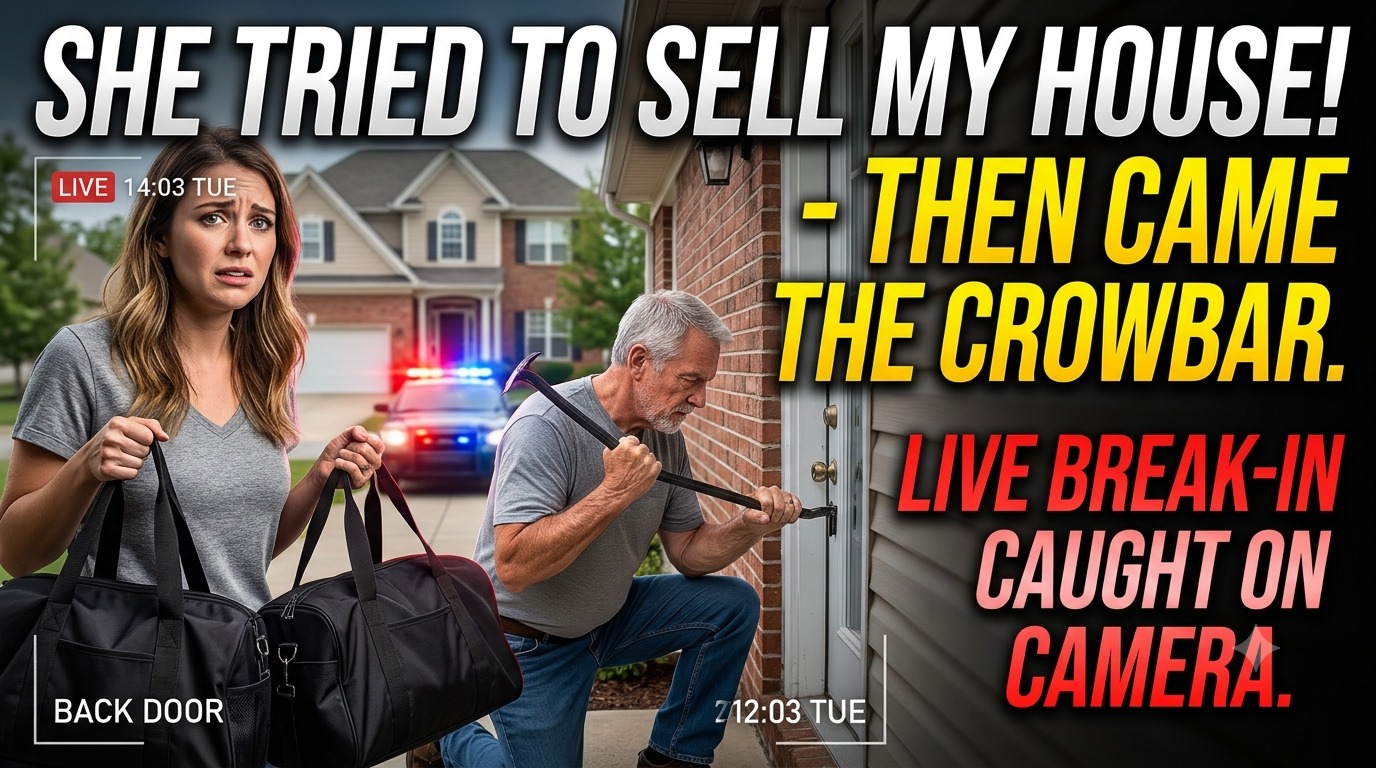
At two in the afternoon on a random Tuesday, I was sitting at my desk at work, watching a live feed of my own back door. On the screen, my fiancée was holding two empty duffel bags, while her father knelt at the lock with a crowbar.
They had no idea I was watching.
Three weeks earlier, I would have told you this woman was the love of my life. Now I was on the phone with a 911 dispatcher, pacing my office, watching the two people I’d trusted most try to break into the house I’d spent ten years of my life buying.
But to understand how we got there, I have to take you back to the beginning.
I’m thirty-four. I grew up without much, and I mean that literally. My childhood was secondhand clothes and hearing “we can’t afford that” so often that I stopped asking. So when I was twenty-five, I made myself a promise. I was going to own something. A real house, with a real front door, that no landlord could ever take from me.
I worked double shifts. I skipped vacations. I ate so much ramen that I can still smell it in my sleep. And five years ago, I finally got the keys to a three-bedroom house with a decent backyard and a small garage. It wasn’t fancy. But I remember standing alone in the empty living room, the afternoon light coming through bare windows, and thinking, I did this. This is mine.
A few years later, I met Kelly. That’s not her real name, obviously.
She was funny, loud in the best way, the kind of person who made a room warmer just by walking into it. We clicked right away. After about a year, she moved into my house. She didn’t pay toward the mortgage, but we split groceries and utilities, and I never minded. I’d bought the house before I even knew her, so it felt fair. Eventually I proposed, and she cried and said yes. We started planning a wedding for the following summer.
Looking back, I can see the first cracks. They were small, and I was too happy to look closely.
Kelly’s family had always struggled with money. She told me stories about her parents maxing out credit cards just to get through the month, and I felt for her. But whenever I met her parents, there was always a little joke hiding inside the conversation. Her mom would squeeze my arm and say, “Kelly really hit the jackpot with a man who owns a house.” Her dad would laugh and say, “Must be nice to retire without a mortgage.”
I laughed along. I thought it was just how they talked.
Then, last spring, Kelly started coming home upset. Her parents had fallen months behind on their mortgage, and the bank had started the paperwork to take their home. She cried in my arms. I held her, and I truly wanted to help. I suggested they sell and downsize, or talk to a financial counselor, or look into a payment plan.
Every suggestion made her angrier.
“You don’t understand,” she said. “They worked so hard. They deserve better.”
A few weeks later, the hints started. Small ones first. “It would be nice if we could help them.” Then less small ones. “You have so much, and they have nothing.” Then one night, over dinner, she said it plainly: “What if we just paid it off? You could take out a loan against the house.”
I put down my fork. I told her I loved her, that I would help her parents any way I could, short of risking my home or taking on their debt. I offered to sit down with them and go through their finances. I offered to help them find a cheaper place.
She stared at me like I’d slapped her.
“That’s not helping,” she said. “That’s just talking.”
After that, something changed. She was on her phone constantly, stepping into the other room to take calls. If I walked in, she’d jump and flip the screen over. She got snappy over nothing. I asked what she wanted for dinner, and she snapped, “Why does everything have to be a question?”
I told myself it was wedding stress. I gave her space. In hindsight, I gave her a lot more than space.
Then one Thursday, I opened the mailbox and found a thick envelope from a real estate company I’d never heard of. I almost threw it out as junk. But my address was printed right there, clear as day, so I opened it.
Inside was a sales packet. Glossy photos. Professional shots of my living room, my kitchen, my backyard. Even the throw pillows Kelly had picked out. There was a listing price, a buyer’s offer, and a proposed closing date.
Two weeks away.
I read it three times. My first thought was that it was a scam. My second thought was worse.
That night, I put the envelope on the kitchen table and asked Kelly, as calmly as I could, whether she knew anything about it.
I watched the color leave her face.
“Oh,” she said, and laughed in a way I’d never heard before, thin and fast. “That’s, um. That’s a surprise. I was looking into bigger houses for after the wedding. I wanted to tell you when it was ready.”
“By selling my house? Without telling me?”
“It’s not selling, it’s exploring options—”
“It’s got a closing date, Kelly.”
She didn’t have an answer for that. She just stood there, and I realized I had never seen her look scared before. Not when her parents’ bank letters came. Not when we had fights. Only now.
I didn’t push. I said goodnight. But after she went to bed, I sat in the dark kitchen with that envelope and I felt something settle in my stomach, heavy and cold.
The next morning, I called the number on the packet. I told them I was the property owner and I wanted to verify some details.
The woman on the phone got very quiet.
“Sir, we have you listed as a co-seller. Along with a Kelly. She told us she was your spouse, and that you were out of the country for work. We have your signature on the listing agreement.”
“I’m not out of the country,” I said. “I’m not married. And I haven’t signed anything.”
Another pause. I could hear her typing.
“Sir, I think you should speak with an attorney. Right away.”
I asked her to send me copies of everything. She did, within the hour. And there it was, in my own handwriting, or a very good imitation of it. A listing agreement. A seller’s disclosure. Even a power of attorney form, supposedly signed by me, granting Kelly authority to complete the sale on my behalf. A cash buyer had already put down earnest money. The closing date was fourteen days away.
I asked why the rush. The agent told me Kelly had explained there were “urgent family obligations” that required fast liquidation.
That was when everything clicked. The calls, the whispering, the jumpiness. The mother’s jokes about the jackpot. The father’s jokes about retirement without a mortgage.
She wasn’t planning a surprise. She was planning to sell my house, collect the check, and hand it to her parents before I ever noticed it was gone.
I laid every document on the table that night. Kelly looked at them, and then she broke. I mean really broke, sobbing so hard she could barely breathe, saying she was sorry, saying she was desperate, saying I would never understand what it was like to watch your parents lose everything.
I stayed very calm. Not because I wasn’t furious, but because I knew that if I started yelling, I wouldn’t stop.
“What you did isn’t just a betrayal,” I told her. “It’s a crime. You forged my signature. You lied about owning my house. There’s no version of this I can come back from.”
I expected her to apologize again. Instead, I watched her face change.
The tears stopped. Her jaw tightened. And she said, in a voice I didn’t recognize, “You’re selfish. You have so much and you wouldn’t give them one piece of it.”
I almost laughed. “That house is the one thing I have. Nobody handed it to me, Kelly. I earned every wall of it.”
“They’re my family!”
“And I was supposed to be your family.”
We went around and around for hours. She’d beg me to give her another chance, then call me cold, then beg again. Around three in the morning I finally told her we were done. I said she had to leave, but I wasn’t going to throw her onto the street that night. She could stay a few days while she figured something out.
That was my mistake. Kindness, with some people, is just another door to push on.
For the next few days, she acted like nothing had happened. She cooked dinner. She chatted about the weather. She even brought up wedding plans once, like we hadn’t just spent a night discussing a felony. I wore headphones in my own living room so I wouldn’t have to hear her.
On Friday, I called a lawyer.
I told him everything. The forged signature, the fake power of attorney, the buyer, the closing date. He listened without interrupting, and when I finished, he folded his hands and said, “This is serious fraud. Real jail time is possible. But I’ll be honest, it could get ugly. She may twist the story.”
I told him I’d think about it. I thought about it for four days. And the more I thought, the angrier I got. Not because she’d hurt me, but because I kept picturing the alternative. What if the packet had gone to a different address? What if I’d thrown it out? I could have come home one morning to a stranger holding a key to my house.
I filed the charges.
I told Kelly that night. I expected tears. Instead, she screamed.
“You’re ruining my life! You’ll regret this! You’re choosing money over love!”
“You chose money over me first,” I said.
I gave her thirty days to move out. She slammed the bedroom door so hard the pictures shook. But the next morning, I found two suitcases by the door, and for the first time in weeks, I breathed.
That should have been the end of it. It wasn’t.
A week later, my phone started buzzing with messages from friends. Kelly had posted a long, tearful Facebook rant. According to her, I’d thrown her out with nothing, abandoned her when she needed me most, and destroyed her over “a misunderstanding.” She left out the forgery. She left out the buyer. She left out the crowbar, but we’ll get there.
I wanted to post everything. Screenshots, documents, the lot. My lawyer said no. It could interfere with the case, he said, and it would make me look like I was acting out of spite.
So I posted one short line: Integrity and trust are the foundation of any relationship. When they’re gone, there’s nothing left to build on.
Then I quietly sent the evidence to the friends who asked. Most of them believed me instantly. A few said they didn’t want to get involved. One guy I’d known for years told me relationships were about sacrifice and blocked me. I let him go.
That was the Facebook phase. I thought it was the worst of it.
Then came the Tuesday I told you about.
I was at work when my phone buzzed with a motion alert from the back of the house. I’d upgraded my cameras a few months earlier, and I thanked every god I could think of for that. I opened the live feed.
And there they were. Kelly, in her gray coat, holding two empty duffel bags. Her father, kneeling at the back door, working a pry tool into the frame. They’d come prepared. They were going in, and they were planning to take whatever they could carry.
I called 911 and stayed on the line. The dispatcher kept saying, “Sir, officers are on the way.” I watched the screen with my heart hammering in my ears, while Kelly’s dad wrestled with the lock and Kelly kept looking over her shoulder, completely unaware that the camera above her head was streaming everything to my phone.
The squad cars pulled in about six minutes later. It felt like an hour.
On the screen, I watched two officers step out and walk calmly up the driveway. I watched Kelly freeze with the duffel bags still in her hands. I watched her father drop the crowbar like it had burned him.
They tried to talk their way out of it, of course. When I got home and gave my statement, Kelly told the officers she’d just come back to pick up a few things she’d left behind.
“She moved out three weeks ago,” I said. “Down to her last sock. And she doesn’t bring a crowbar to pick up socks.”
I handed the officers the footage. They watched it twice and said nothing. Kelly and her father were detained, and I pressed charges for trespassing and attempted burglary. I didn’t hesitate this time.
A few days later, my phone rang. It was Kelly. I almost didn’t answer. But part of me wanted to hear what she could possibly say.
She was crying before I said hello. She told me she was sorry, that she’d been desperate, that she’d only gone back for sentimental things. Then, after a long pause, she said, “I’m pregnant.”
I’ll be honest. For about two seconds, my stomach dropped. Then I thought about timing, and about the woman I’d been dealing with for the past month, and something inside me went very cold and very clear.
“Okay,” I said. “If you’re pregnant, I’ll be there. I’ll support the child, no question. But I need a doctor’s confirmation and a paternity test.”
Silence.
“I’m not ready to see a doctor yet,” she said finally. “You just have to trust me.”
I almost felt sorry for her, how badly she’d miscalculated. “Kelly,” I said, “you forged my name. You tried to sell my home. Trust left the building a while ago.”
I told her I wasn’t playing games. If she wanted my involvement, she could bring proof. Then I hung up.
I never heard another word about the pregnancy. No doctor’s note, no follow-up, no ultrasound. Nothing.
A week later, a letter arrived from her lawyer.
I want you to picture this. It was three pages long, on heavy paper, with a letterhead. It accused me of causing Kelly “severe emotional distress” by ending our engagement and evicting her. It demanded compensation for the time she’d lived in my home, arguing she had “enhanced my quality of life.” And then, my favorite part, it demanded financial support for her parents, on the grounds that I had “benefited from their daughter” and therefore owed them something in return.
I read the whole thing standing in my kitchen, and then I read it again, because I genuinely thought I’d misunderstood.
I took it to my lawyer. He read it, and I watched him press his lips together very hard.
“Is it funny?” I asked.
“It’s creative,” he said.
We drafted a response together. It laid out everything, point by point. The forged signature. The fake power of attorney. The cash buyer. The break-in, with timestamps. And a clear statement that if they pursued any civil action, I would counter-sue for damages, legal fees, and defamation, with every claim backed by evidence.
We sent it on a Monday. I never heard from Kelly or her lawyer again.
It would be nice to say that I walked away feeling victorious. I didn’t. For weeks, the house felt wrong. Every noise at night made me sit up in bed, wondering if it was her or her father coming back. I installed a reinforced security door. I added cameras on every side of the property and paid for a monitoring service that alerts me even when I’m away. It was expensive. It was worth every cent.
I started noticing how much of my life she had left her fingerprints on. The dining table where we ate. The bookshelf we’d organized together. The couch where she binged her shows. None of it was hers, but all of it felt tainted. I rearranged the furniture. I got rid of a few things she’d chosen. It wasn’t petty. I just needed my house to feel like mine again.
The hardest part was the friends. Kelly’s story had traveled farther than I realized, and some people believed it. I got messages that made my blood boil. I don’t know the whole story, but maybe you should forgive her. She’s been through a lot.
Forgive her.
For what? The forgery? The attempted sale? The crowbar? The fake pregnancy? I stopped replying to those messages. I figured the people who mattered already knew the truth.
And honestly, I was a wreck for a while. People don’t warn you about this part. You can know someone betrayed you in the worst way, and still miss the road trips, the inside jokes, the lazy Sunday mornings. Grief doesn’t care whether it makes sense.
So I found a therapist, and it was one of the best decisions I’ve ever made. In our third session, she pointed out something that stopped me cold. I wasn’t just grieving the relationship. I was carrying guilt for not seeing it sooner.
“You didn’t cause her choices,” she said. “And you weren’t responsible for fixing her problems.”
I wrote that on a sticky note and put it on my bathroom mirror. It’s still there.
The legal side finished a few months later. Kelly and her father both took plea deals. I won’t share the exact terms, but Kelly received a substantial fine and mandatory community service for the fraud and the break-in. Her father, who had done the physical work on the lock, received the same, plus probation. Her parents’ house, as far as I’ve heard, was eventually lost anyway. The money Kelly was so desperate to find never came from my front door.
Do I feel bad? Not for a second. I didn’t set out for revenge. I just refused to let them treat my life like a bank account.
If there’s one thing I took from all of this, it’s about boundaries. I used to think boundaries were walls, something cold that pushed people away. I know now they’re more like the locks on your door. They aren’t there to keep out the people who love you. They’re there to show you who tries to pick them.
Watch how someone responds when you say no. Do they respect it? Or do they cry, argue, guilt you, and keep pushing until you break? The way a person handles your no tells you everything about how they’ll treat your yes.
I’m still living in the house. Some nights I stand in that living room, where the afternoon light comes through the windows just like it did on the day I got the keys, and I think the same thing I thought back then.
I did this. This is mine.
And this time, nobody’s taking it.