


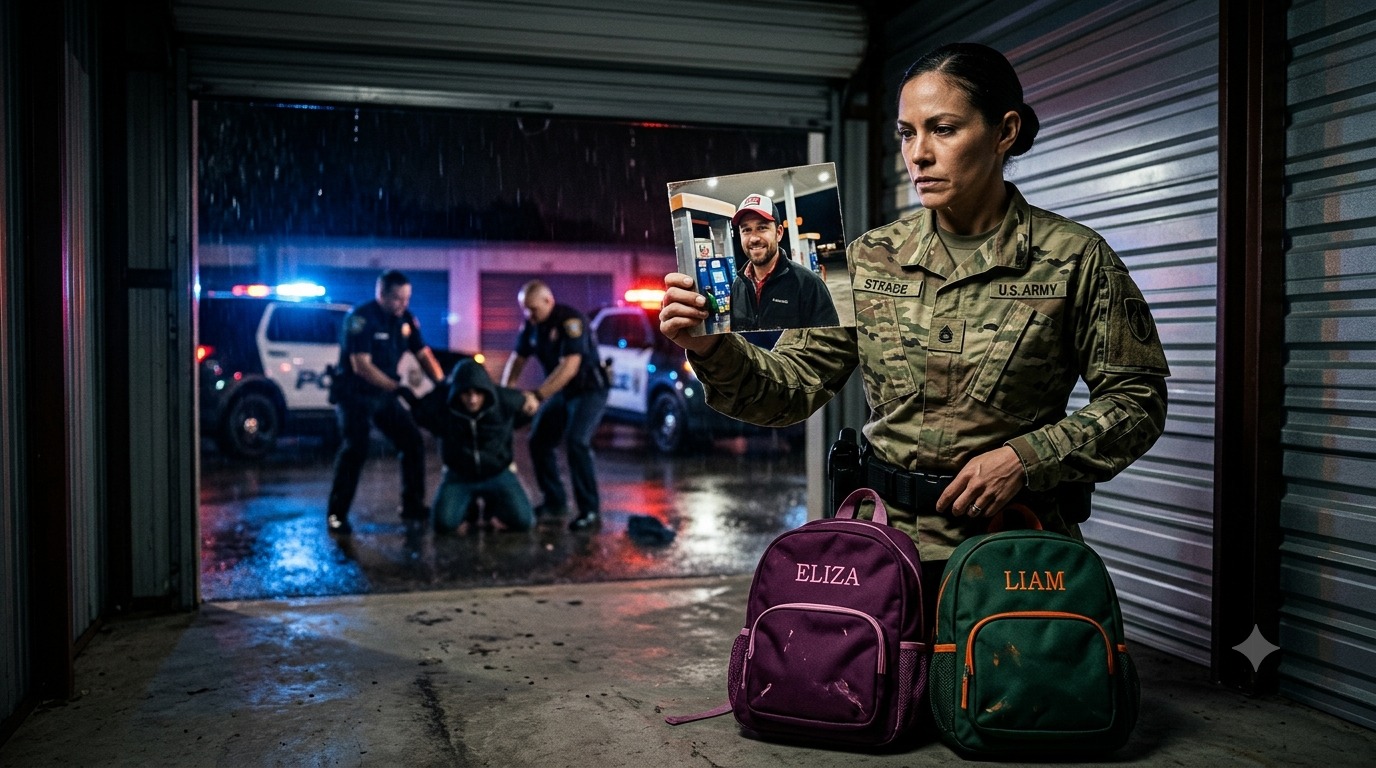
Six months after my ex-husband disappeared at sea, I opened a rusted roll-up storage door registered in my name and found the ghosts of promises he had made to my children.
Sitting on the concrete floor between two stacked cardboard boxes were two brand-new nylon backpacks.
One was deep plum purple. The other was forest green. Embroidered across the front pockets in crisp white stitching were two names: Emma and Noah.
I stood frozen in the dim, dusty corridor of Cape Fear Storage, my breath catching in my throat.
Emma was ten years old. She loved purple because she thought it made her look like an artist. Noah loved green because it matched his favorite baseball cap. Before Ethan vanished on that rented center-console boat in April, he had promised them those exact backpacks for their upcoming fifth-grade school year. He had even called my cell phone twice from a marine supply shop in Wilmington, specifically asking me to double-check the spelling of Noah’s middle initial so the monogram shop wouldn’t botch the order.
Now, those bags sat inside Unit B-17—a unit I had never rented, on a lease agreement I had never signed, thirty miles from my home.
“You alright there, Mrs. Whitmore?”
Calvin Brooks, the storage facility manager, took a cautious half-step backward, adjusting the bifocals dangling from a cord around his neck.
“Those belong to my kids,” I whispered, my voice barely audible above the hum of the highway traffic outside the chain-link fence.
I knelt down on the dusty concrete. The retail tags were still attached to the zippers.
My name is Rebecca Whitmore. I am forty-two years old, a Staff Sergeant in the United States Army stationed at Fort Liberty, North Carolina. For nearly sixteen years, my uniform has taught me how to compartmentalize fear, how to process chaotic intelligence down to its hard facts, and how to stay functional when the perimeter crumbles.
None of that preparation cushioned the blow of looking into that dark unit.
It had started two hours earlier with a routine collection call. Calvin had phoned my office while I was processing logistics transfer sheets, informing me that Unit B-17 was sixty-three days delinquent, carrying two hundred and ten dollars in back rent and administrative penalties. When I drove to the facility off Raeford Road, the rental agreement bore my correct home address and my cell number, but the email address belonged to an old business account Ethan had operated during our marriage, and the signature looked like someone had tried to trace my signature using their non-dominant hand.
I stepped deeper into the unit.
Behind a folded aluminum lawn chair sat a heavy, industrial plastic tote with a loose yellow lid. Inside was a water-resistant manila envelope marked in thick black Sharpie: FAMILY DOCUMENTS — CRITICAL.
I lifted the envelope. My fingers were trembling as I unclasped the metal prongs.
Inside were certified copies of Emma’s and Noah’s birth certificates. Their social security cards. Their original yellow immunization records from the pediatric clinic.
And then, tucked inside a smaller glassine sleeve, was a glossy four-by-six color photograph.
The photograph showed Ethan standing on the sunlit asphalt of a travel plaza beside a dark blue GMC Yukon with heavily tinted windows. He was wearing dark sunglasses, faded denim jeans, and the faded navy blue Carolina Mudcats baseball cap Noah had bought him with his own allowance money for Father’s Day the previous June.
He was holding a cup of convenience store coffee, smiling broadly at the camera lens—not the smile of a drowning man, not the face of a casualty, but the easy, triumphant grin of a man who believed he had outsmarted the universe.
In the passenger seat of the SUV, barely visible through the reflection on the windshield, sat a woman with straight blonde hair and oversized tortoiseshell sunglasses.
Marissa. His twenty-eight-year-old wife.
I flipped the photograph over.
Scrawled in Ethan’s distinctive, left-leaning architect’s cursive were seven words:
“Savannah stop. Fresh air. May 9th.”
May 9th.
Exactly twenty-two days after the Coast Guard called off the active search for their bodies in the waters off Wrightsville Beach.
For six long months, the official narrative in New Hanover and Cumberland counties had been a tragedy of maritime misadventure.
On Saturday morning, April 17th, Ethan and Marissa had chartered a twenty-two-foot Sea Hunt center-console craft out of a marina near Wrightsville Beach, logging a float plan for a day of nearshore bottom fishing around the artificial reefs.
By Sunday evening, the boat hadn’t returned.
On Monday morning, a commercial shrimp trawler spotted the vessel adrift nine miles southeast of Masonboro Inlet. The ignition key was turned to the ‘Run’ position; the fuel tank was sixty percent full; the VHF marine radio was operational and tuned to Channel 16; two adult life jackets were neatly stowed beneath the helm console; and Marissa’s designer tote bag was found on the deck containing her driver’s license, two expired credit cards, and her car keys.
No distress call was ever broadcast. No emergency locator beacon was triggered.
The Coast Guard cutter and regional marine patrols spent five exhaustive days sweeping nearly twelve hundred square miles of ocean surface with sonar and helicopters.
They found nothing. No clothing, no debris, no bodies.
Eventually, the county sheriff’s department transitioned the case to an open missing-persons investigation, but among friends, church members, and neighbors, people began speaking of Ethan and Marissa in the past tense. They offered soft, pitying glances in the grocery aisles; they spoke of rogue waves, sudden squalls, and the cruel finality of the Atlantic shelf.
I had never been able to join that chorus of mourners.
Not because I was harboring a secret flame for my ex-husband. Our divorce had been finalized two years prior after an eight-year downward spiral of secret credit cards, forged signature authorizations on mutual bank accounts, and an eleventh-hour discovery that he had secretly borrowed nine thousand dollars from my retired parents’ pension account to finance an off-grid fishing boat he abandoned six months later.
Ethan Whitmore was charming, handsome, and gifted with that smooth, Southern silver-tongue that could convince a loan officer that a pile of gravel was a diamond mine. But at his core, he was a man who looked at human commitments the way a kid looks at wrapping paper: something to be discarded the second the novelty wore thin.
When the boat vanished, I was left to carry the emotional fallout alone in our small brick ranch house on the outskirts of Fayetteville.
I was the one who had to stand over the stove frying eggs before the morning school bus arrived, while Emma stared at the empty space on the refrigerator where her father’s visit schedule used to hang.
I was the one who had to sit on the edge of Noah’s twin bed at midnight, rubbing his back while he sobbed into his pillow, asking if sharks had eaten his dad or if people could build shelters on uninhabited barrier islands like they did in the adventure novels he checked out from the school library.
And now, standing inside a dusty metal locker, I was looking at proof that while my little boy was crying himself to sleep, his father had been sipping hazelnut coffee in a Georgia parking lot, admiring his new life in the sun.
Calvin was still holding his cell phone in his hand when I stepped out of the unit.
“Ma’am,” he said, his voice dropping into an anxious register. “Should I call the local precinct?”
“Put the phone down for one minute, Calvin,” I said, my voice steady, though my heart was hitting my ribs like a sledgehammer. “I need to call the detective who oversaw the maritime recovery docket.”
I pulled out my phone and dialed the direct line for Detective Paul Hensley of the New Hanover County Sheriff’s Office.
Hensley was fifty-four, a former Coast Guard investigator who had spent twenty years dealing with drownings, smuggling runs, and boating accidents along the Intracoastal Waterway. He had been the lead detective assigned to the floating Sea Hunt back in April. I had kept his direct number pinned to my kitchen corkboard because every four weeks, when the case updates dried up, I called him to ask if any physical remains had washed ashore on the Outer Banks.
He answered on the fourth ring. “Hensley.”
“Detective Hensley, this is Rebecca Whitmore.”
The line paused. “Rebecca. Are you alright? Has something happened with the children?”
“I’m standing inside Unit B-17 at Cape Fear Storage in Fayetteville,” I said, reciting the details with the clipped precision of an operational situation report. “The unit was rented under my stolen identity. Inside, I have located my children’s birth certificates, social security cards, and a color photograph of Ethan and Marissa standing next to a dark blue GMC Yukon at a highway travel plaza. The photograph has a handwritten date on the back: May 9th.”
There was three seconds of pure, static-filled silence on the line.
Then came the sharp rustle of papers being shoved aside.
“Rebecca,” Hensley’s voice had lost its routine exhaustion; it was suddenly taut as a high-tension cable. “Are you still at the storage facility?”
“I am.”
“Do not touch another item. Do not close the roll-up door. Step outside the unit, have the manager lock the security gate, and wait in your vehicle. I am contacting the Fayetteville Police Department and the state bureau right now. I will be on the road within twenty minutes.”
For the next forty-five minutes, Calvin and I sat inside the air-conditioned front office.
He offered me a cup of scorched coffee from an ancient drip machine in the corner. I stared at the dark liquid, unable to take a sip.
All I could see was Noah’s face.
Three nights earlier, while we were cleaning the dinner plates, Noah had turned to me with his small hands submerged in soapy water and whispered: “Mom… if Dad survived on that island, do you think he knows we miss him?”
The realization that Ethan had voluntarily abandoned our children wasn’t just a betrayal of marriage; it was a calculated, psychological amputation. He had staged a funeral for himself, letting his children grieve an imaginary drowning, simply so he could walk away from his debts without the inconvenience of being hunted by collection attorneys.
At 5:40 PM, two marked Fayetteville cruisers pulled into the gravel lot, followed shortly by Detective Hensley’s unmarked state sedan.
Hensley stepped out, wearing a rumpled gray suit and an unbuttoned trench coat. He shook my hand firmly, introduced me to Officer Ruiz, a forensics specialist, and together we walked back down the narrow corridor to B-17.
Ruiz spent an hour documenting the unit under tactical halogen lights: photographing the backpacks, dusting the plastic storage totes for latent prints, and logging the contents of the manila envelope into evidence bags.
Hensley stood beside me under the fluorescent exterior light, holding the May 9th photograph by its edges with latex gloves. He examined the sun angle, the reflection on the SUV’s windshield, and the Mudcats baseball cap.
“Could this be an older photo from last summer, Rebecca?” Hensley asked, his eyes squinting through the glare. “People misdate snapshots all the time.”
“Look at his wrist, Detective,” I pointed out, leaning close.
Hensley raised his magnifying glass.
Around Ethan’s left wrist was a black silicone medical alert band.
“He was diagnosed with severe adult-onset penicillin allergies in February of this year,” I stated flatly. “The doctor ordered that band two months before the boat went missing. He never wore that bracelet last summer.”
Hensley let out a low, slow whistle between his teeth. He turned the photograph over, studying the cursive text.
“Well, Sergeant,” Hensley murmured, meeting my gaze with grim solemnity. “You aren’t imagining things. Your ex-husband didn’t drown. He walked off that boat and caught a ride.”
By the time I pulled into my driveway on Linden Street, it was past seven o’clock.
My sixty-one-year-old neighbor, Diane Keller, met me at the front door wearing an apron dusted with flour. Diane was a retired middle school administrative secretary who had lived down the block for thirty years; since Ethan’s disappearance, she had become the de facto grandmother who met the twins at the bus stop whenever my military shifts ran into the evening.
“They’ve eaten their pasta, Emma finished her North Carolina wildlife poster, and Noah is on the living room rug building a Lego crane,” Diane whispered, pulling me gently into the foyer. She took one look at my pale face and the tension in my jaw. “What happened at that storage facility, Rebecca?”
I shook my head slightly, gesturing toward the living room. “Not in front of the children, Diane. Please.”
We waited until 8:45 PM, after the twins had brushed their teeth, read three chapters of an adventure book, and drifted off to sleep beneath their quilts.
I sat down at my small kitchen table, made a fresh pot of herbal tea, and laid the entire reality out for Diane: the overdue unit, the purple and green backpacks, the photograph from Georgia, and the police tape currently sealing B-17.
Diane sat in silence, her hands clasped around her ceramic mug, her knuckles whitening.
“That man,” Diane whispered, her voice trembling with decades of suppressed fury, “has always been a master of leaving the wreckage for someone else to sweep up. Do you remember the second credit card back in 2021?”
I remembered. He had claimed the four-thousand-dollar balance was for “commercial hydraulic fittings” for his boat repair venture. When I finally demanded the itemized statements, they revealed weekend stays at oceanfront resorts in Myrtle Beach, high-end rod-and-reel combos, and dinners at steak houses. When I confronted him, he had screamed that I was a controlling, unsupportive drill sergeant who didn’t understand the pressures of entrepreneurship.
The next morning at 9:15 AM, Detective Hensley called my mobile phone while I was standing in the supply depot at Fort Liberty.
“Rebecca,” Hensley said, his cadence unusually formal. “We obtained an emergency judicial search authorization for the second lockbox recovered from B-17. We’re reviewing the financial documentation right now. You need to pull your credit bureau monitoring reports immediately.”
My hand tightened around the military field radio I was holding. “Why, Paul? What did he do?”
“Inside that lockbox, we found a finalized application packet for a one-hundred-and-forty-eight-thousand-dollar Home Equity Line of Credit,” Hensley revealed. “The collateral property listed on the deed of trust is your residence at 814 Linden Street. Your full legal name, your military payroll ID, and your social security number are listed as the primary applicant.”
The blood rushed out of my ears with the sound of a rushing river.
“My house?” I choked out, leaning against an olive-drab shipping container. “He tried to borrow against my children’s home?”
“The application is dated March 14th,” Hensley continued. “We are currently coordinating with the bank’s fraud division to verify whether the loan proceeded to underwriting approval, or if any disbursements were transferred before the boat incident.”
March 14th.
On March 14th, I had been in the field at the National Training Center in Fort Irwin, California, participating in a mandatory three-week brigade logistics maneuver. My cell phone had been locked in a company safe; my movements were logged in official Department of the Army personnel rosters down to the hour.
I spent my lunch break parked outside the bank branch on Skibo Road, trembling with cold rage as I spoke with a senior fraud investigator named Mrs. Miller.
“Staff Sergeant Whitmore,” Mrs. Miller confirmed after fifteen minutes of security verification, “we do have an active file for that equity line. The initial underwriting review was conditionally approved in late March based on digital paystubs uploaded through an online portal. However, the final deed of trust required a wet-ink signature in front of a licensed notary public. The application was placed on an administrative hold when the applicant failed to appear for the in-person document closing on April 12th.”
April 12th. Exactly five days before Ethan rented the boat at Wrightsville Beach.
He had tried to extract nearly one hundred and fifty thousand dollars of cash equity from the roof over his children’s heads. And when the bank’s notary requirement blocked his easy score, he had pivoted to his final, desperate fallback: faking his own demise to escape the impending tsunami of collection judgments, lawsuits, and federal fraud investigations.
That afternoon, after freezing my credit files across all three bureaus and placing active fraud alerts with the military legal assistance office, I sat in the front seat of my Tacoma outside the commissary.
My phone buzzed on the center console. The caller ID displayed: Margaret Whitmore.
Ethan’s mother.
She lived in an immaculate brick colonial in Hope Mills, eighteen miles south. Since the April boating tragedy, Margaret had treated me with an icy, sanctimonious condescension, repeatedly informing the twins that their father was “resting in the arms of the angels,” while making loud, passive-aggressive remarks to our mutual acquaintances about how my “cold military demeanor” had driven her precious boy into emotional despair.
I took a deep, measured breath and pressed green. “Hello, Margaret.”
There was no greeting. Her voice was thin, high-pitched, and vibrating with frantic, uncontrolled hostility.
“Rebecca! I have just received a very disturbing phone call from one of my church acquaintances whose nephew works near Raeford Road! What kind of sick, vindictive games are you playing now?!”
I sat upright in the truck seat. “What are you talking about, Margaret?”
“You know exactly what I am talking about!” she shrieked into the receiver. “Spreading vile, disgusting slander about my missing son! Claiming he’s a criminal! Involving the police! Have you no human decency?! The boy is gone! He is resting with the Lord, and you simply cannot stand that you no longer have control over him!”
“Margaret,” I said, my voice dropping into that chilling, dangerous calm I use during military disciplinary boards. “I haven’t told anyone at your church a single word. How on earth do you know what the police are investigating?”
A sharp, ragged intake of breath sounded through the speaker. A microsecond of dead, terrified silence followed.
Then, Margaret spoke the words that burned down her entire defense:
“You had no right to go snooping around that storage unit, Rebecca! You should have left those lockers alone!”
My heart stopped.
I felt the hairs on the back of my neck rise like quills.
I had never mentioned Unit B-17 to Margaret. Detective Hensley hadn’t released a statement to the press. Calvin Brooks hadn’t notified anyone outside the registered leaseholder.
“Margaret,” I said, each syllable dropping like an iron weight into the silence. “How did you know about the storage unit?”
Another suffocating pause hung over the line.
“People talk!” she stammered, her voice suddenly cracking into a defensive panic. “Fayetteville is a small town! You’re tearing this family apart, Rebecca! You’ve always hated Ethan, and now you’re trying to destroy his memory!”
“Who told you about the unit, Margaret? Did Ethan call you?”
“I have nothing further to say to you!” she screamed, and slammed the phone down.
I sat in the quiet cab of my truck, staring at the dead screen.
For six long months, that woman had sat on the sofa in my living room, weeping into floral handkerchiefs, holding my children’s hands, telling ten-year-old Noah that his daddy was an angel watching over him from the stars.
She hadn’t been grieving.
She had known all along.
I forwarded the recording of Margaret’s phone call to Detective Hensley immediately.
Twenty minutes later, Hensley called back. “Do not go to her house, Rebecca. Do not confront her. We are applying for emergency wire-monitoring orders and historical cell tower records on Margaret Whitmore’s domestic lines right now. If she is communicating with him, she is an active accessory to felony identity theft and fraud.”
By Monday morning, the investigative net had widened across two states.
The electronic gate logs from Cape Fear Storage revealed that Ethan’s private four-digit access code had been entered fourteen times between January and the week prior to the April boat rental.
More damningly, the high-definition perimeter security cameras from the facility’s commercial gate had captured a late-model dark blue GMC Yukon pulling through the barriers on March 28th.
Behind the wheel was Ethan Whitmore.
Sitting in the passenger seat, holding an iced latte, was his mother, Margaret Whitmore.
She had sat in the truck while he loaded our children’s birth certificates and the forged equity loan papers into Unit B-17.
On Wednesday afternoon, the definitive break detonated in Wilmington.
Hensley called while I was supervising a convoy staging drill at the Fort Liberty motor pool.
“Rebecca, we found Marissa’s family,” Hensley said, his voice tight with urgency. “Her older sister, Lauren Vail, came forward to the State Bureau of Investigation in Raleigh this morning. She brought a digital voicemail recording she received on her private cell phone four weeks ago.”
“Is Marissa alive?” I asked, stepping behind a heavy five-ton tactical truck to cut the wind noise.
“Listen to this,” Hensley said.
He held his phone to an audio player.
Through a heavy curtain of cellular static and wind interference, a woman’s voice whispered in ragged, terrified gasps:
“Lauren… oh God, Lauren, please don’t delete this… it’s Marissa. I’m so scared… Ethan lied to me about everything. He told me the boat thing was just to shake off the civil collectors… he promised we’d be out of the country before anyone figured it out… but he’s out of his mind, Lauren. He has weapons. He’s talking about going back to North Carolina to take the kids… he said he isn’t leaving without Emma and Noah… if anything happens to me—”
A sudden scuffle sounded in the background, followed by the sharp click of a disconnected line.
The hair on my scalp prickled with ice.
He’s talking about going back to North Carolina to take the kids.
“Where was that call placed from, Paul?” I demanded, my military posture locking into full combat readiness.
“A prepaid burner cell pinging a tower outside of Savannah, Georgia,” Hensley replied grimly. “And that isn’t all, Rebecca. We executed a full forensic analysis of the travel itinerary we recovered from the manila envelope in B-17.”
Hensley paused, taking a slow breath before delivering the final, horrifying revelation:
“The itinerary wasn’t for two people, Rebecca. It was booked through a private maritime charter service operating out of the Florida Keys, departing for an airstrip in Costa Rica.
The passenger manifest listed four names: Ethan Whitmore. Marissa Whitmore. Emma Whitmore. Noah Whitmore.”
The world dropped out from beneath my boots.
I remembered the weekend of April 17th.
Two days before the boat disappeared, Ethan had called me four times, practically begging me to switch custody weekends. He had claimed he wanted to take the twins on a special spring camping and fishing trip down to the barrier islands. He had offered to pay for Emma’s gymnastics uniforms; he had promised Noah they would catch redfish under the stars.
I had said no.
I had refused because Emma had a mandatory school science presentation on Monday morning, and Noah had a baseball playoff game on Sunday afternoon. Ethan had lost his temper on the phone, screaming that I was an inflexible, vindictive ex-wife who was destroying his bond with his children.
If I had said yes…
If I had let my children get into his truck that Friday afternoon…
They wouldn’t have been fishing.
They would have been loaded onto that center-console boat, transferred to a secondary vessel off the coast, and smuggled out of the United States under false passports before the Coast Guard even found the drifting hull.
The only barrier between my ten-year-old twins and an international kidnapping had been a fifth-grade science poster and a Little League baseball game.
“Where are the children right now, Rebecca?” Hensley’s voice cut through the roaring in my ears.
“They’re at school,” I said, my voice dead, flat, and absolute. “Emma is in Room 204. Noah is in the gymnasium.”
“I am dispatching two marked Fayetteville units to that elementary school this second,” Hensley commanded. “Do not leave the military installation alone. We have reason to believe Ethan abandoned Marissa in Georgia five days ago and is currently operating in the Cumberland County area.”
“I’m leaving the post now, Detective,” I said. “I’ll meet your units at the school.”
I hung up. I didn’t panic.
When you spend sixteen years in the Army, fear doesn’t paralyze you; it clarifies the operational objective.
I walked into the company headquarters, briefed Sergeant First Class Alvarez in twenty words, signed out on emergency leave, and sprinted to my truck.
I reached Westarea Elementary School at 2:15 PM, ten minutes before the dismissal bell.
Two Fayetteville police cruisers were already parked in the visitor loop, their blue light bars switched off to avoid alarming the parents in the pickup line.
I hurried through the double security doors, met the principal, and had Emma and Noah brought to the administrative conference room.
When Noah saw my face and my combat uniform, his eyes widened with worry. “Mom? What’s wrong? Did somebody get hurt?”
I dropped to one knee on the linoleum, pulling both of them against my chest, feeling their small heartbeats through their cotton shirts.
“Nobody is hurt, baby,” I whispered, kissing the top of Noah’s baseball cap, then Emma’s forehead. “We just have to take a little trip with Detective Hensley today. Everything is completely fine.”
We escorted the children out through the rear administrative exit, placing them in the back of my Tacoma under the watchful eyes of Officer Ruiz.
Diane Keller was waiting at my house on Linden Street when the police convoy pulled into the driveway.
We brought the twins inside, locked the deadbolts, and drew every heavy curtain across the front windows.
At 4:30 PM, Detective Hensley arrived with an operational update:
“We picked up Marissa Whitmore at a motel off Interstate 95 near Lumberton two hours ago,” Hensley revealed, unrolling a county street map across my kitchen counter. “She was terrified, dehydrated, and cooperative. She gave us everything: Ethan’s current burner numbers, his vehicle description, and his plan.”
“What is his plan, Paul?”
“He’s out of money,” Hensley said grimly. “The offshore accounts he tried to establish in Costa Rica required minimum liquid deposits he couldn’t produce without that home equity loan. He’s desperate, volatile, and convinced that if he can snatch the children, his mother will wire him forty thousand dollars from her personal retirement accounts to fund their escape across the Mexican border.”
“Where is he?”
Hensley pointed his pen at a red circle on the map: an abandoned equipment storage yard three miles from my house, off an industrial spur of the Cape Fear River.
“He’s driving a stolen dark green Ford Explorer with cloned South Carolina plates,” Hensley stated. “Marissa told us he has been conducting surveillance on your house since Tuesday morning. He knows your schedule. He knows you usually leave the children with Diane between four and six on Friday afternoons.”
A cold, razor-sharp certainty settled over my chest.
“He thinks I’m at the base,” I said softly.
Hensley looked up from the map, his eyes narrowing. “What are you thinking, Sergeant?”
“He knows my truck,” I said, gesturing toward the driveway. “He knows Diane’s sedan. If my Tacoma leaves this driveway at 5:15 PM and heads toward the post gate, he’ll assume the house is guarded only by an elderly neighbor and two children.”
Hensley shook his head immediately. “No, Rebecca. We don’t use civilian residences as bait.”
“My children are already in the center of his crosshairs, Detective!” I countered, stepping directly into his space, my rank and my authority as a mother burning behind my eyes. “If you chase him through this county, he runs, he vanishes into the woods, and my children spend the rest of their lives looking over their shoulders every time a car door slams! He comes to this house tonight. And we end it on this lawn.”
Hensley stared at me for ten silent seconds.
He looked at the two purple and green backpacks resting on my kitchen counter. He looked at the framed drawing of the house on the refrigerator.
He slowly nodded. “Tactical units will be stationed inside Diane’s home and in two civilian work vans down the block. We let him cross the property threshold before we take him down.”
At 5:10 PM, the trap was sprung.
Officer Ruiz, wearing an Army physical fitness jacket with the hood pulled low over her cap, climbed into the driver’s seat of my Tacoma, started the engine, and backed smoothly out of the driveway, turning north toward the military installation.
Inside my home, the silence was suffocating.
Emma and Noah had been moved through the rear cedar fence into Diane’s basement twenty minutes earlier, guarded by two plainclothes state investigators with strict instructions to keep them entertained with board games.
I remained in my own kitchen, dressed in dark civilian work clothes, standing behind the heavy wooden door of the pantry.
Stationed in the dark hallway beside the bathroom was Detective Hensley and three members of the Fayetteville Police Department’s tactical entry unit, carbines held low against their tactical vests, ear-pieces humming with encrypted radio traffic.
The grandfather clock in the living room ticked with excruciating precision:
Tick. Tick. Tick.
5:38 PM.
The gray autumn twilight began to bruise into early darkness outside the front window.
Then came the faint, distinctive sound of dry pine needles crunching beneath rubber tires in the alleyway behind my garage.
A car door shut—not with a slam, but with that soft, cautious click of someone trying to avoid alerting the neighborhood dogs.
Through the crack in the pantry door, I watched the rear kitchen storm door.
A shadow separated itself from the darkness of the back patio.
A tall, broad-shouldered figure stepped onto the concrete steps. He was wearing a dark hooded sweatshirt, work boots, and a baseball cap pulled low over his eyes.
In his right hand, he carried a heavy steel pry-bar.
In his left hand, he held a set of brass keys—the old household key I had changed the locks on eighteen months ago.
He slipped the key into the deadbolt. He turned it.
The brass cylinder didn’t move.
A muffled curse slipped through his lips. He raised the pry-bar, inserting the tapered steel wedge between the wooden door jamb and the strike plate.
The wood groaned. With a sharp, splintering crack, the deadbolt popped free.
The kitchen door swung open.
Ethan Whitmore stepped onto my linoleum.
He paused on the threshold, sniffing the air—the scent of fresh coffee and lavender floor soap. He lowered his hood, revealing his unkempt brown hair, a scruffy, unwashed beard, and eyes that were wild, hollowed-out, and bloodshot with mania.
“Noah?” he called out in a low, frantic whisper, taking two steps toward the living room. “Emma? It’s Daddy, guys. Don’t make a sound. We’re going on a trip.”
I stepped out from the pantry.
“The children aren’t here, Ethan,” I said.
My voice was not loud. It was entirely flat, steady, and stripped of every drop of human warmth.
Ethan whirled around, his boots skidding on the floor, the steel pry-bar coming up instinctively in his grip.
When he saw me standing under the kitchen light, his face contorted into a grotesque mixture of shock, fury, and absolute disbelief.
“Rebecca…?” he stammered, his eyes bulging. “You… you’re on duty! Your truck left twenty minutes ago!”
“You always were sloppy with intelligence, Ethan,” I replied, taking one measured step forward. “Just like you were sloppy with the loan application. And just like you were sloppy with the notary stamp in B-17.”
The mention of the storage unit struck him like an electric shock.
His face flushed dark purple. The handsome, charismatic smile that had charmed two wives and a dozen loan officers was gone, replaced by a feral, cornered snarl.
“You ruined everything!” Ethan screamed, raising the heavy steel bar above his shoulder. “That was my money! Those are my children! I built this family, and you took them from me! I’m walking out of here with my kids, Rebecca, and you aren’t going to stop me!”
He lunged forward across the kitchen island.
He didn’t make it two paces.
“POLICE! DON’T MOVE! DROP THE WEAPON!”
The living room doors flew open. Tactical weapon lights flooded the kitchen with blinding, eight-hundred-lumen white beams.
Detective Hensley and the tactical team breached the corridor with terrifying, synchronized speed, carbine muzzles locked dead onto Ethan’s chest.
“DROP IT! GET ON THE GROUND! NOW!”
The steel pry-bar slipped from Ethan’s numb, sweating fingers, clattering loudly against the linoleum.
He threw his hands into the air, his knees buckling under the sheer, concussive weight of the authority surrounding him.
Two officers took him down with mechanical efficiency, driving his chest into the kitchen floorboards right beside the table where he used to eat Sunday pot roast.
The steel handcuffs clicked shut around his wrists with that cold, final, irrecoverable sound.
Ethan groaned, his cheek pressed flat against the floor, spitting out a fleck of floor dust. He twisted his neck, looking up at me with watering, pathetic eyes.
“Rebecca…” he wheezed, his voice cracking into a desperate, childish sob. “Please… tell them to let me up. I’m their father. You can’t do this to their father.”
I stood directly over him.
I looked down at the man who had let his children weep into their pillows for six months while he drank coffee in Georgia.
I looked down at the man who had tried to steal their roof to pay off his gambling debts.
“Their father died six months ago on an empty boat off Wrightsville Beach, Ethan,” I whispered, each word dropping like an iron spike into the floorboards. “You’re just a stranger who broke into my house.”
The officers hoisted him up by his elbows, marching him backward through the shattered frame of the rear door, down the steps, and into the waiting transport cruiser in the alley.
The legal fallout was swift, brutal, and comprehensive.
The United States Attorney for the Eastern District of North Carolina, coordinating with county prosecutors across two jurisdictions, unsealed a twelve-count federal indictment against Ethan Whitmore:
- Attempted International Parental Kidnapping.
- Aggravated Identity Theft.
- Bank Fraud involving a Federally Insured Financial Institution.
- Felony Breaking and Entering.
- Conspiracy to Defraud the United States Coast Guard (carrying statutory restitution penalties exceeding three hundred thousand dollars for the search operations).
Faced with the mountain of forensic evidence—the surveillance footage, the travel manifests, the recorded voicemails, and Marissa’s full state’s-evidence confession—Ethan entered a blind guilty plea to avoid a public jury trial.
In January, a federal judge in Raleigh handed down a sentence of twenty-four years in the federal penitentiary at Coleman, with zero eligibility for parole.
His mother, Margaret Whitmore, was indicted as an accessory after the fact to bank fraud and providing material support to a fugitive. She negotiated a plea agreement resulting in three years of supervised home confinement, significant civil fines, and the complete revocation of all unsupervised visitation privileges with her grandchildren.
Marissa received three years of formal probation in exchange for her comprehensive testimony, quietly relocating back to her family’s home in the mountains of Tennessee.
Today, three months have passed since the glass shattered in my kitchen.
The early North Carolina spring has arrived on Linden Street. The dogwood blossoms are bursting white and pink along the curbs, and the air smells of damp pine needles and fresh-cut grass.
Yesterday afternoon, I sat on the wooden porch steps with a mug of hot tea, watching Noah take batting practice against the cedar fence.
He swung his aluminum bat with clean, confident rhythm, sending tennis balls arching over the grass, his laughter clear and light in the afternoon sun.
Beside him, Emma was sitting on an overturned plastic bucket, using her watercolor paints to capture the vibrant green buds emerging on the crooked little maple tree they had planted by the driveway three years ago.
On the porch behind me, resting against the brick wall, were two brand-new backpacks.
Not the ones from the storage unit. Those had been surrendered to the federal evidence repository and destroyed.
These were two sturdy canvas bags that Emma and Noah had picked out themselves at the military exchange last Saturday: Emma’s was bright sunflower yellow; Noah’s was navy blue with an embroidered baseball patch.
Emma rinsed her brush in a plastic jar of water, looked up at me, and smiled with a warmth that reached the deepest, darkest corners of my soul.
“Look, Mom!” she called out, pointing her wet brush toward the branches. “The leaves came back! Just like you said they would!”
“I see them, baby,” I smiled back, feeling the knot that had lived in my chest for six long months finally dissolve into the warm southern air.
The deadbolt on my back door was new, reinforced with three-inch hardened steel screws set deep into the wall studs.
The mortgage on my house was clean, unencumbered, and protected under my name alone.
And as I watched my children laugh beneath the afternoon sun, whole, safe, and free from the shadows of a con man’s promises, I knew with absolute, unshakeable certainty:
The storm had passed. The perimeter was secure. And our family was finally home