

Chapter 1: Pretend to Be My Mom
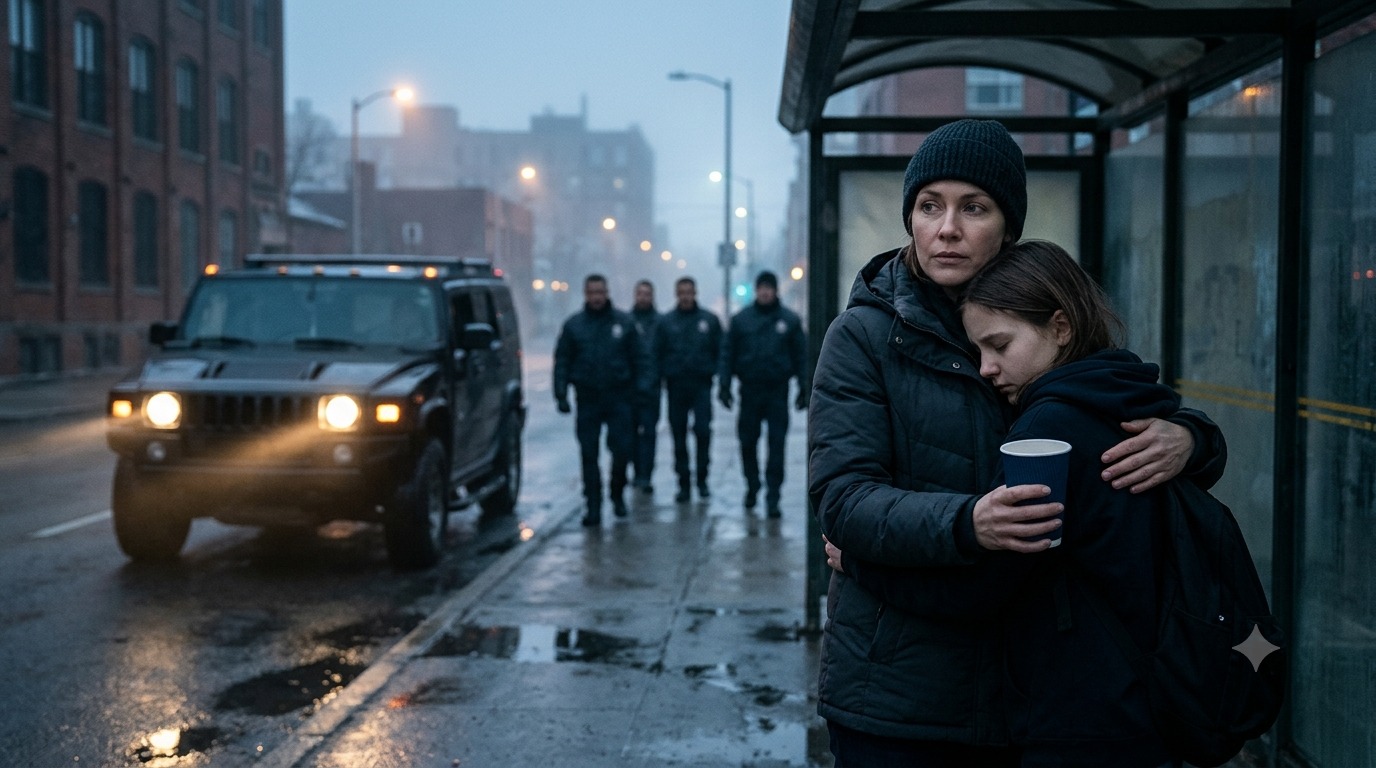
That Sunday morning at the bus stop in Madison began like every other Sunday of my life, until a thin girl ran straight at me and threw both arms around my neck.
“Mom!” she cried, loud enough for the whole platform to hear. “You’re finally here!”
My name is Diana Harlow. I am thirty-six years old. I was standing there in my jacket, holding an empty coffee cup, when she pressed her face against my shoulder. Before I could pull back, before I could even ask who she was, she whispered fast and low against my ear, her voice shaking.
“Please pretend to be my mom. Someone is chasing me.”
I could feel her heart slamming against my chest. It was the heartbeat of a small, frightened animal, quick and light and desperate.
I looked up over her head.
Four men in dark jackets were coming toward us from the far end of the platform. They were not running. That was what frightened me most. They walked with no hurry at all, with the unbothered ease of people who had never once doubted how this would end.
The one in front stopped a few feet away. He was tall, with a clean-shaven face and a lanyard tucked inside his jacket. He looked at me as though I were a piece of furniture that had been put in the wrong place.
“Step aside,” he said. “That girl belongs to us.”
I did not step aside.
I kept both arms around her and met his eyes. I have spent more than twenty years teaching people how to stand their ground, and the first lesson, before any kick or block or throw, is this: the body decides what the mind has not yet admitted. My feet had already settled into the pavement. My weight had already dropped. My shoulders had already gone loose and ready.
He repeated himself, slower this time, as though volume might do what the words had not. “Step. Aside.”
The girl held on tighter. Her fingers dug into the back of my jacket, thin and cold and strong.
The other three men spread out a little, with the practiced geometry of people who had done this before, quietly blocking the path to the street. Nobody else on the platform noticed yet. A man in a suit stared at his phone. A teenager with earbuds bobbed his head to music I could not hear. The morning bus had not yet turned the corner.
“I don’t want to go with them,” the girl whispered again, so quietly that I felt it more than heard it. “Please.”
“Stay exactly where you are,” I told her, barely moving my lips.
The man in front took one more step.
I shifted my weight the way I have taught my students for years, a small change in the hips, nothing a stranger would notice, and kept my voice perfectly even when I answered him.
He had no idea who he was dealing with.
But to explain why that ordinary Sunday changed everything, I have to tell you what the rest of my Sundays had looked like for fourteen years.
Chapter 2: The Bench
I teach karate at a small dojo on the east side of Madison, and I live in a wooden house with my husband, Sean.
Fourteen years ago, our family was driving home from a short weekend trip when another vehicle crossed the center line on a quiet road outside the city. I remember the sound more than the sight. I remember the strange, enormous silence that came afterward, in which I could hear the engine ticking and a bird somewhere in the trees.
Our daughter, Ruth, died that day. She was fifteen years old.
Sean suffered a severe head injury that erased most of his memory. He still knows her name. He still believes, with the whole of his heart, that she is alive and studying in New York.
In the first years after the accident, I tried more than once to tell him the truth. Each time, the words sent him into a state of confusion and deep distress that lasted for days. He would stop eating. He would walk through the house calling her name in a voice I could not bear to hear. After the third time, a neurologist took me aside in a hospital corridor and said, very gently, that some truths could be held by a damaged mind only in small pieces, if at all.
So I learned to stop. I let him keep the version of the world that did not destroy him.
The house carries the quiet of that decision. Sean moves through the rooms with a steady routine that rarely changes. He makes coffee in the same pot every morning. He sits by the same window that faces the street. He watches the sidewalk as if he expects someone to step off a bus and walk up the path with her arms full of books.
When the right words will not come, he falls silent for long stretches. Some afternoons he turns to me and asks where Ruth is.
“She’s at school,” I tell him.
The lie sits between us like another person in the room. I have carried its weight for fourteen years, and I have learned how to hold it without letting the full truth spill onto him when he is not ready to receive it.
There are small signals that tell me when the confusion is rising. He sets an extra plate at the table. He leaves the porch light on long after dark. He stands at the front window with his hands in his pockets, as if waiting for a car to turn into the driveway. On those evenings, I sit beside him in silence. I do not correct him. I do not fill the quiet with explanations that will only hurt. I let the evening pass until the restless energy fades and he drifts back into the safer parts of his memory.
Ruth’s room is still almost exactly the way she left it. Her books stay on the shelf in the order she arranged them. A few photographs sit on the desk. The bed is made. I keep the door closed most days, because looking inside still costs more than I can afford in the middle of an ordinary week. Sean sometimes opens it without warning. He stands in the doorway and calls her name, as though she might answer from the closet or from under the bed, the way she did when she was small. I guide him back to the living room. I ask if he would like more coffee, or if the news is on.
The questions are small. They pull him forward in time for a little while.
The dojo gives the rest of my week a shape that home no longer can. Teaching students how to stand, how to fall, how to protect themselves without searching for a fight keeps my days steady. The wooden floors, the sound of bare feet on mats, the simple rules written on the wall all belong to a world that still makes sense.
At home, the rules are different. At home, I measure every sentence before I speak it.
And every Sunday, I go back to the bus stop.
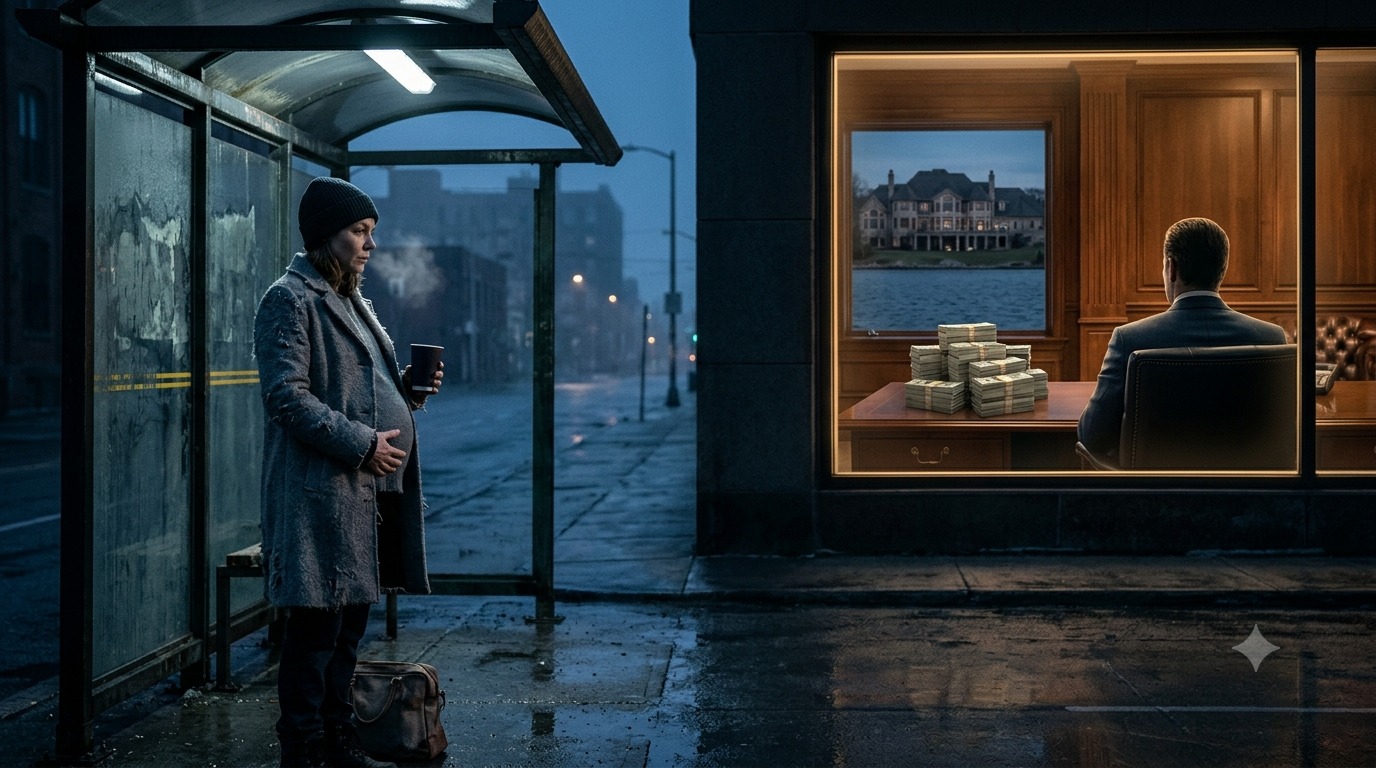
It was where Ruth used to wait for the bus that took her to school and to her weekend activities. She stood there with her backpack and a handwritten schedule she folded into quarters and tucked in her back pocket. After the accident, I began going back to that bench. At first the visits lasted only a few minutes. Then they grew longer. I do not bring flowers. I do not speak aloud. I sit until the quiet becomes too heavy to carry, and then I stand up and walk home.
Most people who wait at that stop are traveling toward something. I am not. I am only staying still long enough to remember a girl who once stood in that same place, with a future that no longer exists.
I told myself the habit would fade when the pain grew smaller. It never grew smaller. It only grew quieter, like a radio left on in another room, one you stop noticing until the whole house falls silent.
I do not know if the choice I made is the right one. I only know that it is the choice I made, and the one I make again each time Sean asks for our daughter by name. The promise is simple. I will not force him to bury Ruth again every time the memory returns. I will carry the knowledge for both of us.
That is what Sundays were. A bench, a cold coffee, a girl who was not coming.
Until another girl came instead.
Chapter 3: Four Men and Three Phone Calls
The man in front cleared his throat. He told me he worked for the facility responsible for the girl.
“She’s a minor who’s run away,” he said, in a smooth, reasonable voice, the voice of a man reading from a script he has recited many times. “We’re required to take her back. You’re interfering with a legal process.”
“Do you have paperwork showing you’re authorized to remove her?” I asked.
He patted his jacket vaguely and produced nothing.
“Then I’m going to ask you and your friends to keep your distance,” I said, “while I contact someone who can verify that.”
I took my phone out with one hand, keeping my other arm locked around the girl, and I called Brian Yates.
Brian is a police officer, and he has been my friend since our daughters were in the same kindergarten class. Mine was Ruth. His was a girl named Hannah, who now lives in Portland and sends me a card every December. He answered on the second ring, and when I told him in a level voice that I was at the Hillcrest bus stop with a teenage girl who appeared to be in danger of being forced into a vehicle, his own voice changed instantly.
“Keep her in your sight,” he said. “Keep space between you and those men. Don’t engage. I’m requesting the nearest unit right now and I’ll handle the report from my side. Stay on the line if you can.”
“I’m going to make two more calls,” I said. “I’ll leave this open.”
The second call went to Ethan Cross, and the third to Cody Brennan, two of my senior students, men in their thirties who had been training with me for years and who lived close enough to reach the stop within minutes. I did not explain much. I only said, “I need you at the Hillcrest bus stop. Come and stand beside me until the police arrive.”
“Ten minutes,” Ethan said.
“Five,” said Cody.
I ended the calls and kept one arm around the girl. She still had not spoken since that first whisper in my ear. Her fingers stayed locked on the back of my jacket.
The tall man said again that she belonged at the facility. He added, in a kinder voice, a voice I liked even less, that she had “behavioral problems,” and that leaving with a stranger would only create more difficulty for her. The other three men shifted, but stayed quiet. One of them glanced toward the street, calculating how long it would take for more people to appear.
“Nobody is leaving,” I said, “until the proper authorities confirm who has legal responsibility for her.”
Ethan and Cody reached the stop before any marked unit. They did not shout or posture. They simply walked up and took positions on either side of me and the girl, calm and wide-shouldered, with their hands loosely at their sides. It was exactly what I had taught them: you do not need to threaten anyone. You only need to make the next step look expensive.
The presence of three additional adults changed the tone of the conversation. The man who claimed authority began speaking more carefully. He said they only wanted what was best for the minor, and that this could all be settled quietly if I would just cooperate.
“I am cooperating,” I said. “With the police.”
A patrol car pulled up a minute later, and then another. Brian had already passed along the basic facts, so the officers who stepped out understood they were dealing with a possible custodial dispute involving a juvenile. They separated the parties and asked for identification.
The four men handed over driver’s licenses. Nothing else. No letter, no badge, no guardianship order, no employee card from any licensed facility. When the officers asked for the name of the facility and for a supervisor who could confirm the story, the men became noticeably less cooperative. One of them said that they were not required to answer further questions without a lawyer.
A few minutes later, all four of them walked back to a dark SUV parked near the corner and drove away.
The officers wrote down the plate number, the men’s physical descriptions, and my full statement. They spoke briefly with the girl, away from the rest of us. When they finished, they told me that Child Protective Services had been notified and would respond to the scene, and that until the worker arrived, the girl would wait with a female officer in a secure location nearby.
I asked whether there was any chance she could be placed with a private individual while the investigation began.
“That’s the worker’s decision,” the senior officer told me. “You can make the request when she gets here.”
The worker, a tired and kind-eyed woman named Carla Mendez, arrived about twenty minutes later. She spoke with the girl alone first, then with me. I told her exactly what had taken place, from the moment the girl ran to me to the moment the SUV pulled away. I gave her my full name and address, and I told her that I was a licensed martial arts instructor with no criminal record. I said I was willing to provide temporary care if the agency decided it was safe.
Carla made several phone calls. She checked my information against her databases. After a long wait, she came back and said that an emergency temporary placement could be approved for a limited time, while the agency searched for any existing records on the girl and began investigating the men.
She turned to the girl. “Lena, do you feel safe going with Ms. Harlow?”
The girl looked at me. Then she nodded, once.
That was how I learned her name.
Papers were signed on the trunk of the patrol car. I received a list of conditions and a time frame for follow-up contact. Ethan and Cody stayed until the final signature was complete. Then Ethan squeezed my shoulder, and Cody said, “Call us if you need anything,” and they left.
Chapter 4: The Drive Home
I walked Lena to my car. She sat in the passenger seat and fastened her seat belt without being asked, with the precise, careful movements of someone who has learned not to cause trouble.
I started the engine and pulled away from the stop that had been part of my Sunday routine for so many years. The wooden house was only a short drive across town. For the first time in a long while, I was not returning to it alone.
The temporary care papers rested on the console between us. They represented a legal opening that might close again within days, but for the moment they allowed me to take the girl away from the men who had claimed her without proof. I did not know how Sean would react when we walked through the door. I knew only that leaving her at the stop, or turning her over to a system that might already have failed her once, was not a choice I could make after what I had just seen.
Lena did not speak. She stared out the window at the streets of Madison, which looked exactly as they had on every other Sunday, and which felt like a foreign country.
At a red light, I glanced over at her. She was thirteen years old, according to what she had told the officers. She had a thin face, a fading bruise on her wrist, and a school notebook folded in half and tucked inside her shirt, pressed against her ribs, as if she were holding her own heart in place.
“You don’t have to tell me anything yet,” I said. “Not until we’re behind a locked door.”
She turned her head and looked at me for the first time since the bus stop. She had gray eyes, very tired.
“Thank you for not asking me why,” she said.
“I figure you’ll tell me when you’re ready.”
The light turned green. I kept both hands on the wheel and watched the road. Behind us, the bus stop returned to its ordinary shape, a bench, a shelter, a faded schedule behind scratched plastic.
The next few hours would test the careful balance of the house I had kept for fourteen years. I drove slowly, kept my speed steady, and prepared myself for the conversation that would begin the moment we stepped inside.