

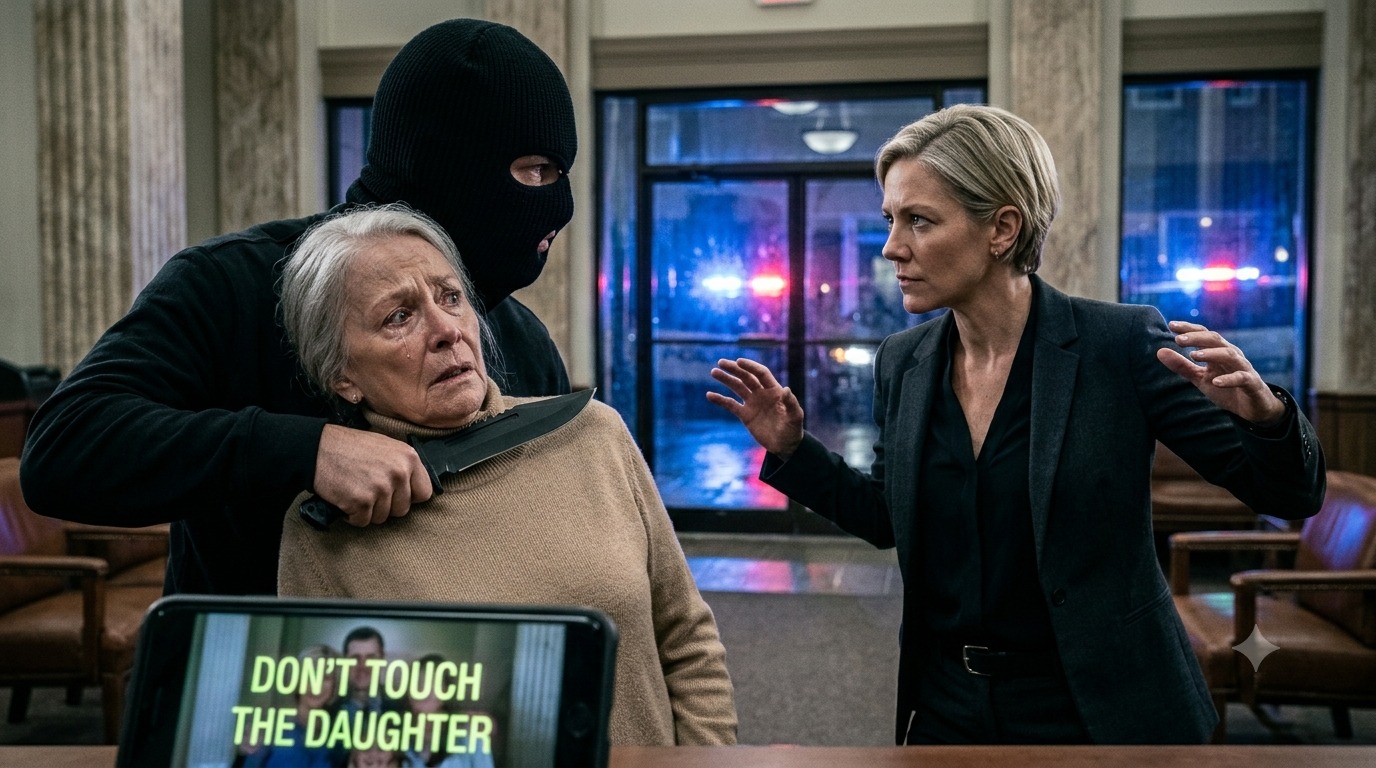
The serrated hunting knife was pressed so firmly against my mother’s throat that I could see the flesh indent with every erratic pulse of the man’s thumb.
“Get on your knees, you bitch!” he screamed through the mouth-slit of a black knit ski mask.
I didn’t drop. I raised both palms to chest level, fingers splayed wide, deliberately keeping my elbows slightly flared to signal absolute compliance while retaining my center of gravity.
My mother was seventy-two years old. Her silver hair was coming undone from its tortoiseshell clip, and her cardigan was trembling so hard against her chest that the brass buttons clicked together like small teeth.
“Mom,” I said, my voice dropping into that deep, flat cadence I had used during convoy ambushes in Helmand Province fifteen years ago. “Look right at my eyes. Keep your eyes on me. Everything is going to be fine.”
My name is Caroline Whitaker. I am forty-one years old, a Major in the United States Army currently attached to the logistics command at Fort Belvoir. For nearly nineteen years, my entire professional life has been dedicated to operating calmly while everything around me collapses into noise and blood.
Yet nothing in the manuals, nothing in the tactical simulators, prepares you for the sight of your own mother’s throat pressed against six inches of carbon steel under the fluorescent lighting of a suburban bank lobby.
The morning had begun with the small, sacred rituals of leave. I was staying in the small, red-brick ranch house off Amherst Street in Winchester, Virginia—the house my parents bought in 1982. Mom had made scrambled eggs, slightly charred the white toast in her vintage four-slice toaster, and insisted, as she did every six months, that her ancient Mr. Coffee drip machine produced a richer brew than anything sold in northern Virginia.
At 9:30 AM, she wiped her hands on a floral dish towel and reminded me of our appointment at the Shenandoah Community Bank on Valley Avenue. Her five-year certificate of deposit had reached maturity, and she wanted to review her rollover yields.
“You can sit in the truck, Caroline,” she had teased as I shifted the gear into park. “I’ve been writing checks and managing accounts since before you had teeth.”
“I’m already parked, Ruth,” I had replied, laughing as I stepped out into the crisp autumn air. “And you’ve been reminding me of that since my eighteenth birthday.”
Inside, the branch smelled of damp carpet, industrial lemon polish, and weak breakroom coffee. At 10:17 AM, Mom was chatting with an elderly acquaintance near the queue velvet ropes.
Then the front glass doors slammed back against the stone interior with the force of an explosion.
Three men. Black tactical balaclavas. Dark work jackets.
Two carried compact semi-automatic pistols. The third—a stocky man moving with awkward, frantic aggression—gripped an eight-inch tactical blade.
“Everybody down on the floor! Don’t touch your phones or you die!”
The lobby erupted into sheer terror. A woman holding a toddler shrieked; an elderly man dropped his cane. I lunged forward to hook my arm around Mom’s waist, but the knife-wielding man moved faster. He lunged around the divider, seized a fistful of Mom’s hair from behind, and yanked her backward into his chest.
She cried out—a small, choking whimper that made my blood drop thirty degrees in a microsecond.
Her reading glasses fell to the carpet. The right lens cracked into a white web against the fibers.
“Get the manager out here!” the man holding Mom roared, his blade digging beneath her ear. “Open the vault, or I open her neck right now!”
The branch manager, pale and trembling in a navy suit, stepped out with his hands raised. “Sir, please! The time-locks… there are secondary security delays, nobody needs to get hurt—”
The robber shifted his weight, and a thin, bright crimson line welled up on the pale skin beneath Mom’s jawline.
Every muscle in my body coiled like a high-tension cable. My military training screamed for action, but the spatial calculus was hopeless: ten feet of open linoleum, two gunmen covering the perimeter, and a trembling blade resting directly over her carotid artery.
“You!” the knife-man barked at me, his eyes bloodshot behind the wool. “On your knees!”
“I’m not reaching for a weapon,” I said, taking half an inch of forward ground. “Let her go. Take me instead. She’s seventy-two years old.”
“Shut your mouth!” he screamed, jerking Mom again.
And then, the mask of military restraint I had worn for nineteen years split open.
I looked through the eyeholes of that black mask, locked directly onto his pupils, and whispered:
“You have three seconds to pray.”
He blinked. “What did you say?!”
Before he could process the threat, the gunman watching the street shouted from the glass doors: “Cops! Unit turning in from the boulevard! Move, move, move!”
Panic detonated. The man holding Mom flinched toward the exit. His grip on her collar loosened for a fraction of a second.
Mom stumbled sideways, crashing heavily against an oak armchair.
I threw myself across the carpet, covering her body with my own, wrapping my arms over her neck as boots pounded across the linoleum. Outside, tires shrieked against the asphalt. A gunshot cracked in the alleyway.
Sirens flooded the parking lot within seconds. Winchester police officers breached the entryway, carbines raised, shouting commands.
Only when the lobby was fully locked down did I sit Mom upright against my knees.
There was blood on her white collar. Her left wrist was swelling rapidly, darkening into an angry purple bruise.
“Caroline,” she gasped, her cold fingers clutching my forearm. “Caroline, you scared me.”
“I scared you?” I breathed, my forehead pressed against hers, my hands shaking uncontrollably as the adrenaline began to withdraw. “You scared me to death, Mom.”
By 1:00 PM at Winchester Medical Center, the emergency room physician confirmed that Mom’s wrist was severely sprained rather than fractured. The laceration on her neck was cleaned, stitched with three butterfly strips, and bandaged.
Detective Lena Ortiz, lead investigator for the Winchester Police Department, met us in the private consultation cubicle. She was a compact, sharp-featured detective with a dark ponytail, tired brown eyes, and a notepad already filled with witness notes.
“One suspect was apprehended two blocks away after tossing a weapon in a dumpster,” Detective Ortiz told us. “The other two managed to get into a stolen gray sedan that was later found abandoned near the bypass. We are reviewing traffic cameras now.”
Mom sat on the edge of the examination bed, holding an untouched paper cup of ginger ale with her good hand.
“Detective,” Mom said quietly, her voice unusually small. “There is something you need to write down.”
Detective Ortiz looked up, her pen poised. “Yes, Mrs. Whitaker?”
“The young man who grabbed me with the knife… he knew my name.”
The room went tomb-silent.
I turned from the window, staring at her. “Mom, you told me that earlier, but are you absolutely certain? The bank lobby was pandemonium.”
Mom looked at me with the quiet, unshakeable stubbornness that had carried her through thirty-four years as a public school administrator.
“Caroline, I have answered to the name Ruth for seventy-two years,” she said evenly. “When that boy caught my hair and pulled me backward, right before he started screaming about the vault, he leaned his face into my ear and whispered: ‘Easy, Ruth. Don’t make this harder than it has to be.’ He said it before anyone in that lobby opened their mouth.”
Detective Ortiz’s pen hovered over the page. “Did the voice sound familiar, Mrs. Whitaker? Did he have an accent?”
“Local,” Mom answered. “Shenandoah Valley. Nothing distinct. But he smelled like stale menthol cigarettes, and he kept twitching his left arm, pulling at his sleeve.”
Ortiz took down my separate statement in the hallway, pressing me on my tactical assessment of their behavior. When she asked why I told the robber he had three seconds to pray, I met her gaze without flinching.
“Because if his knife had cut her carotid, Detective, I would have had three seconds to crush his windpipe before she bled out.”
Ortiz studied my uniform ribbons, nodded slowly, and closed her notebook. “Understood, Major. Go home and take care of your mother.”
We returned to the brick ranch on Amherst Street around 4:30 PM.
The house was peaceful, but the peace felt fragile—like thin ice over deep water. I heated canned tomato soup, toasted fresh sourdough on the griddle, and made sure Mom took her anti-inflammatory medication.
Around 6:30 PM, the front door knocker sounded.
Mom flinched so violently that she knocked a salt shaker onto the floor. I placed my hand on her shoulder, walked into the entryway, and looked through the brass peephole.
Standing on the porch steps in the twilight was Earl Pritchard.
He was holding two brown paper grocery bags in one arm and a cellophane-wrapped bouquet of white carnations in the other. Earl was sixty-six years old, barrel-chested, with thinning silver hair and the hearty, resonant baritone of a man who served on three church administrative committees. He had been my father’s hunting partner, his lodge brother, and his closest friend for more than three decades.
When Dad passed away six years ago from congestive heart failure, Earl had stepped into the breach: he shoveled Mom’s walk in the winter, cleared the storm gutters, and served as the court-appointed executor of Dad’s estate.
“Caroline!” Earl exclaimed as I unlocked the deadbolt. “Thank God you’re both alright! I heard the sirens on the scanner, and my heart nearly stopped!”
He stepped into the kitchen, setting the grocery sacks down on the laminate island. He had brought roasted chicken from the deli, fresh cloverleaf rolls, and a box of bakery lemon shortbread cookies.
He wrapped Mom in a gentle, paternal embrace, taking care not to bump her splinted left wrist.
“Ruthie,” Earl sighed, his voice thick with emotion. “I can’t believe this happened in broad daylight. This town is falling apart.”
For fifteen minutes, he was the same dependable Uncle Earl I had known since childhood. He offered to replace the loose handrail on the basement stairs; he complained about the city council’s road resurfacing delays; he checked the battery in Mom’s hallway smoke detector.
Then, while peeling the plastic film off the deli chicken, Earl casually paused and looked up.
“Did those animals manage to force their way into your safety deposit box, Ruth?”
Mom blinked, looking up from her tea. “My safety deposit box? No, Earl. They were screaming about the cash vault. They never went near the safe deposit boxes.”
I leaned against the doorframe, watching Earl’s shoulders.
I didn’t say a word. But the military logician inside my brain logged the anomaly instantly: The evening news reports had only mentioned an attempted armed robbery in the teller lobby. No one in the press, and no one in the bank, had ever mentioned the safe deposit vault.
“Good,” Earl said, exhaling a quick, audible sigh of relief as he wiped his fingers on a paper napkin. “Good. That’s a blessing. I know you keep your father’s land deeds and the original insurance policies locked up in that drawer. Well, I won’t wear you two out tonight. You call my cell if you need anything at all.”
After his sedan backed down the driveway, I stood in the kitchen looking at the carnations in the glass jar.
“Mom,” I asked quietly. “Why would Earl ask about your safety deposit box?”
“He helped me inventory your father’s personal effects after the funeral,” she replied, massaging her aching wrist. “We took the original deed to the forty-two acres out in Frederick County and put it in the bank box along with the burial policies.”
“Does Earl have a signature card for that box?”
“No,” Mom said firmly. “It’s in my name alone. Why are you looking at me with that police-interrogation face, Caroline?”
“Just keeping the timeline straight,” I murmured.
At 11:15 the following morning, Detective Lena Ortiz called my personal cell phone.
I stepped into the quiet hallway, closing the kitchen door behind me. “Major Whitaker.”
“Major, we processed the suspect who was apprehended behind the auto shop,” Ortiz said, her tone professional, measured, and distinctly uneasy. “His name is Dylan Pritchard. Thirty-four years old. Local Winchester resident.”
The air in my lungs turned to liquid nitrogen.
Pritchard.
“Earl Pritchard’s nephew?” I asked, my voice dropping an octave.
“Yes,” Ortiz confirmed. “Fingerprint identification is definitive. We have him in the county detention center on three counts of armed bank robbery and felony assault. Did you know him?”
“I watched him pitch in the Little League finals when I was in high school,” I whispered, staring through the hallway toward the living room where my father’s portrait hung above the mantel. “His uncle was in our kitchen twelve hours ago bringing my mother deli chicken.”
Ortiz paused. “Major, do not contact Earl Pritchard. We are running cell tower dumps and financial audits on Dylan right now. Keep your mother in the house.”
I hung up, leaning my forehead against the cool drywall of the hallway.
Earl Pritchard. The man who had given the eulogy at my father’s funeral. The man who sat at our Thanksgiving table when I was ten years old.
I walked back into the kitchen. Mom was sitting at the table, her glasses perched on her nose, slowly turning the pages of an old spiral address book with her good hand.
“Mom,” I said gently, sitting across from her. “The detective called. They identified the man who was arrested.”
She looked up, smiling faintly. “Did they? Some drifter from Interstate 81?”
“No, Mom. It was Dylan. Earl’s nephew.”
Her coffee mug froze an inch above the saucer. For three seconds, she simply stared at me, her mind violently rejecting the information.
“Dylan?” she stammered, her voice trembling. “No… that’s impossible. Dylan used to come here with his mother to pick blackberries in the summer. Your father taught that boy how to grease a tractor wheel. He was reckless with money, sure, but… robbing a bank? Putting a knife to my neck?”
“He wasn’t the one with the knife,” I said, reciting what Ortiz had logged. “Dylan was the getaway driver who bailed out early. But he was in that car.”
Before Mom could process the horror, the landline on the wall rang.
Mom reached for it instinctively before I could intercept. I moved beside her, pressing my ear close to the plastic handset.
Earl’s voice came through the receiver, choked with theatrical, agonized grief:
“Ruthie… oh God, Ruthie, have you heard? The sheriff’s office just called my house. It was Dylan. My sister’s boy. I am so sick to my stomach I can barely stand on my feet.”
Mom looked at me, her eyes wide with shock. “Earl… we just found out.”
“I haven’t spoken to that boy in seven months, Ruth!” Earl wept, his baritone cracking convincingly. “He’s been running with meth addicts down in Front Royal, gambling on sports, drowning in debts. If I had known he was even in Frederick County, I would have dragged him to the precinct myself! I am so sorry… so profoundly sorry that his filth touched you.”
Mom exhaled, her shoulders slumping with immediate relief. “Oh, Earl. You can’t be held responsible for what your grown nephew does. You’ve been good to us.”
I stood beside her, watching her face soften, feeling an overwhelming surge of dread.
Earl was building his alibi before the police even knocked on his door.
That afternoon, while Mom slept off the effects of her painkillers in the back bedroom, I pulled the green expanding file labeled “Thomas Whitaker — Estate” from the bottom of the hallway cedar chest.
Dad had been an obsessive record-keeper. He had receipts for roofing shingles from 1994, maintenance logs for his riding mower, and handwritten notes explaining insurance deductible changes.
Tucked into the very back pocket, behind the funeral invoices, was a white envelope postmarked six weeks earlier from Old Dominion Title & Escrow in Winchester.
I unfolded the letter. It was an initial title commitment inquiry regarding a proposed commercial conveyance of Parcel 44-B: forty-two acres of rolling timberland and pasture off Cedar Creek Grade.
The land had been in the Whitaker family since 1912. My grandfather had farmed it; my father had hunted deer on it; and my mother had repeatedly told me that she wanted the property kept pristine until she passed it to me.
According to the title document, a formal purchase offer had been submitted by an entity called Blue Ridge Development Holdings LLC for the amount of $420,000.00.
Listed as the designated seller’s representative and primary contact point was Earl Pritchard, Agent-in-Fact.
My pulse hammered in my temples.
I took the letter into the bedroom. Mom woke up as the door clicked, blinking against the afternoon light.
“Mom,” I said, holding up the letter. “Did you authorize Earl to put Grandpa’s forty-two acres on the market?”
She pushed herself up against the pillows, squinting at the paper. “What? Caroline, don’t be ridiculous. That land is yours. I would never sell your father’s land.”
“Then why is your name listed on a purchase agreement from six weeks ago?”
Mom took the paper, her reading glasses sliding down her nose. As she read, her brow furrowed into deep, bewildered lines.
“Earl brought some estate papers over back in May,” she whispered, her voice faltering. “He said there were leftover administrative filings from your father’s tax returns. He had three or four pages with yellow signature tabs. He said it was standard closure paperwork.”
“Did you read every page, Mom?”
She looked down at her hands, her chin quivering. “Caroline… I trusted him. He was your father’s executor. He took care of the probate court when I could barely get out of bed.”
I didn’t yell. I sat on the edge of the mattress, took her uninjured hand, and kissed her knuckles.
“Get dressed, Mom. We’re going to see an attorney.”
At 3:30 PM, we sat in the wood-paneled office of Martin Kessler, a veteran property and probate attorney whose practice had operated near the Frederick County Courthouse for forty years.
Kessler examined the title commitment, ran a search on the county land records database, and pulled up the instrument Earl had utilized: a Limited Durable Power of Attorney signed by my mother six years ago, two weeks after my father’s funeral.
“Mrs. Whitaker,” Kessler said, peering over his spectacles, “this power of attorney was strictly drafting to allow Earl to execute vehicle transfers, close bank accounts with balances under five thousand dollars, and file your late husband’s final municipal tax returns. It contains no statutory power to convey, encumber, or liquidate real property.”
“Then how could he sell the land?” I asked.
“He couldn’t,” Kessler replied flatly. “The title company caught the defect. They issued a formal title objection three weeks ago, demanding that Earl produce either a General Power of Attorney with specific real estate conveyance powers, or the original, unencumbered physical deed signed directly by Ruth Whitaker.”
Kessler tapped his desk blotter.
“And where was that original physical deed located, Mrs. Whitaker?”
Mom’s face went the color of skim milk. “In my safety deposit box at Shenandoah Community Bank.”
The puzzle pieces snapped together with terrifying, hydraulic clarity.
Earl didn’t just stumble into asking about the safety deposit box.
He had tried to sell the land out from under my mother using an expired, limited document. When the title company refused to close without the physical deed, he hit a stone wall. He couldn’t forge her signature on a new deed without an in-person notary.
He needed that box opened. And he needed it opened without my mother realizing what was being removed.
That evening, the phone rang in our kitchen at 7:40 PM.
It was Sharon Bell, a retired head teller from the bank who had sung in the Methodist choir with Mom for thirty years.
“Ruthie,” Sharon said, her voice dropping to a conspiratorial murmur through the speakerphone. “I’ve been sick with worry since Tuesday. But there’s something that has been eating at my conscience, and my husband told me I had to tell you.”
“What is it, Sharon?” Mom asked.
“Three weeks ago, on a Thursday morning, Earl Pritchard stopped me outside the pharmacy on Pleasant Valley Road,” Sharon said. “He bought me a coffee, asked how my retirement was going, and then he started asking very specific questions about the security protocols at the Shenandoah branch.”
My hand gripped my legal pad. “What did he ask, Mrs. Bell?”
“He asked if the branch still kept the master safe deposit keys in the secondary teller cabinet during morning hours,” Sharon whispered. “And then, right before he left, he asked if Ruth still came in every single Tuesday morning at ten o’clock sharp to do her banking. He said he wanted to surprise her with lunch.”
Mom sat motionless, her hand hovering over the receiver, her face completely devastated.
“Thank you, Sharon,” I said gently. “Please don’t discuss this with anyone else.”
The line disconnected. The old wall clock in the kitchen ticked with brutal regularity: tick, tick, tick.
“Why would he do this to us, Caroline?” Mom whispered, the tears finally cutting tracks through her makeup. “Your father would have died for that man.”
“Money, Mom,” I answered, pulling up my laptop. “When people are desperate, loyalty is the first thing they sell.”
On Friday morning, Kessler pulled public civil litigation filings from the Shenandoah County Clerk’s office:
- Pritchard Construction & Grading LLC had defaulted on three separate heavy equipment leases totaling $210,000.00.
- A concrete supplier in Hagerstown had secured an active mechanics’ lien against Earl’s personal residence.
- A private commercial hard-money lender had initiated foreclosure proceedings on his warehouse on Route 11, with a final cure deadline of October 31st.
Earl wasn’t merely short on cash. His entire life’s work was thirty days away from complete liquidation.
At 2:15 PM, Detective Lena Ortiz called my phone.
“Major Whitaker, we executed a search warrant on Dylan Pritchard’s smartphone and his apartment in Stephens City.”
“Did you find the connection to Earl?”
“It’s worse than that, Caroline,” Ortiz said, her voice taut with grim intensity. “We recovered a series of encrypted Signal messages sent to Dylan’s burner device at 9:15 PM on Monday night—the night before the robbery.”
“What did the message say, Detective?”
Ortiz exhaled through the receiver.
“The sender texted: ‘Ruth will be at the teller counter at 10:15 AM sharp. Take the keys from her purse. Grab the green tin box from vault drawer 142. Do not touch the daughter. She’s an active Major—if you touch her, the feds will tear this county apart.'”
The room spun.
Do not touch the daughter.
Earl knew my leave schedule. He knew I had driven up from Fort Belvoir on Sunday afternoon. He had known Mom’s Tuesday morning routine down to the minute.
He didn’t want the bank’s money. He had recruited his degenerate nephew and two street thugs to execute an armed smash-and-grab inside the vault, using the chaos of a takeover robbery to steal Mom’s safe deposit box and snatch the forty-two-acre family deed.
He had calculated that an eighty-year-old bank would assume the deed was lost or stolen in the general confusion. He would then produce his fraudulent purchase agreement, claim the original deed was delivered to him by Ruth prior to the incident, and pocket the $420,000 cash buyout from the developers to pay off his loans before anyone uncovered the fraud.
He was willing to hold a hunting knife to my mother’s throat to keep his commercial warehouse.
“We are obtaining a felony arrest warrant for Earl right now,” Ortiz told me. “Conspiracy to commit armed robbery, kidnapping, and commercial wire fraud. But he’s not at his house, and his truck isn’t at his commercial yard. We have units watching the interstate.”
“He’s coming here,” I said, my voice dead, flat, and absolute.
“Major, do not engage him,” Ortiz ordered. “I’m dispatching two marked units to your address right now.”
“He’s coming here because he knows the title company gave us the inquiry letter,” I said, looking out the front window at the quiet autumn street. “He knows the net is closing. And he needs to know how much Ruth told the police.”
I hung up the phone.
I didn’t panic. I went into the back bedroom, opened my military duffel bag, and pulled out my issued tactical boots. I laced them tight.
I walked into the kitchen, brought Mom into the back study, closed the heavy oak door, and locked it from the outside.
“Mom,” I said through the keyhole. “Stay on the floor behind Dad’s cedar desk. Do not open this door until you hear my voice.”
“Caroline, please be careful,” she wept softly.
At 4:45 PM, a familiar gray Ford F-250 diesel rumbled up the curb, parking directly behind my sedan.
The engine shut off. Earl Pritchard stepped down onto the asphalt.
He wasn’t carrying groceries this time. He was wearing an olive-drab work jacket, his silver hair windblown, his hands shoved deep into his pockets. He walked up the concrete steps and pushed through the storm door without knocking.
He stepped into the hallway.
I was standing at the end of the corridor, beneath the framed photograph of him and my father laughing at the Fourth of July barbecue.
“Caroline,” Earl said, his voice unusually tight, his eyes darting across the empty living room. “Where’s your mama?”
“She’s resting, Earl,” I said, taking two slow, deliberate steps forward. “Her wrist hurts.”
Earl stepped into the kitchen, glancing around the counters. “I just came from town. I heard some… disturbing rumors. People are saying the police are asking questions about me down at the courthouse.”
“Are they?”
“Caroline, you know me,” he said, his voice rising, taking on that frantic, theatrical preacher’s timber. “I loved your father like my own flesh! I would never hurt this family! Someone is setting me up! Dylan is lying to save his own skin!”
I reached into my pocket, pulled out the printed title commitment letter from Old Dominion Title, and laid it flat on the laminate island between us.
Beside it, I laid the screenshot of the text message Detective Ortiz had forwarded to my phone:
“Ruth will be at the counter at 10:15 AM sharp. Grab the green tin box from vault drawer 142. Do not touch the daughter.”
Earl looked down at the paper.
Every trace of color, every drop of theatrical indignation, drained out of his weathered face. His jaw went slack. The heavy, broad-shouldered man seemed to shrink by three inches inside his canvas jacket.
“You tried to sell my grandfather’s land to Blue Ridge Development,” I whispered, each word dropping like an iron weight into the silence. “And when the title company demanded the original deed from drawer 142, you sent three junkies with knives into a public bank to rob your best friend’s widow.”
Earl’s breathing turned into a ragged, wet wheeze. “Caroline… you don’t understand the pressure… they were going to take everything I built… the warehouse, my father’s equipment… I was going to pay her back! I swear to Almighty God, I was going to put the money into an annuity for her!”
“You put a knife to my mother’s throat, Earl.”
His right hand twitched inside his jacket pocket.
In my world, when a suspect’s hand drops below the waistline during a confrontation, you do not wait to see what emerges.
Earl’s fingers began to pull a small, snub-nosed .38 revolver from his coat lining.
I didn’t draw a weapon. I took two explosive forward strides, bridged the five-foot gap before his elbow could clear his ribs, seized his right wrist with both hands, and drove my thumbs into the radial nerve cluster while pivoting my hips.
The mechanics were second nature.
Earl gasped as the nerve fired white-hot pain down his arm. The heavy steel revolver slipped from his numb fingers, clattering uselessly against the kitchen linoleum.
Before he could regain his footing, I leveraged his arm over my shoulder, swept his left ankle with the heel of my boot, and slammed his two-hundred-and-twenty-pound frame face-down onto the floorboards.
I dropped my knee directly onto the hinge of his shoulder blade, pinning his arm behind his back in a combat restraint, and drove his cheek hard into the kitchen floor.
Earl groaned, his face pressed against the wax paper crumbs of the lemon cookies he had brought us forty-eight hours ago.
“Thomas…” Earl wheezed into the floorboards, tears of agony and terror spilling into his silver sideburns. “Thomas would never… have let you do this to me…”
I leaned down until my lips were two inches from his ear.
“My father died six years ago, Earl,” I whispered with absolute, freezing clarity. “And the only mistake he ever made in this life was thinking you were a man of honor.”
Outside, the wail of sirens ripped through the neighborhood.
Blue and red strobe lights painted the kitchen walls, reflecting off the glass jar of white carnations on the counter.
The front storm door burst open. Detective Lena Ortiz and two uniformed Winchester officers rushed into the hallway, sidearms drawn.
“Major!” Ortiz shouted.
“Subject is disarmed and secured,” I announced, never shifting an ounce of pressure from his shoulder. “Weapon is on the floor beside the refrigerator.”
One of the officers stepped forward, ratcheting heavy steel handcuffs around Earl Pritchard’s thick wrists.
Only when the cuffs clicked shut did I stand up, straighten my sweater, and walk down the quiet hallway to unlock the study door.
Mom was sitting behind the cedar desk, her hands folded in her lap, her eyes clear, dry, and resolute.
“Is it over, Caroline?” she asked softly.
“It’s over, Mom,” I said, kneeling beside her and wrapping my arms around her shoulders. “He’s gone.”
Six months later, in the warm, blooming spring of 2027, the grand jury of Frederick County returned a fourteen-count indictment against Earl Pritchard and his co-conspirators.
Faced with the forensic cell phone extraction, the recorded title company testimonies, and Dylan Pritchard’s state plea agreement, Earl entered a guilty plea to Conspiracy to Commit Armed Bank Robbery, Attempted Grand Larceny, and Assault with a Deadly Weapon.
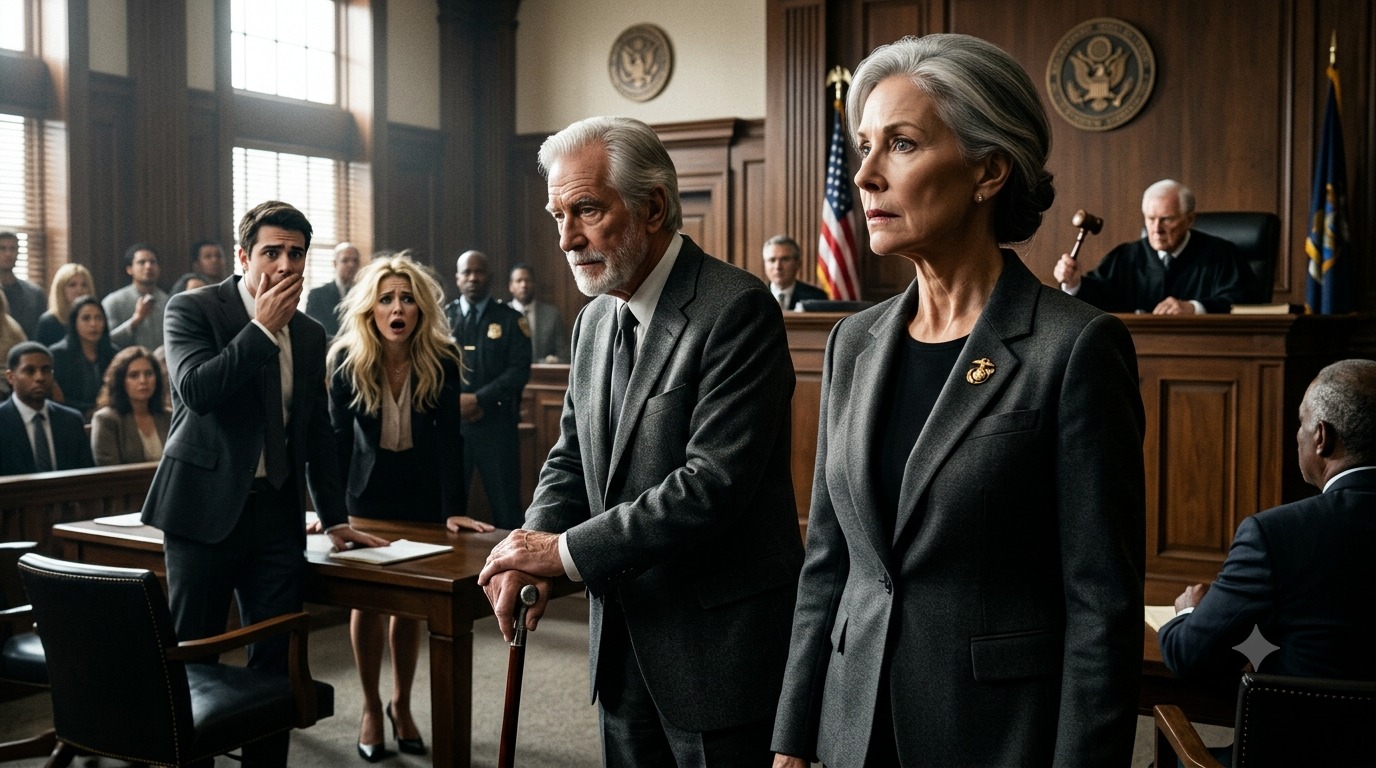
At the sentencing hearing in Winchester, Earl sat at the defense table in a bright orange corrections jumpsuit, his head bowed, his once-imposing frame withered by months in the regional jail.
Mom declined to give a spoken victim impact statement.
Instead, she sat upright in the second row of the courtroom gallery, wearing her good navy cardigan and her repaired glasses. She didn’t look at Earl with hatred. She looked at him with that quiet, devastating pity that only an elementary school principal can muster for a child who has permanently ruined his own life.
The judge handed down a sentence of twenty-two years in the Virginia Department of Corrections, with no eligibility for discretionary parole.
On a radiant Saturday afternoon in late May, Mom and I drove out to Parcel 44-B in my pickup truck.
The forty-two acres of rolling Shenandoah timberland were alive with the vibrant green of mountain laurel and blossoming dogwoods. In the distance, the soft blue silhouettes of the Blue Ridge Mountains stood ancient, unmoving, and pristine against the bright Virginia sky.
We walked along the old tractor road until we reached the stone overlook where my father had built a wooden bench overlooking the creek.
Mom’s wrist had healed completely. The small pink scar beneath her jawline was barely visible—a tiny line that was already fading into the soft creases of her neck.
She sat down on the weathered cedar boards, breathing in the sweet scent of damp pine needles and wild clover.
“Your father loved this ridge,” she said, her voice carrying lightly on the mountain wind. “He used to say that people come and go, but the land remembers who treated it with respect.”
I sat beside her, resting my arm around the back of the bench.
“It’s titled in your name, Mom. And when the time comes, it will stay in this family.”
Mom turned toward me, reached up with her good hand, and tapped my cheek with two fingers, smiling that warm, unshakeable smile that had guided me through forty-one years of life.
“You know, Caroline,” she said with a soft chuckle. “You’re entirely too bossy for a girl who used to burn the microwave popcorn.”
I threw my head back and laughed—a loud, clear, unburdened sound that echoed down the valley and rolled across the unbroken hills of home.