

My parents joined our homeowners association board in June, and by the middle of September, I had fourteen violation letters stacked inside a cardboard shoebox and a mother who waved at me from her front porch every single morning.
Two fingers lifted off her ceramic coffee mug. Exactly 6:40 AM. Thirty feet across the neat strip of St. Augustine grass dividing our driveways.
Those fourteen letters cost me three thousand one hundred and forty dollars. One of them cost me my grandmother’s harbor-blue front door, which I was forced to roll over with three coats of flat, lifeless beige because the board cited it as an unapproved architectural alteration. The fourteenth letter threatened a statutory lien against the very house I had purchased four years earlier specifically to be close to my father after his debilitating stroke.
I paid every single assessment. I wrote the violation letter number on the memo line of every check in my tight, mechanical cursive, and I never uttered a word of protest. Because in the Pruitt household, the person who speaks up about the fire is always accused of holding the match.
My name is Lee Ann Pruitt. I am forty-six years old. For twenty-two years, I have worked as an official freelance court reporter in the civil litigation district of San Antonio, Texas. My entire professional existence consists of sitting at the quiet end of a polished mahogany conference table, resting my fingers on a computerized stenotype machine, and transcribing exactly what other human beings say at two hundred and twenty-five words a minute.
I do not react. I do not grimace. When a corrupt corporate director lies under oath, I capture the lie verbatim. When a ruthless trial attorney bullies an injured plaintiff, I spell the cruelty with absolute orthographic precision. The only phrase I am legally permitted to inject into the official record is: “Excuse me, Counsel, could you please repeat that?”
I am exceptionally good at making a room full of combative people forget I exist. The fatal miscalculation my mother made that summer was assuming that silence in a woman is the same thing as ignorance.
The fourteenth letter was waiting inside my curbside mailbox on the third Friday of September, tucked neatly beneath a supermarket coupon circular. It was housed in the identical, heavy cream-colored legal envelope as the thirteen that preceded it. No ninety-cent postage stamp. No United States Postal Service cancellation mark. Just my printed address—412 Cedar Hollow Lane—affixed with an adhesive laser label, and the green ink pine tree logo of the Cedar Hollow Homeowners Association stamped in the upper left-hand corner.
I opened the envelope standing on the asphalt curb because I had learned over the summer that carrying those letters into the house unopened only stretched out the agony of the walk to the kitchen.
SPECIAL ENFORCEMENT ASSESSMENT
RE: PATTERN OF CONTINUED PROPERTY NON-COMPLIANCE
PENALTY LEVIED: $1,500.00
DUE DATE: Within ten (10) calendar days of notice.
Failure to remit full payment will result in the immediate filing of an encumbrance lien against the real property at 412 Cedar Hollow Lane.
Signed,
Darlene Pruitt, President, Board of Directors
Walter Pruitt, Secretary, Board of Directors
My father’s signature at the bottom was cramped and shaky, the unmistakable neurological aftermath of the ischemic stroke that had paralyzed his right side five years ago. I had spent four months trying to decide whether his trembling hand had actually held the pen, or if my mother had simply dragged his limp fingers across the signature block to manufacture a legal quorum.
“Everything alright over there, honey?”
My mother’s voice floated across the lawn. It was warm, melodic, and carried effortlessly on the humid Texas air. She was standing on the porch of 416 Cedar Hollow, tilting a green plastic watering can over her hanging Boston ferns. She had been standing there when I pulled my sedan into the drive. She was always standing there.
“Everything’s fine, Mom,” I called back, my voice flat as plywood.
“You know the board simply cannot play favorites, Lee Ann,” she said, smoothing down the front of her floral housecoat. “Standards are what keep this neighborhood respectable.”
I folded the heavy cream stock back into its envelope, walked through my front door, and headed straight for the hallway linen closet. On the floor sat a blue cardboard shoebox that had originally held a pair of size-8 leather work loafers.
I carried the box to the kitchen island, tipped it over, and arranged the contents in chronological order, exactly the way I index evidentiary exhibits prior to a federal deposition.
- Letter 1 (July 14): Unauthorized exterior color palette (Front Door). Fine: $100.00.
- Letters 2, 5, and 11: Sanitation containers visible from municipal roadway. Fines: $50.00, $100.00, and $150.00.
- Letter 6: Turf grass height exceeding maximum allowance of 5.0 inches. (My mother had personally stepped across the property line on a Tuesday morning with an oak yardstick from her sewing room to measure my front berm at 5.5 inches; I watched her kneel in the grass from my upstairs home office). Fine: $200.00.
- Letter 9: Commercial guest vehicle parked in driveway overnight. (This was my twenty-year-old son Caleb’s battered 2011 Toyota Corolla when he visited for Labor Day weekend). Fine: $250.00.
- Letters 3, 4, 7, 8, 10, 12, and 13: A garden hose left connected to the spigot overnight; an unseasonal decorative autumn wreath displayed six days prior to September 1st; a dark oil droplet the size of a fifty-cent piece on the concrete driveway; an unapproved warm-white porch bulb exceeding the recommended sixty-watt luminosity.
Every single time a letter appeared, I remediated the cited condition immediately. I hauled the plastic rolling bins behind the cedar fence before 5:00 AM. I mowed the front lawn at seven in the evening in ninety-eight-degree August humidity. I scrubbed the oil droplet from the driveway using degreaser and non-clumping cat litter.
And every single time, I sat at my table and wrote a personal cashier’s check.
Thirteen checks totaling $1,640.00. On the memo line of every check, I carefully noted the infraction tracking number: Letter #1, Letter #5, Letter #12. It is an unbreakable reflex from twenty-two years in the legal system: If it is not entered into the physical record, it legally did not occur.
That money had been painstakingly carved out of a savings account labeled “Caleb — Spring Semester.” Caleb was a junior studying mechanical engineering at the University of Texas at Austin, and the bursar’s office did not grant extensions because a suburban homeowners association had decided to turn his mother into a target.
I picked up my pen and wrote check number fourteen: $1,500.00.
Memo line: Letter #14 — Special Assessment.
My pen hovered over the date line for nearly thirty seconds. In the quiet kitchen, the hum of the refrigerator sounded deafening. A question surfaced from the deepest, most exhausted corner of my mind: How many checks does it take to buy your own family’s permission to exist?
I signed it. That brought my summer total to $3,140.00.
I looked out the narrow leaded-glass window beside my entryway at the exterior door. It was coated in three thick layers of paint called Sandstone Desert—a flat, joyless tan that was the exact color of dust and submission.
For six years before that July, the door had been painted Harbor Blue.
In truth, it had been blue for most of my conscious life. My paternal grandmother, Opal Pruitt, had owned a modest wood-frame house down in Seguin with an ancient pecan tree that dropped nuts onto the tin roof every autumn with a sound like someone gently rapping on the door. Her front door was painted Harbor Blue.
When I was nine years old, Grandma Opal gave me a short-bristled brush, and together we repainted that heavy cedar slab. I ended up with more sticky blue enamel on my canvas sneakers than on the wood, but she just threw her head back and laughed, wiping my nose with an old rag soaked in mineral spirits.
“A front door ought to tell folks you’re glad they arrived, Lee Ann,” she had told me. “It ought to look like an open sky.”
At Grandma Opal’s house, I never had to perform. I never had to apologize for taking up space. I just had to step across the threshold.
My mother detested her. Grandma Opal was my father’s mother, and she possessed an uncompromising habit of saying precisely what she meant at the Sunday dinner table—a trait my mother classified as a vulgar character defect.
The blueprint for my entire adult relationship with my family was drafted during the sweltering summer of 1996, when I was sixteen years old.
I had spent three grueling months working double shifts as a busser and line server at a hickory pit barbecue joint off Interstate 35. My uniform smelled permanently of mesquite smoke and pork grease. Every night, I took my crumpled cash tips, flattened them out against my desk, and tucked them inside a Maxwell House coffee can hidden beneath the floorboards under my twin bed.
I was saving to buy a maroon 1988 Honda Civic hatchback that an elderly deacon at our church was selling for $2,400. It had manual roll-up windows, no functioning air conditioning, and a dent in the passenger quarter-panel, but to me, it represented unconditional freedom. By the second week of August, I had counted out $2,180.00.
One humid Tuesday afternoon, I came home from a twelve-hour shift, pulled up the edge of the carpet, and lifted the lid of the can.
It was completely empty.
I walked into the laundry room, where my mother was methodically folding white bath towels.
“Mom, where’s my car money?”
She didn’t stop folding. She smoothed the corner of a terrycloth washcloth against the laminate surface with her palms.
“It’s a family bridge loan, Lee Ann,” she said, her voice breezy and unbothered. “Your sister Kendra made the varsity competition cheer travel squad. The regional finals are in Orlando, Florida, at the Disney complex. The registration fees and the uniform packages were due by three o’clock today.”
My voice cracked down the center. “That was my money, Mom! I worked fifty hours a week for three months! That car was my only way to get to my college prep classes!”
My mother turned around, her eyes hardening into that cool, immovable wall I would come to know intimately over the next thirty years.
“Kendra is ten years old,” she said, her tone dripping with manufactured maternal wisdom. “A child only gets one childhood, Lee Ann. She has an extraordinary gift, and this family will not clip her wings. You are the strong one. You have always been dependable. You’ll earn it back before the school year starts.”
I screamed. I wept until my ribs ached. I ran down the hallway and slammed my bedroom door with such volcanic force that an oval framed print of the Last Supper fell off the drywall and shattered on the baseboards.
In the den, my father sat in his plaid armchair, reached for the remote control, and quietly turned up the volume on the evening news.
The money was never repaid. Not twenty dollars of it.
What was repaid, every single Thanksgiving dinner for the next twenty-five years, was the legend of my supposed selfishness. My mother transformed the incident into one of her signature comedic anecdotes: “The Great Honda Tantrum of 1996.”
She would imitate my teenage voice—shrill, frantic, and ridiculous—waving her hands around the table while aunts, uncles, and eventually Kendra’s husband roared with laughter over their sweet potato casserole.
“Lee Ann practically shook the foundation of the house over an old beat-up car,” Mom would say, chuckling into her iced tea. “While poor little Kendra just sat there in her cheer skirt, terrified her sister hated her.”
And every year, sitting at the end of the table, I smiled politely and laughed along with them. Because early on, I learned the iron law of the Pruitt family: If you push back against the family myth, you are automatically branded the monster who ruined the peace.
So I stopped pushing back.
I graduated from high school, went to stenography college, and entered a profession where my silence was not merely appreciated—it was legally mandated.
My marriage to Brent dissolved quietly in 2018. There were no affairs, no screaming matches, and no shattered dishes. We simply sat at our kitchen table in San Antonio one rainy evening after thirteen years, looked across a pile of unpaid utility notices, and realized that we had quietly functioned as polite, exhausted roommates for half a decade. Caleb was thirteen. I kept our modest two-bedroom townhouse, maintained my client accounts, and survived.
Then, in March of 2019, my mother called my cell phone at 5:15 in the morning.
My father had collapsed on the concrete floor of their detached garage. A massive left-hemisphere stroke. He survived the emergency craniotomy, but his mobility, his speech, and his cognitive endurance were permanently compromised. He required intensive rehabilitation: physical therapy sessions every Tuesday and Thursday morning, occupational retraining to hold a spoon, and someone with enough physical leverage to catch two hundred pounds of dead weight if his knee buckled on the wet bathroom tile.
“Kendra cannot possibly assist,” my mother declared over the hospital cafeteria coffee, not even looking at me. “She has two toddlers, and Gary’s corporate travel schedule is utterly brutal. You’re divorced now, Lee Ann. You don’t have anything holding you down.”
That June, the single-story brick ranch directly next door to my parents—412 Cedar Hollow Lane—went on the market following an estate sale.
I thought it was divine intervention. I liquidated my divorce settlement, took out a modest mortgage, and purchased the property for $268,000. It was titled solely in my name: Lee Ann Pruitt, a single woman.
For two full years, every Tuesday and Thursday at 8:00 AM, I backed my sedan into their driveway, helped my father into the passenger seat, and drove him thirty miles to the rehabilitation clinic in north San Antonio. While he spent ninety minutes learning how to lift a wooden dowel, I sat in the front seat with my steno machine balanced on my knees, editing litigation transcripts to keep my billing hours afloat.
I gave my mother a brass spare key to my front door for medical emergencies. I never asked for it back.
And the very first thing I did after unloading my moving boxes was buy a two-gallon bucket of exterior acrylic paint and restore the front door to Grandma Opal’s Harbor Blue. The previous HOA board approved the architectural request within seven days.
When my father turned seventy, our church hosted a celebration potluck in the fellowship hall. There was a sheet cake decorated with frosting tools and a digital slideshow of his life.
My mother stood up before eighty parishioners, tapped her iced tea glass with a butter knife, and offered a tearful tribute. But she didn’t mention the hundreds of hours in therapy waiting rooms. She didn’t mention the daughter who lived thirty feet away and lifted him off the floor when he fell.
She turned toward the center table and raised her glass high.
“To my precious baby girl, Kendra,” Mom proclaimed, her voice trembling with emotion. “The absolute angel who holds this entire family together with her unconditional love.”
Kendra—who had visited our father exactly three times that entire calendar year—blushed modestly, dabbed at her eyes with a lace handkerchief, and received a standing ovation from the church elders.
Later that afternoon, while I was rinsing punch glasses over the industrial sink in the church basement, an elderly woman from my mother’s prayer circle patted my arm with exaggerated pity.
“Your mama shared how you had to move back to the street after your marriage fell apart, darling,” the woman whispered softly. “Bless your heart. It is such a blessing that your parents were willing to take you back into the fold.”
I stood by the sink, holding a wet paper towel, and realized the narrative had already been set in concrete: My two years of round-the-clock labor and caretaking had been rewritten as my personal failure, while my presence was framed as an act of their saintly charity.
I swallowed the bile in my throat and stayed. I stayed because when I looked across the driveway at my father shuffling through the garden with his four-prong cane, I loved him. I convinced myself that being needed was close enough to being loved.
Then came Mother’s Day of this year.
The gathering took place around my mother’s formal mahogany dining table. Kendra had recently filed for a high-conflict divorce from Gary in April and had moved into my parents’ back guest bedroom along with her two children, aged eight and five.
The kids were running wild through the hallway, banging cabinet doors, while Kendra reclined on the sofa, scrolling through her phone and complaining about her temporary spousal support allowance.
After the pot roast was cleared, my mother brought out an iced sour-cream pound cake.
She sliced a thick piece, laid it on my plate, set her silver dessert fork down, and leaned her forearms onto the lace tablecloth.
“Lee Ann,” she began, using that soft, melodic voice she reserved for moments when she was about to ask someone to bleed for her. “Kendra is going through an unimaginable tragedy right now. She needs stability. The babies need their grandmother close by during this transition.”
I held my coffee cup halfway to my mouth. “Okay. What does that mean?”
“It means she needs somewhere permanent to land,” Mom said, smiling pleasantly. “Your house has the perfect three-bedroom floor plan for the children. You could sell the property to Kendra for what you paid for it back in 2019. A family rate. Two hundred and sixty-eight thousand. You’d walk away completely clean, with no real estate commissions, and you could move right back into a nice, maintenance-free condominium in San Antonio. You always loved the city, honey.”
Across the street, an identical brick ranch on Cedar Hollow Lane had closed three weeks earlier for $418,000.00.
My mother wasn’t asking for a favor. She was casually asking me to gift my younger sister one hundred and fifty thousand dollars in accrued home equity so Kendra wouldn’t have to adjust her lifestyle.
Kendra kept her eyes glued to her iPhone screen, chewing a piece of cake as if she were completely detached from the transaction.
At the head of the table, my father used his rocker knife to slice his cake into smaller and smaller microscopic squares, his eyes fixed firmly on his plate.
I took a slow sip of black coffee.
“No, Mom,” I said.
The word was not loud. It carried no theatrical venom. It was just a clean, monosyllabic syllable.
“Excuse me?” My mother’s smile froze around the edges.
“I said no,” I repeated, looking her dead in the eyes. “I live there. That is my home. I am not selling it.”
For nearly ten seconds, the dining room went completely vacuum-silent. In forty-six years, I don’t think I had ever uttered a flat, unqualified refusal to Darlene Pruitt without offering a three-paragraph defensive apology to soften the blow.
She didn’t raise her voice. She simply picked up her fork, took a deliberate bite of pound cake, and said: “Well. Does anyone care for another pot of decaf?”
We finished the afternoon discussing the church rummage sale. When I walked across the lawn to my house that evening, my chest felt lighter than it had in a decade. I genuinely believed the boundary had been established, respected, and concluded.
I was profoundly, catastrophically wrong.
Three weeks later, in mid-June, the annual general meeting notice for the Cedar Hollow Homeowners Association arrived in the mail.
Cedar Hollow was a quiet, master-planned enclave of thirty-eight single-family homes constructed in the mid-2000s. Nobody ever wanted to serve on the voluntary five-person board; meetings were historically held in neighbor’s living rooms, lasting twenty minutes, primarily to approve the lawn-mowing contract for the common retention basin.
At Sunday dinner the following week, my mother casually announced that she and my father had submitted their names for the two vacant board seats.
“We feel it’s time to give back to the community,” she declared, spooning green beans onto my father’s plate. “And it will force your daddy to put on proper trousers and get out of that recliner twice a month.”
At the annual meeting on June 28th, exactly nine lot owners showed up in the recreation room of the local firehouse. My parents cast their own ballots and secured two proxies from elderly neighbors down the block.
They won both open seats uncontested.
At the organizational board meeting on July 8th, Darlene Pruitt was appointed Board President, and Walter Pruitt was named Corporate Secretary.
I remember hugging my mother in the firehouse parking lot afterward, feeling a genuine surge of relief. I thought the administrative responsibilities would channel her frantic, controlling energy away from Kendra’s messy divorce, and give my father a sense of dignity after years of feeling useless.
Sixteen days later, Letter #1 arrived in my mailbox: Unapproved Exterior Door Color.
By the end of August, my life had devolved into a state of silent, psychological siege.
Every morning at 5:30 AM, my alarm sounded. By 6:40 AM, I was walking down my front steps with my steno case over my shoulder. And there, standing on the elevated porch of 416 Cedar Hollow in her quilted peach housecoat, was my mother.
Two fingers lifted from her ceramic mug. A sweet, neighborly nod.
I waved back. Every single morning, I waved back.
Once, as I backed my sedan into the street, I glanced into my rearview mirror and caught her leaning over her porch rail, holding her smartphone horizontally, carefully framing a digital photograph of my front lawn.
I told myself she was photographing the morning mist on her hydrangeas. I told myself she was texting a garden picture to Kendra. A person who spends her life accommodating bullies will invent extraordinary rationalizations just to avoid admitting that the person who gave them life is actively hunting them.
My professional life that summer was dominated by an eight-week contract dispute in federal district court involving an international pipeline conglomerate.
Day after day, I sat at the foot of the witness box while high-priced commercial trial lawyers argued over the placement of semicolons in commercial lease covenants. During one intense afternoon cross-examination, an elderly corporate litigator slid a thirty-page document across the table to a recalcitrant vice president who kept insisting that a critical warranty clause had been misunderstood.
The attorney leaned forward, tapped his gold pen against the paper with three sharp clicks, and said: “Counsel, the document says what it says. We are not here to debate your private intentions; we are here to enforce the text.”
I transcribed those words into the steno record: THE DOCUMENT SAYS WHAT IT SAYS.
That night, stuck in bumper-to-bumper traffic on Interstate 35 heading back to Cedar Hollow, those seven words kept looping through my consciousness like an earworm.
It suddenly occurred to me that I was performing the exact same function in my domestic life that I performed in the courtroom: I was sitting silently at the end of the table, absorbing the blows, entering the cruelty into my mental transcript, and refusing to speak a single word in my own defense.
The only difference was that in the courtroom, I was billing eighty-five dollars an hour for my silence. At home, it had cost me $3,140.00 and the blue door my grandmother loved.
On Saturday morning, September 13th, at 7:15 AM, I walked the fourteenth check down to the brick home at the end of the cul-de-sac belonging to Hank Odom.
Hank was the long-serving treasurer of the Cedar Hollow HOA. He was a seventy-two-year-old retired insurance claims adjuster with a silver crew cut, a steel-trap mind, and the immovable posture of a man who had spent forty-two years detecting arson fraud for state farm bureaus.
He was out on his front lawn in khaki shorts, dragging a garden hose around a bed of purple crape myrtles.
“Morning, Hank,” I said, stepping onto his driveway. “I brought by the payment for the September special assessment.”
Hank shut off the brass brass nozzle, wiped his palms on his shorts, and took the cream envelope from my hand. He slid his index finger under the flap, pulled out the cashier’s check, and stared down at the memo line.
“Letter number fourteen,” Hank read out loud, his gravelly voice devoid of inflection.
He slid the check into his breast pocket and tapped it twice with his thumb.
“You’re the most punctual property owner in this entire subdivision, Lee Ann,” Hank said, looking past my shoulder toward the street. “You’re also the only property owner whose checks I’m currently depositing into the association account.”
A cold prickle of alarm danced along the back of my neck. “What do you mean, Hank? Is the neighborhood delinquency rate that high?”
Hank reached down, retrieved his hose, and looked at me with clear, untroubled gray eyes.
“I voted against the board resolution that authorized unilateral executive fines back in July, Lee Ann,” Hank stated evenly. “That is every single syllable I am legally permitted to utter on my own front lawn. Good day to you.”
Across the street, seventy-nine-year-old Mrs. Inez Salgado was deadheading her hybrid tea roses wearing a woven straw hat and gardening gloves. Inez had lived in Cedar Hollow since the developer poured the very first foundation slab in 2004. Her late husband, Ruben Salgado, had been a senior municipal building inspector and the founding president of the original HOA.
Seeing me standing with Hank, Inez raised her bypass pruners and called out in her bright, raspy voice: “Twenty-one years in this cul-de-sac, Lee Ann, and I have never once seen the inside of an enforcement envelope! My green waste bins sit out by the curb until Thursday afternoon every single week!”
She snipped a dead blossom with a sharp clack.
“My Ruben wrote the original charter for this community right at our dining room table,” Inez added proudly. “Kept every single draft and resolution in a big lime-green three-ring binder. Ruben was a terribly fussy man about paperwork. Said if you don’t write down the limits of power, little people will always turn into petty kings.”
I smiled politely, murmured an agreement, and walked back up the asphalt toward my house.
From the porch at 416, my mother lifted two fingers from her coffee mug.
I lifted two fingers back, walked inside my front door, and locked the deadbolt behind me.
At three o’clock that Saturday afternoon, the crunch of heavy tires on gravel sounded outside my living room window.
A pearl-white GMC Yukon Denali pulled into my driveway, parking crooked across the concrete. The driver’s door swung open, and my sister Kendra stepped down, wearing oversized designer sunglasses pushed up onto her highlighted hair, holding a set of keys on a glittery lanyard.
She didn’t knock. She has never knocked on a door I paid for in her life.
She twisted the brass handle, pushed my beige door wide open, and breezed into the foyer with an airy, sing-song greeting: “Hey, hey! Anybody home?”
She immediately looked up at the ceiling molding in the front hall, assessing the drywall joints with critical, appraising eyes. She walked through my home exactly the way wealthy divorcees wander through an open-house showing on a Sunday afternoon—touching the granite counters, running her fingers along the cedar window sills, opening the pantry doors to inspect the shelving.
“The spare bedroom down the hall,” Kendra mused out loud, peeking through the doorway. “Do you think two twin beds would fit in there comfortably for the babies, or should I go with custom bunk beds and slide the dresser inside the walk-in closet?”
I stood by the kitchen island, holding a yellow legal pad, watching her measure my home with her eyes.
“Why are you measuring my bedrooms, Kendra?”
She walked back into the kitchen, pulled off her sunglasses, and tossed a single printed sheet of standard printer paper onto the granite counter. It was a standardized real estate document downloaded from an online legal forms portal, filled out in sloppy blue ballpoint ink:
RESIDENTIAL PURCHASE AGREEMENT (STANDARD / AS-IS)
PROPERTY IDENTIFICATION: 412 Cedar Hollow Lane
PURCHASE PRICE: $279,000.00 (Cash Consideration)
CLOSING TERMS: Thirty (30) days from execution. No inspection contingencies.
BUYER: Kendra Pruitt-Holloway
“That is eleven thousand dollars more than you paid for the place four years ago, Lee Ann,” Kendra announced, folding her arms across her chest with the triumphant magnanimity of a medieval queen granting a royal pardon to a peasant. “Gary’s settlement lawyers finally released the frozen liquid escrow accounts this morning. I am prepared to cut you a certified cashier’s check on Monday.”
I looked down at the $279,000 figure.
“The house on the corner with my exact floor plan just appraised for four hundred and twenty thousand, Kendra.”
Kendra rolled her eyes, sighing loudly with theatrical exhaustion. “Oh, come on, Lee Ann! That house has professional stone landscaping and hardwood upgrades! Don’t be greedy. We’re family. Besides, Mom said you’d be ready to talk sense by the middle of this month.”
My fingers tightened around my pen. My voice remained entirely level—the exact, neutral register I use when asking an expert witness to verify a patent number.
“Ready to talk sense because of what, Kendra?”
“Because of the HOA nightmare!” she blurted out, laughing as if the answer were completely self-evident. “Mom said once the violation fines got suffocating enough, you’d realize that keeping this place wasn’t worth the daily grief anyway. I’m doing you a massive personal favor here! You can take the two-seventy-nine, walk back down to San Antonio, and get yourself a cute little high-rise condo near the Riverwalk. You always liked being alone in the city.”
In a deposition, when a witness accidentally confesses to fraud on the record, an amateur attorney immediately pounces, shouting and revealing his hand.
A master litigator does something entirely different: He looks down at his notes, maintains a completely impassive expression, and pins down the chronological timeline.
“When did Mom tell you that, Kendra?”
Kendra waved her manicured hand dismissively. “I don’t know. Sometime back in June? Right after the annual board election. Look, don’t make this weird.”
“I’m not making it weird,” I replied softly. “I’m simply asking for the date.”
“June, July, whatever! Who cares?” She glanced at her Apple Watch and grabbed her keys. “I have to pick up the kids from a gymnastics party in Boerne. Just sign the agreement and leave it on Mom’s counter tomorrow before Sunday dinner. Mom says you always come around once you look at the numbers.”
She turned on her heels and strutted out through the front door. Through the front window, I watched her Yukon back down the driveway. At the curb, she tapped her horn twice in a cheerful rhythm.
Next door, on the porch of 416, my mother paused her watering can and waved back.
At 7:15 that evening, my phone buzzed on the armrest of my armchair. A text message from Kendra:
Sorry if I sounded pushy earlier!! Just wanted to let you know Mom says once the violation fines hit five grand, you’ll take the $279k offer just to stop the bleeding. I really don’t want this to turn ugly between us Lee Ann. Think about the family.
I sat in the darkening room, reading those thirty-two words three consecutive times.
Once the fines hit five grand.
I had paid $3,140.00.
My mother had established an exact, calculated financial threshold. She had weaponized the municipal authority of our neighborhood association, drafting an extortion quota to systematically bleed her eldest daughter’s savings until my will collapsed and her golden child could claim the prize.
I took a digital screenshot of the text message. I emailed the high-resolution file to my encrypted legal cloud drive, tagged it under EXHIBIT A, and backed it up to two external thumb drives.
Then, I did what I should have done seventy days ago: I opened my laptop, went to the Cedar Hollow community portal, and clicked on the tab labeled Governing Documents & Bylaws.
The page loaded with a yellow banner across the center of the screen:
NOTICE: Association Bylaws, Architectural Guidelines, and Enforcement Policies are temporarily offline for scheduled statutory review and revision by the Board of Directors. Effective July 9th.
July 9th. Exactly twenty-four hours after Darlene Pruitt was sworn in as President.
I closed the laptop screen. I put on my denim work jacket.
I stepped out into the humid Texas twilight, crossed the quiet asphalt of the cul-de-sac, and knocked firmly on the front door of Mrs. Inez Salgado.
She opened the door wearing a pale yellow cardigan, her silver hair pulled back in a tortoiseshell comb. She took one look at my face, stepped aside, and gestured toward her hallway without asking a single question.
“I’ll get Ruben’s book,” she said simply.
She returned from the back study carrying a three-inch, heavy-gauge lime-green vinyl binder. The plastic cover was cracked along the spine, the clear sleeve yellowed with twenty years of age, but the interior tabs were meticulously organized in Ruben Salgado’s elegant, draftsman cursive.
She pressed the heavy binder into both of my hands.
“Fussy men leave a clear trail, Lee Ann,” Inez whispered, patting the plastic cover with her wrinkled palm. “Take it. Read every line. And don’t you dare let them run you out of this street.”
I brought the binder back to my kitchen island. I brewed a fresh pot of black roast coffee, clicked on the overhead halogen task lamp, laid out an eighty-page yellow legal pad, and uncapped a fresh yellow chisel-tip highlighter.
For the next four hours, the only sound in the house was the rustle of vintage 2004 twenty-pound bond paper.
I cross-referenced my fourteen enforcement letters against the official 2004 Charter of the Cedar Hollow Homeowners Association. What I found was a systematic catalog of administrative tyranny:
- Page 18, Article 6, Section 2 (Mailing Requirements): “All formal notices of architectural violation or monetary assessment MUST be dispatched via United States Postal Service Certified Mail, Return Receipt Requested, to the registered address of the record property owner.” (My mother had hand-delivered fourteen envelopes with zero postage, entirely bypassing statutory delivery verification).
- Page 22, Article 7, Section 3 (Special General Meetings): “A special plenary assembly of the voting membership must be convened within twenty-one calendar days upon receipt of a written petition signed by the registered owners of not less than ten percent (10%) of the active residential lots.” (Cedar Hollow contained thirty-eight total lots. Ten percent was four signatures).
- Page 29, Article 8, Section 4 (Fine Schedules): The maximum lawful assessment for a first-tier decorative infraction was statutorily capped at twenty-five dollars, with a mandatory thirty-day cure period prior to the escalation of secondary penalties. My mother had invented her own arbitrary numbers out of thin air: $100, $200, $1,500.
It was an egregious display of ultra vires abuse, but in my line of work, I knew that procedural errors alone rarely destroy an entrenched narcissist. A corrupt board will simply issue a retroactive apology, re-issue the notices through certified mail, and continue the harassment under color of authority.
Then, at 1:42 AM, my highlighter stopped on Page 31.
My eyes locked onto the black typewriter text of Article IX, Section 9-4: Conflicts of Interest & Fiduciary Prohibitions.
I read the text once in absolute silence. Then, because the empty kitchen was so heavy, I read the paragraph out loud to the empty room:
“Any director, officer, or committee member who possesses a direct or indirect personal, familial, or pecuniary interest in any transaction, enforcement proceeding, or real estate matter coming before the Association—including any financial interest, real property acquisition, or benefit sought by a member of said director’s immediate family (defined herein as spouse, sibling, child, or parent)—shall fully disclose the nature of such interest in writing to the full Board of Directors prior to any formal action.
Such interested director shall be strictly barred from initiating, debating, or voting upon any enforcement action or fine related thereto.
ANY ACTION TAKEN IN VIOLATION OF THIS SECTION SHALL BE RENDERED NULL AND VOID AB INITIO UPON THE FINDING OF A MAJORITY OF THE DISINTERESTED DIRECTORS, AND ALL FINES OR ASSESSMENTS COLLECTED THEREUNDER SHALL BE IMMEDIATELY RESTITUTED TO THE AGGRIEVED OWNER.
FURTHERMORE, ANY DIRECTOR WHO KNOWINGLY AND WILLFULLY VIOLATES THIS FIDUCIARY PROHIBITION SHALL BE SUBJECT TO IMMEDIATE FORFEITURE OF OFFICE AND SUMMARY REMOVAL UPON A SIMPLE MAJORITY VOTE OF THE MEMBERSHIP AT A SPECIAL MEETING CALLED FOR THAT PURPOSE.”
I set my phone on top of the open page.
On the glass screen, Kendra’s text message glowed in the dark: Mom says once the violation fines hit five grand, you’ll take the $279k offer…
The legal matrix snapped together with terrifying, hydraulic perfection:
- The Interested Director: Darlene Pruitt, President.
- The Immediate Family Member: Kendra Pruitt-Holloway, daughter.
- The Pecuniary Interest: A bad-faith, below-market real estate acquisition engineered to seize $140,000 in equity.
- The Mechanism: Fourteen unlawful, uncertified fines initiated, signed, and enforced directly by Darlene Pruitt to manufacture the necessary financial duress.
I leaned back in my chair, staring at the yellow highlighter ink.
I didn’t feel triumphant. I didn’t feel a surge of vindictive adrenaline. I felt a deep, sickening sorrow that settled into the pit of my stomach like wet cement.
Because I knew what using Page 31 would require. It wouldn’t require a high-priced downtown attorney, and it wouldn’t happen behind closed doors. It would require me—the woman who had spent forty-six years being the quiet ghost at the end of the table—to stand up in a room full of my neighbors and publicly dismantle my own mother.
Sunday dinner at my parents’ house had taken place at 5:00 PM sharp every week since before I learned to walk.
The smell of braised pot roast, celery, and sweet carrots filled the kitchen of 416 Cedar Hollow. The table was set with the everyday stoneware plates patterned with faded pink wild roses around the rims. My father sat at the head of the table in his Sunday button-down shirt, laboriously carving his roast into bite-sized portions with his curved rocker knife.
My mother passed the wicker basket of buttered dinner rolls across the table.
“Did you look over that paperwork Kendra brought by yesterday, honey?” Mom asked, her voice light and musical.
I set my fork down on the linen napkin. I took a slow breath, keeping my posture entirely relaxed, my cadence completely even.
“Mom, did you ever formally disclose to the HOA board in writing that Kendra is attempting to purchase my home?”
My mother’s hand paused over the butter dish. She didn’t look up immediately.
“Why on earth would I do that, Lee Ann? That is private family business. The association handles neighborhood maintenance; our family handles our own affairs.”
“So you never disclosed it to Hank Odom or the other directors?”
Now she looked up. Her eyes narrowed into two cold, defensive slits.
“Disclose?” she repeated, spitting the word out as if it were a foul taste. “Where on earth did you pick up that kind of legalistic nonsense? Who have you been gossiping with?”
“I haven’t been gossiping with anyone, Mom. I’ve been reading.”
She set her silver butter knife down with a sharp clatter against the porcelain rim.
“Now you listen to me, Lee Ann,” she warned, leaning across the table, her voice dropping into a tight, venomous whisper. “I am telling you this strictly out of maternal love. If you start stirring up trouble with the board, the association will have no choice but to retain formal legal counsel. And under Texas property law, the legal fees incurred by the association get billed directly back to the non-compliant homeowner. Do you understand me? Billed right back to your personal ledger.”
She glanced pointedly toward my father, whose hand had begun to shake violently against his water glass.
“And your daddy’s systolic pressure was one-hundred-and-sixty at his cardiology screening on Thursday,” she added, twisting the knife with practiced, effortless cruelty. “I would think very, very carefully before you go giving your poor father another stroke just to satisfy your stubborn pride.”
At the head of the table, my father set his fork down. A single drop of brown gravy spilled onto the clean tablecloth. He looked down at his trembling hand, his chest hitching, but he didn’t utter a sound.
The front door banged open. Kendra marched into the dining room, her two children running past toward the back den. She dropped her designer purse onto the sideboard, pulled out a chair, and looked directly at me.
“Did she sign it?” Kendra demanded.
Nobody answered.
My mother smiled at me—that triumphant, sickeningly sweet maternal smile she had used for thirty years whenever she was about to force me into submission.
“Honey,” Mom purred, reaching across the table to pat my wrist. “Just sign the transfer agreement with your sister, and every single bit of this unpleasantness vanishes by tomorrow morning. I can personally have the board waive that fifteen-hundred-dollar special assessment. Cancelled with the stroke of a pen. Wouldn’t that be a wonderful relief for your budget?”
I can personally have the board waive that fifteen-hundred-dollar special assessment.
She sat in her own dining room, under the chandelier, and confessed to total executive corruption without even realizing she had provided the final confession.
I didn’t yell. I didn’t cry.
I picked up my cloth napkin, folded it neatly into quarters, and set it beside my unfinished plate.
“Thank you for dinner, Mom,” I said softly.
I stood up from the table. I walked to the head of the dining room, leaned down, and kissed the soft crown of my father’s thinning hair, just as I had done every Sunday for four decades.
My father reached up with his trembling, uncoordinated left hand and tapped my wrist twice.
Tap. Tap.
The secret signal from the therapy waiting rooms.
I turned and walked through the front entryway.
Behind me, my mother’s voice chased me through the aluminum screen door: “Don’t you dare try to make me look like the villain in front of this neighborhood, Lee Ann! You’ll regret it until the day you die!”
At eleven o’clock that night, standing in my dark bedroom, I looked through the blinds. The porch light at 416 Cedar Hollow was blazing bright and yellow in the dark—an arrogant, unblinking eye watching my driveway.
At 6:00 AM on Monday, I dialed my son Caleb in Austin.
He was just finishing his morning run around Lady Bird Lake, his breath coming in steady rhythms through his AirPods.
“Mom?” he asked immediately, hearing the gravity in my silence. “What did Grandma do?”
I sat at my kitchen counter and laid it out sequentially: the fourteenth letter, the five-thousand-dollar target, Kendra’s purchase offer, the green binder, and Page 31.
When I finished, there was a long silence on the line.
“Mom,” Caleb said, his voice entirely steady, sounding like a grown man whose integrity had been forged in the fire. “For twenty years, you have let them treat you like an unpaid servant because you were terrified of being the one who caused the scene. You aren’t causing this scene. You’re just entering the truth into the record. Do it. I’ll drive down from Austin on Friday to stand right behind you.”
By noon on Monday, the counter-offensive was operational.
I didn’t hire an expensive litigation firm. I didn’t send angry, threatening emails. I utilized the precise machinery of Ruben Salgado’s 2004 Charter:
- The Petition: Under Article VII, Section 3, I drafted a formal, single-page requisition demanding an Emergency Special Meeting of the Voting Membership to address executive fiduciary malfeasance and conflict-of-interest violations.
- The Signatures: I needed four property owners to legally mandate the assembly. By Tuesday afternoon, I had seven signatures: Hank Odom (Treasurer), Mrs. Inez Salgado, the retired civil engineer at 404, the high school biology teacher at 420, and three other original owners who had watched Darlene Pruitt strut around the neighborhood with her clipboard all summer.
- The Summons: Under the bylaws, when a valid ten-percent petition is lodged with the Treasurer, the President cannot cancel the assembly. Hank Odom executed the mandatory statutory notices and scheduled the emergency meeting for Saturday, September 27th, at 10:00 AM in the common pavilion beside the neighborhood retention pond.
When my mother received her formal director’s summons on Wednesday morning, she marched across the grass to my driveway while I was loading my laptop into my car.
“What is the meaning of this circus, Lee Ann?!” she screeched, waving the white paper in my face. “You are humiliating this family! Do you have any idea how ridiculous you look, running to the neighbors with your pathetic grievances?!”
I didn’t stop loading my steno bag. I shut the car door, locked it, and looked at her with the cool, unblinking detachment of a federal magistrate.
“The meeting is legally convened under Section 7-3, President Pruitt,” I said. “I encourage you to review your fiduciary disclosures before ten o’clock Saturday morning.”
The color drained from her cheeks, replaced by a mottled, incandescent fury. She turned on her heel and stomped back across the lawn.
Saturday morning broke clear, dry, and unseasonably cool under a high Texas autumn sky.
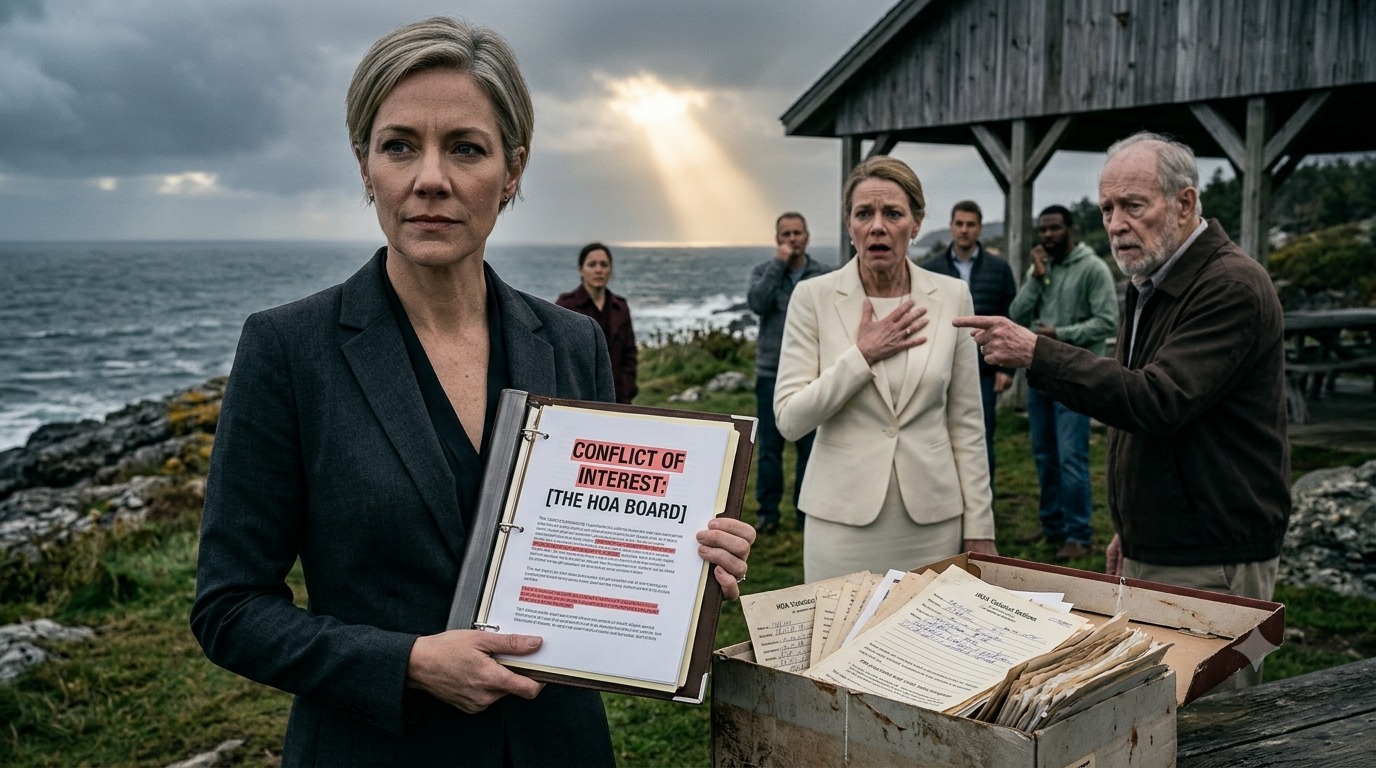
The open-air cedar pavilion near the retention pond was packed. Out of thirty-eight homes in Cedar Hollow, twenty-six property owners were present in folding lawn chairs, while four others had submitted signed voting proxies to Hank Odom.
The air was tense, electric with suburban anticipation.
At the folding table at the front of the pavilion sat the board of directors. My mother sat in the center, dressed in an immaculate cream pantsuit, her hair sprayed into a rigid shell, her reading glasses perched on the bridge of her nose. To her left sat my father, looking frail and uncomfortable in an oversized navy blazer. To her right sat Hank Odom, who had placed a digital audio recorder and a heavy ledger in front of his seat.
Kendra sat in the front row of the folding chairs, wearing oversized sunglasses, arms crossed defensively over her chest.
I sat in the third row, dressed in my professional charcoal court suit. Caleb sat directly to my left, his broad shoulders squared, holding a heavy cardboard storage box on his lap.
At 10:02 AM, my mother rapped a wooden kitchen gavel against the plastic tabletop with sharp, authoritative cracks.
“This special meeting of the Cedar Hollow HOA will come to order,” Darlene announced, projecting her best church-committee voice. “We are here at the request of an owner petition regarding recent architectural enforcement notices. As President, I want to assure the community that the board’s sole objective has always been the preservation of our property values and adherence to established standards. Now, Lee Ann, if you have a brief comment, the board will grant you three minutes.”
I stood up.
I didn’t walk to the open space in front of the table; I walked calmly to the center aisle, where every single neighbor could see my face and the exhibits.
“I do not require three minutes of board indulgence, Madame President,” I said, my voice carrying cleanly across the cedar rafters. “I am here to enter an evidentiary record under Article IX, Section 9-4 of the Cedar Hollow Association Charter.”
My mother’s face hardened. “This is an administrative review, Lee Ann, not a courtroom. We do not have time for theatrical—”
“Between July 14th and September 19th of this year,” I continued, completely ignoring her interruption, “I received fourteen consecutive enforcement assessments totaling three thousand one hundred and forty dollars.”
A collective, audible gasp rippled through the gathered neighbors.
Mrs. Salgado shook her head, muttering angrily under her breath: “Absurdo! Tres mil dólares?!”
“Every single notice was delivered without postage, without certified receipt, in direct violation of Article VI, Section 2,” I stated, as Caleb handed me the first exhibit folder.
I held up the blue shoebox.
“Inside this box are fourteen original envelopes. Every single check was paid on time. But these assessments were never about a blue door, or a garden hose, or a trash can left out on a Wednesday afternoon.”
I turned toward the audience, pulling a glossy twelve-by-eighteen foam board from Caleb’s hands.
It was a certified blown-up forensic reproduction of Kendra’s text message from September 13th:
“Mom says once the violation fines hit five grand, you’ll take the $279k offer just to stop the bleeding. Think about the family.”
The pavilion went dead, tomb-silent.
Kendra gasped, her face flushing bright crimson as twenty neighbors turned their heads simultaneously to glare at her in the front row.
My mother shot out of her chair, her gavel slamming against the table. “That is a private, privileged family communication! It has no bearing on this community! This meeting is adjourned!”
“You do not have the legal authority to adjourn this assembly, Darlene,” Hank Odom’s voice rumbled across the pavilion.
The retired claims adjuster didn’t stand up. He simply reached into his briefcase, pulled out an identical copy of the 2004 Charter, and laid it flat under the microphone.
“Under Section 9-4,” Hank announced, looking squarely at Darlene Pruitt, “any director who holds an indirect pecuniary or familial interest in a real estate acquisition involving an enforcement matter must submit a formal written disclosure to the board. Madame President, did you submit such a disclosure regarding your daughter Kendra’s written purchase offer on 412 Cedar Hollow Lane?”
Darlene’s mouth opened and closed like a fish suffocating on a pier. “I… that was merely an informal family discussion! It had nothing to do with the architectural violations!”
“Then why did you state on Sunday evening that you would personally order the board to waive the fifteen-hundred-dollar special assessment if Lee Ann signed the deed over to her sister?” I asked, my voice cutting through the humid air like a scalpel.
Darlene’s eyes bulged with panic. “You… you are a liar! You are twisting my words!”
At the head of the table, something extraordinary happened.
My father—who had sat silently through five years of manipulation, who had spent decades turning the television volume up to drown out his wife’s cruelty—slowly placed both palms flat on the plastic table.
He pushed his weight onto his feet. His knees trembled beneath him, but he refused the wooden cane resting against his chair.
He stood at his full height, his paralyzed right side hitched up, his gray eyes locking directly onto his wife of forty-eight years.
He reached down, picked up the microphone in his uncoordinated left hand, and brought it to his lips.
The pavilion held its collective breath.
“She… she said it,” Walter Pruitt said.
His speech was thick, slurred, and slow, but every single syllable was as heavy as cast iron.
“Darlene… said it at dinner. She told the girl… she’d kill the fine… if she gave the house to Kendra.”
My father lowered the microphone onto the table. He turned his head slowly toward me, looked across the rows of folding chairs, and gave me a single, firm nod.
The match had finally burned out.
Darlene collapsed back into her chair, her mouth hanging slack, her pristine ivory facade completely pulverized before every neighbor she had spent four months trying to intimidate.
Hank Odom stood up, holding a printed ballot.
“Under the provisions of Article IX, Section 9-4,” Hank announced into the microphone, “the floor is now open for a motion of summary removal for cause regarding Board President Darlene Pruitt.”
“I move!” Mrs. Inez Salgado’s voice rang out from the second row, her wooden cane thrust into the air. “Remove her right now!”
“Second!” shouted the high school teacher from 420.
Hank called the question. “All voting members in favor of the immediate removal of Darlene Pruitt from the Board of Directors, raise your right hand.”
Twenty-six hands shot into the air simultaneously. Caleb and I counted them together. A unanimous, uncontested super-majority.
“The motion carries,” Hank declared with a single strike of his knuckles against the table. “Darlene Pruitt is hereby removed from the Board of Directors of the Cedar Hollow Homeowners Association, effective this second. Furthermore, under Section 9-4, all fourteen enforcement assessments levied against 412 Cedar Hollow Lane are declared ultra vires, null, and void ab initio. The treasurer will issue a full restitution check in the amount of $3,140.00 within seven business days.”
Kendra grabbed her purse, pushed through the crowd of neighbors, and practically sprinted toward her Yukon in tears.
Darlene sat frozen at the table, utterly deserted, as twenty-six of her neighbors stood up, gathered their folding chairs, and walked out of the pavilion without offering her a single word of comfort.
Two weeks after the emergency assembly, the restitution check from the Cedar Hollow HOA arrived in my mailbox via certified mail.
I endorsed the check and deposited the entire $3,140.00 directly into the university bursar’s account for Caleb’s spring tuition.
Kendra did not buy a house in Cedar Hollow. After the public humiliation at the pavilion, she packed her children and her belongings into a rental truck and moved into a two-bedroom apartment complex twenty miles away in New Braunfels. We have not spoken a single word since that morning.
My mother’s reign as neighborhood matriarch was permanently extinguished. She no longer stood on her porch at 6:40 AM with her green watering can. Whenever I backed my car out of my driveway, the blinds across the front windows of 416 remained tightly drawn.
She attempted to corner me once, near the neighborhood mailbox cluster, hissing that I had destroyed the family name and broken my father’s heart.
I looked at her with the peaceful, unburdened clarity of a woman who had finally stepped out from beneath the weight of someone else’s shame.
“The document says what it says, Mother,” I told her gently, and walked away.
My father’s routine did not change. Every Tuesday and Thursday morning at 8:00 AM, I still walk across the grass, help him down the front porch steps, and assist him into the passenger seat of my car for his physical therapy sessions.
We do not discuss the HOA. We do not discuss Darlene.
We sit in comfortable, healing silence while the tires hum along Interstate 35, and sometimes, while we wait at a red light, he reaches across the center console and pats my wrist twice.
Tap. Tap.
On the first Saturday in October, the Texas air finally broke into a crisp, radiant seventy degrees.
Caleb drove down from Austin for the weekend, carrying a brand-new two-gallon metal bucket of exterior acrylic paint and two fresh synthetic-bristle brushes.
We stood together on my front porch, the morning sun warming the brick facade.
Caleb dipped his roller into the tray and offered it to me with a wide, easy grin. “Ready, Mom?”
“Ready,” I said.
With one long, smooth upward stroke, I rolled the paint across the middle of the beige wood.
The color was vibrant, brilliant, and deep—a color that looked like the open autumn sky over a pecan orchard in Seguin.
Harbor Blue.
We painted through the afternoon, listening to the radio, laughing whenever the blue paint speckled our clothes. And when we finally stepped back onto the lawn at sunset to look at our work, I knew with absolute certainty that I would never again make myself small just to keep someone else comfortable.
My front door was blue again. And for the first time in forty-six years, it was open to the world.