

Chapter 1: The Whisper
“How fast can you get your son’s insulin to school?”
The school nurse said it in a whisper, the way people talk when they are standing in a hallway they don’t want to be overheard in. Then she added the sentence that stopped my heart.
“Because whatever is in his pens right now, Mr. Doyle, it isn’t insulin.”
I was in the middle of a quarterly budget meeting. Eleven people sat around a long glass table, and a slide of colorful bar charts glowed on the wall behind me. My phone had buzzed against the tabletop with the school’s number, and I had answered it with the quick apologetic nod you give a room when you know it can only be one thing: your kid.
“What do you mean, it isn’t insulin?”
I said it louder than I meant to. Every head at the table turned toward me. Somebody’s pen stopped moving.
Mrs. Gable’s voice stayed calm, but it was the kind of calm that nurses use when they have already decided something is badly wrong and are working very hard not to let the person on the other end of the line hear it.
“Owen’s blood sugar was 290 before lunch,” she said. “I gave him his correction dose, exactly the amount on his care plan. It should have started working within the hour. I waited forty minutes and checked him again.”
I had stopped breathing, and I didn’t notice.
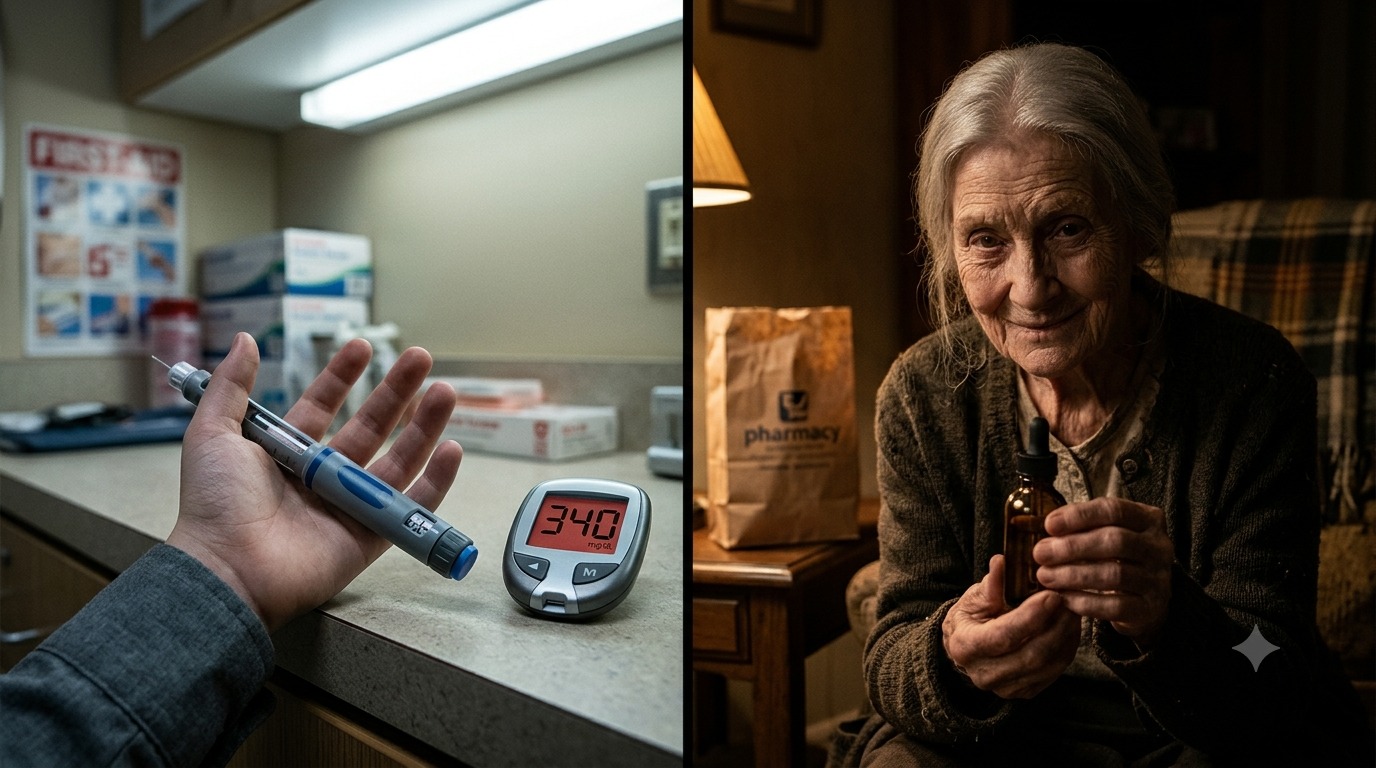
“It’s 340 now. He’s showing ketones. So I opened a brand-new pen from the box in the cabinet and tested it the way we’re trained to, a small priming dose into the air. Nothing, Mr. Doyle. Not a drop of anything that behaves like insulin. The pharmacy label looks right, but the lot number doesn’t match any lot in the system. I have never seen anything like this in twenty-two years.”
I was already standing. My chair rolled backward and tapped the wall. My boss said my name, once, in the tone of a person who expects an explanation. I didn’t turn around. I didn’t pick up my jacket or my laptop. I walked out of that conference room with the phone pressed so hard against my ear that it hurt.
“I have a pen in my car,” I said. My voice sounded like it belonged to someone else. “A real one. I picked it up from the pharmacy myself, last week. It’s in the emergency kit. I’m eighteen minutes out. Is he okay? Is he okay right now?”
“He’s awake and talking,” she said. “He’s thirsty. His stomach hurts. And he’s scared. I’m checking him every ten minutes, and I’ve got the ambulance on standby. But I need real insulin in this building, and I need it now.”
The elevator was too slow, so I took the stairs, three flights, two at a time. My shoes slapped the concrete and echoed up the stairwell like someone chasing me.
Then Mrs. Gable said the thing that made my legs turn to water.
“Mr. Doyle,” she said, so softly I almost lost it under the sound of my own footsteps, “I don’t think this was a mistake.”
Chapter 2: Our Life in Numbers
Owen was nine years old.
He had been diagnosed with type 1 diabetes when he was six. I still remember the week it happened in the flat, overlit way you remember car accidents. First came the thirst. He drank water like a kid who had crossed a desert, glass after glass, and then complained that his mouth was still dry. Then came the bathroom trips at night, and the bedwetting that he had outgrown years earlier. He got thin in a way I told myself was a growth spurt. Then, at a birthday party for a boy in his kindergarten class, in a backyard full of balloons and shrieking children, he stood up from the picnic table, said, “Daddy, I feel funny,” and collapsed on the grass.
The ambulance took him to the children’s hospital. His blood sugar was so high the machine in the ER couldn’t put a number on it. He spent four days in the ICU in diabetic ketoacidosis, which is a clinical way of saying his body had started to burn itself for fuel and poison itself in the process. I sat beside a bed with rails on both sides, holding a hand so small that an IV board was taped to the back of it, and a doctor with kind, tired eyes explained to me that my son would need insulin for the rest of his life.
“Every day,” she said. “Every meal. Every night. Forever.”
I remember nodding as though I understood. I did not understand. Nobody understands, not until you’ve lived it.
After that, our whole family ran on numbers. Carbs in a sandwich. Carbs in a cupcake at a classmate’s party. Units for lunch, units for correction, a glucose reading every few hours, and an alarm at three in the morning, every night, to check that he was still safely in range while he slept. We learned to count the sugar in a banana by sight. We learned to read nutrition labels the way other people read headlines. We bought a little insulated pouch with a cartoon shark on it, and Owen named it “Chomp,” and Chomp went everywhere with him.
His mother, Nadia, and I had separated two years earlier. It was not a gentle ending, and it was not a quiet one. We fought about money, about schedules, about whose turn it was to drive, about the thermostat, about the way I folded towels. We fought about almost everything.
But we had never, not once, fought about his insulin.
That was the one thing we both took seriously. Or at least, that’s what I believed.
Lately, though, something had been wrong. His numbers had been strange for months: highs that wouldn’t come down no matter what we did, nights when a correction dose seemed to disappear into thin air. At his last appointment, his endocrinologist, Dr. Abbott, had looked at the report from his glucose logs, folded her hands, and asked questions in a careful voice that I did not like at all.
I had an explanation for everything. Growth spurts. Puberty on the way. School stress. A new teacher. A cold he was fighting off. And if I’m being honest, and I owe you honesty, because I certainly did not give it to the people who deserved it, I had blamed his mother.
I had no idea that the answer had been sitting in plain sight the entire time, smiling at me every single week.
The new box of pens in the nurse’s cabinet had been delivered that very morning. And as I came out of the stairwell into the parking garage with my keys already in my fist, I realized that I knew exactly who had dropped it off.
Because I had asked her to.
Chapter 3: Eighteen Minutes
My mother’s name is Lorraine.
She had retired the year before, after thirty-one years as an office manager at a dental practice, and she had practically begged me to let her help more. “I raised three children, Danny,” she liked to say. “I’m not going to sit in a recliner and watch game shows.” So she picked Owen up from school on Tuesdays and Thursdays, my long days at work. She was on the school’s approved pickup list. She made him grilled cheese. She taught him to play gin rummy, and she let him win more often than she should have.
That morning I had been buried in a presentation, and I’d sent her a quick text: Mom, can you grab Owen’s refill from the pharmacy and drop it at the nurse’s office? I’m slammed.
She had written back almost instantly. A red heart. Then a photo of the white paper pharmacy bag sitting on her passenger seat, with the receipt stapled neatly across the top.
I remember looking at that picture at my desk and thinking, with real gratitude, How lucky am I?
I hit the exit of the parking garage so fast that my tires shrieked against the concrete. A security guard glared at me through the booth window and I barely noticed him. The sun was out, the sky was ridiculously blue, and somewhere ahead of me, on the other side of a city that suddenly felt enormous, my son was lying on a cot.
The car’s speakers rang. The screen on the dash said Nadia.
I had a half-second of dread. We texted about logistics. We didn’t call each other.
“The school called me too,” she said. Her voice was thin and wavering, the way a voice gets when someone is holding a very large feeling inside a very small space. “I’m on the other side of the county, Danny. I’m at least forty minutes out. Tell me you’re close.”
“I’m close,” I told her. “I’ve got the pen from the car kit. It’s real. I got it myself last week.”
“Okay.” She breathed out. “Okay. Okay.”
Then she asked the question that I didn’t want to answer.
“Who brought the new box to the school this morning?”
I hesitated. A second. Maybe two. A second too long.
“Mom did,” I said.
The silence on that line felt like it lasted a year. I could hear the road noise from her end, the clicking of her turn signal, her breath going in and out.
Then Nadia said, very quietly, “Danny, I have been trying to tell you something for months. And you never let me finish.”
“Not now,” I said. My jaw was so tight I could barely get the words out. “Please. Just get to the school.”
She didn’t argue. That should have told me something, too.
My phone chimed with a text from Mrs. Gable, which the dashboard read aloud in its flat, polite robot voice: Latest number: 362.
I knew what those numbers meant. Above 250 with ketones, and we followed the plan: call the doctor, push fluids, recheck often. If he started vomiting, or if his breathing changed, or if he became confused or sleepy, it could tip into DKA, the same condition that had put him in the ICU the week he was diagnosed. A child could die from it. A child could die from it in a school nurse’s office with a bucket beside him and a cup of water in his hands.
I ran a yellow light. Then another that was more orange than I’d like to admit. A man in a pickup leaned on his horn and I didn’t even look over.
Through the car’s speakers, still connected to the nurse’s open line, I heard a small voice in the background. I would know that voice in a crowd of ten thousand children.
“Is my dad mad at me?” Owen asked. “I didn’t do anything wrong. I promise. I took my shot. I took it right.”
Something inside my chest cracked open.
He was nine years old, sick and scared and lying on a cot, and his first thought was not I’m hurting. It was I’m going to be in trouble. That is what nine-year-olds do. They search themselves for the thing they must have done wrong.
“You’re not in trouble, bud,” I said, loud enough for the phone to catch it, loud enough that I think I was shouting at the windshield. “Nobody is mad at you. Not me, not Mom, nobody. I’m almost there. I’m almost there, Owen. Hang on.”
I pulled into the bus lane in front of the school and left the car running with the door half open behind me.
Chapter 4: The Cot
The school secretary, Mrs. Ruiz, saw the insulated pouch in my hand through the glass of the front office. She buzzed the door open before I even reached it.
“Down the hall,” she said. “Go.”
I have walked that hallway a hundred times for science fairs and parent conferences. It is lined with finger-paintings and construction-paper turkeys. That day it felt a mile long, and every bright drawing on the wall seemed to be watching me run.
The nurse’s office was small and smelled of rubbing alcohol and crayons. Owen lay on a cot against the wall with a paper cup of water cradled in both hands and a plastic bucket on the floor beside him, just in case. His cheeks were flushed. His lips were dry. His eyes had that tired look I hated, the one that doesn’t belong on a child who should still be arguing about recess.
“Hey, bud,” I said, and my voice broke on the second word.
“Hi, Dad.” He tried to smile. “I’m not in trouble?”
“No. Never. Not for this.”
Mrs. Gable was a woman in her fifties with short gray hair and reading glasses on a beaded chain, and she moved like someone who had trained her whole life for the worst ten minutes of a stranger’s day. She took the pen from my hand and did what I would later be grateful for every time I thought about it. She did not just trust me. She read the pharmacy label, then checked it against Owen’s care plan on her clipboard, then checked the lot number against the pharmacy printout I had in my wallet from the week before. Then she nodded once.
“This one’s good,” she said.
I had done this hundreds of times. Clean the spot on his thigh with an alcohol wipe. Dial the dose his plan called for. Press the pen to the skin, push the button, and count to ten so none of it leaks back out. My hands knew the routine so well that they shook anyway, which I suppose is what love does to routine.
Then we waited.
Rapid-acting insulin doesn’t work like a light switch. People who don’t live with diabetes think it should. It takes time to start, to move through the body, to begin pulling sugar out of the blood and back into the cells where it belongs. Those minutes felt like hours. Mrs. Gable checked his meter again. Then again. I held Owen’s free hand and told him a long story about a dog we’d once seen at the park that I swear could skateboard, and I made up more details with every sentence, and he almost laughed.
The paramedics arrived anyway. Mrs. Gable hadn’t been willing to take chances, and I was ashamed of how grateful I was that someone was thinking clearly when I could not. Two of them came in with a stretcher and a quiet, practiced gentleness. They checked his breathing and his pulse and tested his ketones, and after a short conversation with the nurse they decided he should go to the ER to be safe.
That was when Owen grabbed my sleeve.
His fingers were cold and sticky, and he pulled me down until his mouth was almost at my ear.
“Don’t let them throw away my pens,” he whispered. “Grandma says if we keep them, I’ll get better.”
I looked up.
Mrs. Gable was standing three feet away. She had heard every word. She didn’t gasp, and she didn’t say a thing. I watched her eyes go very still, the way a person’s eyes do when the last piece of a puzzle clicks into place.
She turned, took the box of pens that my mother had delivered that morning, and slid it into a clear plastic evidence bag from a drawer I hadn’t known she had. She sealed the top. Then she wrote the time across the seal with a black marker, her hand perfectly steady.
She looked at me and said, “I’m required to report this, Mr. Doyle.”
“I know,” I said. And I meant it.
Chapter 5: Three Hundred, Two Sixty, Two Ten
At the hospital they gave Owen fluids through a tiny IV and set up a monitor that beeped in a steady, reassuring rhythm. A nurse with a tattoo of a hummingbird on her wrist showed him how the bed remote worked, and he forgave the whole building for a moment because the bed could go up and down.
His sugar came down slowly, steadily, the way it was supposed to. Three hundred. Two sixty. Two ten. I watched every number the way I used to watch the sky in hurricane season. Every point felt like a plank on a bridge I was building as I crossed it.
By the time Nadia came running through the doors of the pediatric ER, with her hair coming loose from its clip and her shirt on inside out, he was sitting up against a pile of pillows. He was asking for crackers and complaining about the TV remote.
“Mama!” he said.
She crossed the room in three strides and hugged him so hard that he laughed and squeaked, “You’re squishing my IV!” She kept her face buried in his hair for a long time. Her shoulders shook once, twice, and then went still. When she finally let go, she wiped her eyes with the heel of her hand and told him she loved him more than all the crackers in the world.
Then she turned to me.
I had braced for anger. I had been bracing for it for hours, honestly, practically begging for it, because anger would have been something I knew what to do with. Anger I could have answered with defensiveness. I’d have shouted back.
Her face wasn’t angry.
It was worse. It was sad. It was the sadness of a person who has been standing alone at a window for a very long time, waving at someone who wouldn’t look up.
She took her phone out of her back pocket, opened an app, and handed it to me without a word.
It was a spreadsheet.
Column A was dates. Column B was Owen’s average glucose for each day, pulled from his meter logs. She had color-coded it the way she color-coded everything: green for in range, yellow for high, red for very high. She had been keeping it for five months. I scrolled up, then down, then up again, and the pattern revealed itself the way a picture does in one of those hidden-image puzzles. Once you see it, you cannot unsee it.
Every Tuesday night, a stripe of red. Every Thursday night, red. Wild, high, stubborn numbers that wouldn’t respond to corrections, no matter how carefully she worked.
Every other day of the week, the colors were green and yellow and normal.
“Tuesdays and Thursdays,” Nadia said, very quietly. “Your mother’s days. I told you in March. I told you again in May.”
I opened my mouth. Nothing came out.
“You told me I was trying to turn Owen against your family.”
She was right. I had said that.
I remembered the exact moment. We’d been standing in her driveway during a handoff on a chilly Saturday in March, Owen’s backpack sitting at my feet. She had held up this same phone, with an earlier version of this same spreadsheet, and tried to show me the pattern. I had barely glanced at it. I had rolled my eyes. I had told her she was being paranoid and dramatic and that my mother had raised three kids and knew more about taking care of a child than Nadia ever would.
And the worst part, the part that was turning my stomach to acid in that bright, humming ER, was the memory of who had planted the idea in my head in the first place.
My mother.
For months, she had been dropping tiny, careful remarks after her Tuesday and Thursday pickups, always in a soft, worried tone, the way you bring up a leak you’ve noticed in a friend’s roof.
Owen said his mom forgot his shot again, honey. I didn’t want to say anything.
He told me they had pizza last night, and his mom didn’t count the carbs. I just worry.
I think Nadia’s overwhelmed, Danny. She’s doing her best, but maybe he’d be better off with you full time.
I had believed every word. Every single word. I’d nodded and thanked her and told her she was a good grandmother. In June, I had even called our family lawyer and asked, with a lump of guilt in my throat that I’d dismissed as concern, what it would take to change the custody schedule.
And there was the appointment with Dr. Abbott. I thought of it now with a sickening clarity. She had flagged Owen’s A1C, the three-month average that tells a doctor how well a child’s diabetes has really been managed. Then she had asked, very carefully, whether there was any chance doses were being missed in one of the households.
I had turned my head and looked straight at Nadia.
Nadia had looked at the floor.
And I hadn’t understood that she was looking at the floor because she’d already shown me the evidence, twice, and I had thrown it back in her face.
Standing in that ER, with my son finally laughing at a cartoon behind me, I felt sick in a way that had nothing to do with fear.
Chapter 6: Grandma’s Special Days
Around four o’clock, a hospital social worker came into the room. She was a calm, soft-spoken woman named Priya, and she was accompanied by someone I didn’t know, a woman in a charcoal blazer with a badge clipped to her belt and a notepad in her hand.
“Mr. Doyle, Nadia,” Priya said, “this is Detective Lowry.”
Mrs. Gable had reported exactly what she’d found. The hospital had followed up. And now a detective was standing beside my son’s bed in a pediatric ward decorated with cartoon whales.
Detective Lowry was polite, but she did not waste time. She was maybe forty-five, with tired, intelligent eyes and the kind of stillness that makes you want to tell her the truth before she asks. She sat down on a plastic chair and asked who had access to Owen’s medication. Who stored it. Who delivered it. Who had delivered the box that morning. What the pickup schedule looked like.
I answered everything. My mouth went dry, and my answers started to sound like a confession.
Then she asked something I hadn’t expected.
“Mr. Doyle, has anyone in Owen’s life ever talked to him about stopping his insulin?”
I opened my mouth to say no. Of course not. Absolutely not.
Then I remembered what Owen had whispered on that cot, with his cold, sticky fingers wrapped around my sleeve.
Grandma says if we keep them, I’ll get better.
The word no died in my throat.
Detective Lowry watched my face change, and she nodded slowly. She didn’t say anything. She simply pulled her chair a little closer to Owen’s bed and spoke to him in a different voice, the voice of someone asking a favor of a friend.
“Owen, I’m a person whose job is helping kids stay safe. Would you help me understand your Tuesdays and Thursdays?”
Owen looked at me first. His eyes were enormous. I understood in that instant that he knew something was wrong, something much bigger than a bad number, and that he was waiting for permission to tell it.
I nodded, though my throat was closing up.
And then my son, in the bravest little voice I have ever heard, told a police detective about Grandma’s special days.
He said Grandma picked him up from school, and they went for ice cream, but only the sugar-free kind, which he said tasted “like frozen cardboard but it’s okay.” He said they went back to her house, and she made him grilled cheese, and they played gin rummy at the kitchen table.
He said that on Grandma days, she told him he didn’t need his evening shot.
“She said she had something better,” he told Detective Lowry. “Healing drops. They’re in a little brown bottle, and I put them under my tongue. They taste like licorice and kind of like pennies.”
He said the drops would teach his body to make its own insulin again, the way it used to before he got sick. Grandma said the doctors didn’t want him to know that, because they made money from kids like him. She said the real medicine was inside him all along.
He said she made him pinky promise not to tell Mom or Dad.
“She said Mom would be mad,” he said, “and Dad wouldn’t understand yet. She said it was our secret. She said when I got better, it would be the best surprise ever.”
His eyes filled with tears, the big, slow, silent kind that gather and don’t fall.
“Did I ruin the surprise?” he asked me. “Dad? Did I ruin it?”
I stood up. I had to. I said, “I’ll be right back, bud,” in a voice that wasn’t mine, and I walked out of the room before my face could give me away.
I stood in the hallway with my forehead pressed against the cool painted wall, breathing like I was underwater. I don’t know how long I stayed there. Long enough for the floor tiles to blur. Long enough to count the number of times I’d said thank you, Mom in the last five months, and to understand that each one had been a small, bright knife.
Nadia came out after a minute and stood beside me.
She didn’t say I told you so. She didn’t have to. It hung in the air between us, huge and quiet and entirely deserved. She just put her hand flat on my back, between my shoulder blades, and kept it there. And for the first time since the divorce, I leaned into her touch instead of away from it.