


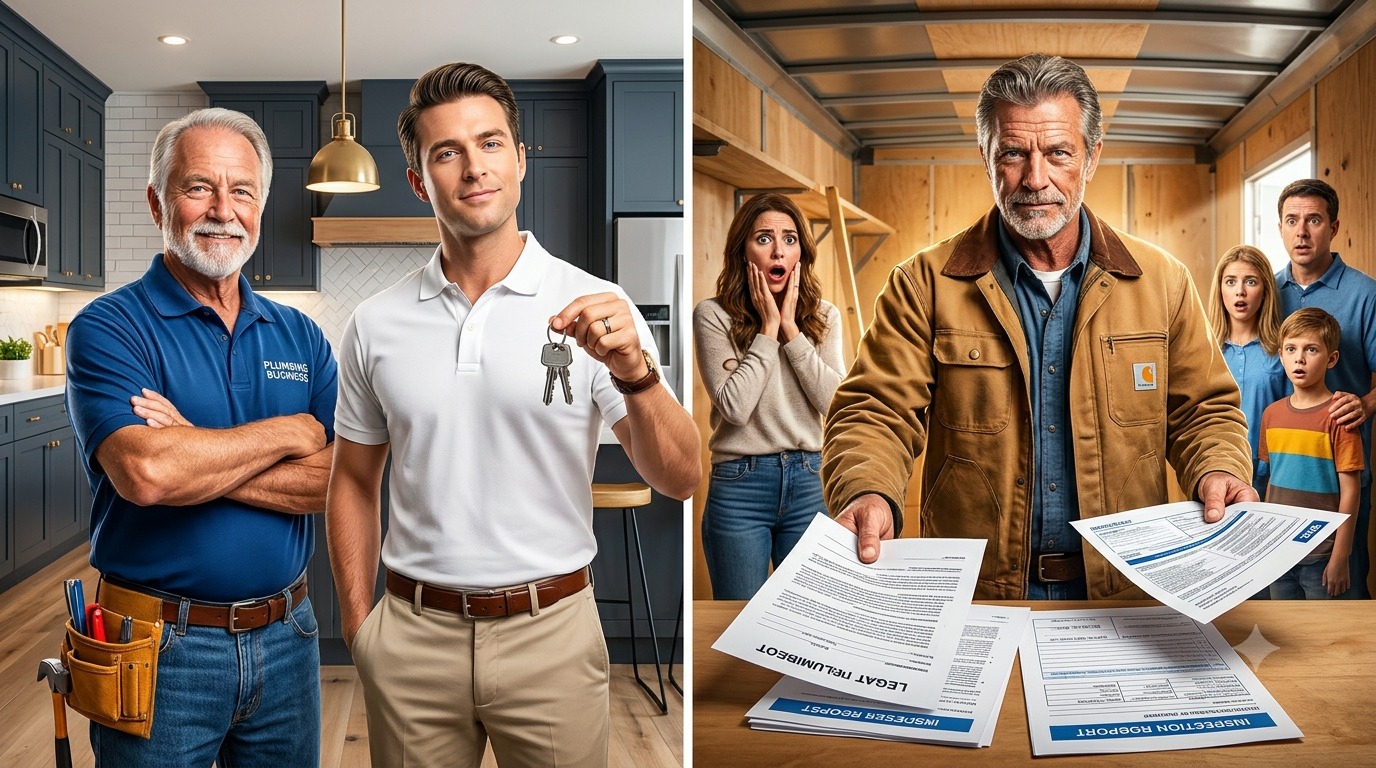
Don’t worry, you’ll still have a job. My sister’s husband said that to me in my parents’ kitchen, resting his heavy hand on my shoulder like he was trying to sell me a rusted pickup truck I couldn’t afford.
My name is Brett. I am thirty-six years old now, a licensed master plumber living and working in Salina, Kansas, and for fourteen grueling years, I was the invisible engine that kept my father’s plumbing empire running.
Two nights before that humiliating kitchen conversation, my father had hosted a family dinner that nobody bothered to invite me to. Everyone else was there: my mother, my younger sister Bethany, her husband Chase, and a couple of my dad’s retired golf buddies sharing prime rib and small talk.
At that secret dinner, my father slid a brass-keyed keyring across the spotless tablecloth and officially handed Chase the presidency of Dave’s Plumbing. Chase had been married to my sister for all of six months, and before that, he had spent his days selling mid-tier used cars off the back row of a local dealership lot.
So when Chase stood in my parents’ kitchen that Sunday afternoon and magnanimously assured me that my services would still be retained under his glorious new management, I did not blink. I looked him dead in the eye and gave him my answer.
No, I’ll have a company, I told him calmly, and you’ll have a massive problem.
Then I unclipped my work keys from my belt loop, dropped them onto the laminate counter right beside the leftover pot roast, and walked out the back door without looking back. By the following spring, my father’s iconic face had been painted completely off every single van he owned, and ironically, I wasn’t even the one who orchestrated it.
Almost a year to the day after that betrayal, my father’s voice crackled over my cell phone, older and smaller than I remembered, begging me to rescue his biggest commercial job under his company name so nobody would ever have to know the truth. What he didn’t realize was that I had already been hired to replace him months ago.
To understand how an entire family business can rot from the inside out, you have to understand what Dave’s Plumbing truly meant to this town. My dad’s name is Dave, and he started the outfit back in 1988 with a single beat-up van, a heavy pipe wrench his own father had handed down, and a whimsical cartoon of his own grinning face drawn by a buddy on a greasy bar napkin.
The logo featured a grinning man in a baseball cap with a wrench slung over his shoulder, painted proudly on the side of every van above the bold motto: Dave’s Plumbing. We Show Up.
My father was fiercely proud of that cartoon face. When I was a little boy riding shotgun in the summer heat, I genuinely believed my father was a local celebrity because his smiling caricature stared back at us from driveways across every neighborhood in Salina.
I started riding along with him during my summer breaks when I was fifteen years old, lugging heavy cast-iron pipe, shoveling deep trenches in frozen Kansas clay, and learning how to solder copper tubing over an old coffee can in our family garage. By the time I turned eighteen, I was working as a full-time apprentice, breathing flux fumes and mastering the trade from the ground up.
The winter I turned twenty, my father’s knees completely gave out on him. Three decades of kneeling on unforgiving concrete slabs and twisting his spine inside cramped crawlspaces caught up with him all at once on a freezing January morning, when he slid underneath a kitchen sink and physically could not push himself back up.
I had to grab him by his heavy leather belt and drag him out into the hallway. He laughed it off later with a raspy chuckle, but he didn’t laugh that morning, because he knew his fieldwork days were officially over.
After that health scare, my father retreated permanently to the air-conditioned sanctuary of the office, holding onto his master license, answering phone calls, pulling city permits, and methodically consuming an entire pot of black coffee every single day. And I took over everything else.
I managed the field crews, engineered the complex bids, negotiated with major commercial builders, and answered the terrifying 2 a.m. emergency calls when freezing water cascaded through a client’s ceiling. I was twenty years old, commanding rugged men twice my age and telling them where to report by seven every single morning.
Most of those rough-around-the-edges plumbers respected my work ethic, but the one man who mattered more than anyone else was Lefty. Lefty had been my father’s very first hire back in 1991, back when I was still wearing diapers and toddling around the shop floor.
Nobody in Salina had called him by his given Christian name since the Reagan administration; he was naturally left-handed, possessed thick forearms like weathered fence posts, and possessed a heart wide enough to fix a dripping kitchen faucet completely free of charge if an elderly widow offered him nothing more than a warm cup of black coffee and a brief conversation.
My father used to preach that exact philosophy to me during my teenage years, teaching me that if you take care of the widows in your community, their sons will remember your name when they finally build their dream homes. It was hands down the single greatest piece of business advice my father ever imparted, though later on, he conveniently forgot he ever uttered it.
When I turned twenty-four, a massive mechanical contracting firm out of Wichita caught wind of my reputation and offered me a lucrative position as a senior project foreman, complete with top-tier benefits, a brand-new company truck, and a salary that dwarfed what I was pulling in at home. I brought the official offer letter straight to my father’s desk, not because I was bluffing, but because I wanted to see how much my presence actually meant to him.
He read through the formal proposal twice, took off his wire-rimmed glasses, and asked me what it would take to keep me in Salina. I had already mapped out the mathematics in my head. I told him I didn’t want a flat hourly wage or a static salary, but rather a direct partnership: half of all annual net profits generated by Dave’s Plumbing, while he retained complete ownership of the name and the vans.
At that time, our fleet consisted of just three vehicles, and my half amounted to roughly forty thousand dollars a year. He pondered the proposition for less than sixty seconds before extending a calloused hand, and we sealed the partnership right there over the Wichita offer letter.
My mother dutifully recorded the agreement on a yellow legal pad, wrote down the current date, and tucked it away inside the metal file cabinet in the back room. That simple handshake held firm for a full decade, during which our fleet expanded from three vans to eleven.
That explosive growth was no stroke of blind luck; I hunted down commercial developers, showing up at sprawling job sites every Saturday morning bearing fresh donuts and a precise tape measure, learning the distinct communication styles of every general contractor in the region.
The biggest residential and commercial builder in the entire county was a formidable man named Sid Varner. Varner Homes erected entire suburban subdivisions year after year, sometimes pumping out thirty custom homes simultaneously, and within a few years, Varner contracts accounted for more than half of our total annual revenue.
Sid had my personal cell phone number programmed into his phone, bypassing the office receptionist entirely whenever an emergency struck one of his job sites. Two summers before that disastrous family dinner, Sid and I stood knee-deep in red basement mud, staring in disbelief at a main sewer drain line that a competing plumbing outfit had laid backward.
Out of nowhere, Sid looked at me and said that if I ever decided to branch out on my own, I had better call him before I even thought about calling my own mother. I laughed off his comment, assuring him with absolute loyalty that I would never abandon my father’s company.
Here is the crucial legal detail that absolutely nobody in my family ever stopped to consider, myself included: I had held my own independent master plumber’s license since I was twenty-six years old. In the state of Kansas, plumbing licenses are administered strictly at the municipal level, and the city building department in Salina knew my professional credentials inside and out.
Over fourteen years of relentless labor, I had never signed a single piece of restrictive paperwork preventing me from competing or operating my own independent business. My father simply assumed he would never need a non-compete clause, and I was far too consumed by loyalty to ever give him a reason to draft one.
Most fiscal years, our company cleared roughly one hundred eighty thousand dollars in clean profit, splitting my share evenly right around ninety thousand dollars while I worked sixty-hour weeks and handled every miserable midnight emergency call. My father’s half hovered around ninety-two thousand dollars, which he collected purely for answering office phone calls and drinking his morning coffee.
I never voiced a single complaint about that lopsided arrangement because it was his company, and his cartoon face adorned the doors of every van rolling down the asphalt. When I turned thirty, I gathered the courage to ask him if he would consider transferring a small percentage of company ownership into my name, not asking for the whole pie, just a formal stake.
He waved his half-empty coffee mug dismissively in the air and told me that when he passed away, the whole operation would belong to me anyway, asking why on earth I wanted to complicate things with lawyers and paperwork. Like a fool, I believed him implicitly, trusting his word as absolute law.
Every single Christmas holiday, after enjoying a few glasses of my mother’s spiked punch, my father would proudly rise from his armchair, raise his cup high, and announce to the room that he had built the entire company with his bare hands while Brett merely ran the errands. Everyone around the dining table laughed heartily, and I forced a smile right along with them, assuming it was just harmless parental bluster.
Then my sister Bethany brought Chase into our lives. Bethany was five years younger than me, always treated as the delicate, fragile centerpiece of the family whom my mother worried over constantly.
She met Chase down at Cottonwood Motors when she walked in to inspect a used SUV, and within a single afternoon, he managed to talk her into financing a brand-new vehicle while simultaneously charming her phone number right out of her pocket. They were married eight months later in the spring of 2024.
Chase was the archetypal smooth-talker who addressed every man as boss man and every woman as young lady, pumping your hand with the crushing force of a hydraulic press during every greeting. He possessed an online business degree from some obscure digital university, a credential my father paraded around church circles as if Chase had single-handedly cured a terminal illness.
The summer preceding that secret dinner, Chase decided to ride along with my field crews for exactly one single day to familiarize himself with the technical trade, a grand experiment that lasted precisely until lunch break. Around ten o’clock that morning, he picked up a gleaming length of heavy copper pipe, squinted at it, and asked Lefty if it happened to be the gold kind.
Lefty simply stared at him in profound silence for ten excruciating seconds before turning back to his soldering torch without uttering a word. Yet, at our mandatory Sunday dinners that summer, Chase dominated the conversation by pontificating loudly about the plumbing industry, throwing around corporate buzzwords like market scaling, profit margins, and leaving money on the table.
My father nodded along with his eyes sparkling with absolute reverence, hanging on every syllable as if Chase were dropping divine scripture. One Sunday afternoon in August, as Bethany casually passed the bowl of mashed potatoes across the table, she looked right at me and asked how much money Brett actually managed to pull in from the company each year, just out of innocent curiosity.
My father didn’t answer her directly, but he cast a lingering, speculative glance across the tabletop in my direction—a cold, calculating look I had never once received from him in my entire life, as if he were silently evaluating my worth on a spreadsheet.
I should have recognized the danger right then and there. The very next Saturday morning, I stopped by the local plumbing supply warehouse at seven sharp to pick up a commercial water heater for an ongoing installation.
Duffy, the counterman who had known me since my high school wrestling days, rang up my invoice, but instead of handing over the thermal receipt paper, he kept his grip on it with a strange, hesitant expression. He looked at me and asked if he was supposed to offer congratulations or express his condolences, admitting he had no idea what proper etiquette required in such a bizarre situation.
Confused, I asked him what on earth he was talking about. Duffy pulled his wife’s cracked smartphone out of his shirt pocket, explaining she had left it with him to get the glass display repaired, and turned the screen around so I could gaze directly at my sister’s public Facebook feed.
The digital post had gone live at 9:40 the previous night, accompanied by a glowing caption announcing a fresh chapter and overflowing with immense pride for her husband, the newly appointed president of Dave’s Plumbing, punctuated by three celebratory heart emojis and a little wrench icon.
The primary photograph captured our entire family seated around my parents’ dining room table, using my mother’s finest lace tablecloth, feasting on pot roast, and smiling radiantly at the camera lens. The secondary photograph showed my father standing proudly at the head of the table, ceremoniously dropping a heavy brass keyring right into Chase’s eager palm.
It wasn’t just any ordinary key ring; it was the historic, battered brown leather fob adorned with the heavy brass letter D—the exact set of keys that had hung securely on my designated hook in the back office for fourteen consecutive years.
I stared back at the first photograph, methodically counting every single human being seated at that table, searching for an empty chair or a placeholder, only to realize there wasn’t a single vacant seat. They hadn’t set a place for me and subsequently removed it; a place for me had never even crossed their minds.
You genuinely didn’t know about this, did you, Duffy murmured quietly, abandoning all pretense of asking a question. I paid for the water heater in full, loaded it onto the back of my flatbed, completed two grueling service calls that morning, and deliberately refused to call a single soul in my family.
If they could cowardly wait two days to inform me of my professional execution, I could easily wait two days to let them stew in their own cowardice. Sunday dinner at my parents’ house had commenced religiously at two o’clock every single week for as long as I had drawn breath, and I walked through their front door precisely at two.
My mother stood anxiously at the stove stirring gravy, my father commanded his traditional throne at the head of the table, Bethany meticulously arranged cloth napkins, and Chase occupied the exact chair I had sat in for fourteen straight years, sporting a brand-new Dave’s Plumbing polo shirt with the factory fold creases still sharp across the fabric.
Have a delightful dinner on Friday, I announced into the tense air as I stepped into the dining room. An absolute, suffocating silence blanketed the room; my mother abruptly set down a serving spoon, while Bethany kept folding and unfolding the exact same linen napkin with trembling fingers.
Honey, we were intending on breaking the news to you today, my mother stammered weakly, her eyes darting away from mine. Sit your ass down and eat, Brett, my father commanded sharply, folding his hardened hands over the edge of the tablecloth as if he were preparing to deliver a holy invocation.
I am seventy-three years old, my father began, his voice carrying the defensive weight of a man trying to convince himself of his own righteousness, and I am forced to contemplate what happens to this flourishing enterprise after I am gone. I have deliberated over this transition for a considerable length of time. Chase possesses a brilliant head for commerce, he holds a genuine university business degree, and he brings innovative ideas and a concrete blueprint designed to elevate this company into what it should have transformed into decades ago.
I possess the established builder relationships, I retorted, my voice tightening with suppressed fury, I manage the field crews, and I have poured fourteen years of my life into building this reputation. You possess exceptionally capable hands, Brett, my father conceded coldly, and nobody is attempting to strip that reality away from you; you will simply continue executing your daily labor in the field exactly as you always have.
And exactly what compensation package accompanies that labor? I demanded. My father glanced sideways at Chase, who eagerly leaned his forearms forward over the table.
What we are envisioning moving forward, Chase chimed in smoothly with his corporate grin, is transitioning all field personnel over to a fair, standardized wage structure aligned with regional industry norms, looking right around sixty or sixty-five thousand annually. That represents an exceptionally lucrative figure for a standard field technician.
I currently pull in ninety thousand through my profit share, I fired back instantly. That profit share represented half of the entire company, my father shouted, his face flushing a mottled red as his voice rose in defensive indignation, year after year, Brett, half of our net earnings! Do you possess any comprehension of what a qualified corporate general manager commands on the open market? Chase will successfully administer this entire operation for a mere fifty-five thousand!
Chase was genuinely eager for a fresh professional pivot anyway, Bethany interjected defensively, still refusing to lift her gaze from her folded napkin. It represents a harmonious alignment for everyone involved.
I locked my eyes onto my father, my voice dropping an octave as I demanded to know why he had repeatedly promised me for years that upon his retirement, the business would rightfully become mine. And who is explicitly stating that the enterprise won’t remain within the family circle, my father countered aggressively, pointing a shaking finger at my brother-in-law. Chase is legally family now.
That was the exact moment Chase stood up from his chair, strode around the perimeter of the table, and planted his heavy hand squarely on my shoulder once again. Hey there, boss man, Chase patronized with a sickening smirk, don’t you worry about a thing; you’ll still have a steady job right here with us.
I stared in absolute loathing at his hand resting on my shoulder until he finally chose to withdraw it under the weight of my glare. No, I replied evenly, I am walking away with an entire company, and you are about to inherit a catastrophic problem.
I reached up to my keychain, unclipped both my commercial van key and my master office key, and dropped them with a sharp metallic clatter onto the laminate counter right beside the untouched pot roast. My mother cried out my name in sheer desperation, while my father barked a demand asking where on earth I intended to go, asking if I planned to crawl off to Wichita at thirty-four years of age with my tail tucked between my legs.
No, I told them as I turned my back on the dining room, I am staying right here in Salina. I walked out to my truck in the driveway, and not a single soul from that house had the courage to follow me.
On Monday morning at eight o’clock sharp, I walked down to the municipal licensing bureau and formally registered my own independent plumbing entity. The veteran clerk behind the counter had known me since I was an eighteen-year-old apprentice, and when she peered down at the business name written across my application form, she looked up over the rim of her reading glasses, offered a silent, knowing nod, and stamped the paperwork without uttering a single syllable.
The name I chose was Brett’s Plumbing; I wasted five minutes contemplating something cleverer, but Dave’s Plumbing had survived for thirty-six years built around a simple first name, and I figured my father would experience a deeper stroke if my new venture closely mirrored his legacy. That very afternoon, I drove down to McPherson and acquired a used white service van from an elderly residential plumber who was hanging up his wrenches to retire out in the desert heat of Arizona.
It was a battered 2016 Ford transit with one hundred forty thousand hard miles on the odometer, a cracked dashboard that rattled like loose change, and a distinct cabin odor that can best be described as the lingering essence of a previous plumber. I handed over fourteen thousand dollars in cashier’s checks drawn straight from my personal savings, securing my commercial liability insurance and municipal bonding certificates before the sun went down.
I already owned all my own professional hand tools, because my father’s ironclad rule from my very first day on the job was that a true tradesman must always supply his own wrenches, a mandate I suddenly found myself profoundly grateful for. I established my makeshift headquarters right inside my suburban garage, ordering two large magnetic vinyl placards from the downtown print shop to slap onto the van doors displaying my business name alongside my direct cell phone number—a number already memorized by half the commercial contractors and homeowners in Salina.
Two weeks later, a corporate check arrived in my mailbox representing my final proportional payout for the truncated operational quarter, calculated precisely down to the exact penny. In the handwritten memo line, penned in my father’s unmistakable cramped cursive, were a single, devastating word: Final.
I sat alone inside my parked truck in the driveway, staring at that solitary word for a long, quiet interval before endorsing the check and depositing it into my newly opened bank account, knowing I had busted my knuckles earning every cent of it. My father placed exactly one phone call to me throughout the entirety of that first autumn season, marking our only verbal interaction for months.
You abandoned three active commercial contracts midway through execution, his voice barked over the speaker without even offering a standard greeting, referencing the Osterman bathroom renovation, the downtown parish hall, and the main water supply line up on Ninth Street. Try to maintain a shred of professional dignity, Brett, and go back and finish what you started.
Those accounts officially belong to Chase now, Dad, I replied coldly, reminding him that my brother possessed such a brilliant head for corporate business. He slammed the receiver down in my ear.
Now, I want to establish absolute clarity regarding what transpired next, because my father spent the subsequent year weaving a very convenient narrative across town. I possessed Sid Varner’s private mobile number stored in my contacts list, yet I deliberately refused to dial it during those initial weeks.
Varner commercial accounts comprised well over half of the total revenue generated by Dave’s Plumbing; if I had poached Sid’s business on my very first week as an independent operator, the entire town would have justifiably accused me of maliciously gutting my aging father’s livelihood on my way out the door. And frankly, they would have been entirely correct in that assessment.
Consequently, I exercised supreme restraint, refusing to solicit any of my father’s existing customer base or reach out to general contractors. However, having personally answered the office emergency lines for fourteen straight years, a massive percentage of Salina’s residential and commercial property owners already had my personal cell phone number permanently magnetized to their kitchen refrigerators. When their plumbing systems failed and they dialed that familiar number, I answered every single time.
The very first call came from elderly Mr. Osterman, whose master bathroom renovation I had been forced to abandon midway through framing. He informed me that the company had dispatched some young kid out to his residence who lacked the basic competence to locate the primary water shutoff valve, followed by some arrogant fellow strutting around in a clean polo shirt demanding to be addressed as boss man.
Mr. Osterman declared bluntly that he wanted me and nobody else to finish his home. I gently reminded him that I no longer maintained any affiliation with Dave’s Plumbing, to which the old man retorted that he possessed functional reading comprehension and was deliberately calling my personal number because I was the only tradesman he trusted.
So I returned to his home, completed the master bathroom renovation under my own banner at a fair, transparent price, and established the operating template for how I navigated that entire autumn. I never initiated a single solicitation call; I simply answered my phone when my community reached out for help.
The catastrophic operational decline that befell my father’s company under Chase’s visionary leadership reached my ears primarily through Lefty. Lefty chose to remain employed at Dave’s Plumbing following my departure, a decision I completely understood given his thirty-three years of unwavering dedication to my father’s legacy; a loyal man does not simply walk away from his life’s work overnight just because the sun shifted its course.
Yet every single Saturday morning without fail, Lefty would drive his truck over to my garage, pull up a folding chair, sip a cup of terrible drip coffee, and recount tales of corporate mismanagement so utterly absurd that I frequently had to set my mug down on the workbench to process the sheer incompetence. During Chase’s inaugural week at the helm, he convened a mandatory seven o’clock morning team assembly out in the dusty shop bay, supplementing the gathering with a pink box of stale donuts and a large white marker whiteboard.
At the very top of the board, Chase boldly scrawled a corporate manifesto declaring that they were no longer mere plumbers, but rather a premier water solutions enterprise. Lefty immediately raised his weathered hand from the back of the room and dryly suggested that the only true water solution operating in the building was currently flushing down the toilet.
Chase aggressively transitioned all field technicians over to a pure commission-based compensation model under the delusional assumption that it would magically incentivize the hustlers to maximize output. He began aggressively underbidding every commercial contract by a full twenty percent below our historic cost baselines, arguing that our previous pricing models left massive amounts of capital sitting idly on the table—a corporate philosophy that essentially meant pricing jobs below operational breakeven points.
He aggressively swapped out our time-tested, heavy-duty commercial water heaters for cheap, failure-prone residential bargain units sourced from an unverified online discount liquidator, resulting in a wave of basement floods across Salina by the time winter frost set in, forcing our exhausted field crews to execute endless unpaid warranty callbacks. Most destructively of all, Chase officially abolished our legendary twenty-four-hour emergency night call service in November, dismissing overtime labor as an unjustifiable corporate cost center.
For thirty-six glorious years, Dave’s Plumbing had guaranteed our community that a qualified technician would always answer the phone and show up in the dead of night; that foundational guarantee formed the very lifeblood of our motto. Under Chase’s regime, the office phone diverted automatically after six o’clock in the evening to an automated digital recording instructing callers to leave a voicemail during standard weekday business hours.
When a ferocious Arctic cold front slammed into Kansas that January, plunging ambient temperatures down to eleven degrees below zero in the middle of the night, a frozen copper supply line violently ruptured inside the sub-floor crawlspace of the historic Fenwick residence. Mrs. Fenwick instinctively dialed Dave’s Plumbing, relying on a tradition her family had trusted since 1990, only to be greeted by a cold digital recording.
Desperate and freezing, she cast her gaze across her kitchen and noticed an old, faded magnetic business card stuck to her refrigerator door displaying my personal cell phone number from years prior when I used to plaster my direct line across every piece of marketing collateral. She punched my digits into her phone, and I pulled up to her freezing driveway at two-thirty in the morning amidst howling blizzard winds, sliding onto my back in the freezing mud beneath her house to isolate the main shutoff valve and reconstruct a pristine section of insulated copper piping before dawn broke.
When Mrs. Fenwick insisted on frying up a plate of hot eggs in gratitude while her elderly husband hovered in the doorway wrapped in a flannel robe, he shook his head and muttered that Dave’s Plumbing used to dispatch men in the middle of the night. I looked him in the eye and gently informed him that Dave’s Plumbing was standing right in his kitchen, because Dave’s Plumbing was officially me.
By the time March rolled around, I happened to be driving my service van past my father’s commercial shop on my way to a downtown installation when I was forced to pull my vehicle over to the curb in sheer disbelief. Parked right outside the bay doors was a commercial graphics trailer from a local body shop, accompanied by two technicians clad in paper hazmat suits aggressively painting over the iconic branding adorning the side of one of our company vans.
My father’s legendary cartoon face was already half-obliterated—the cheerful grin, the jaunty baseball cap, and the heavy wrench slung over his shoulder vanishing beneath heavy coats of primer. In their place, the body shop workers were stenciling a sleek, corporate blue-and-silver mountain range accompanied by a sterile new moniker: Summit Plumbing Solutions.
Lefty filled in the painful blanks during our Saturday coffee session later that week, explaining that Chase had pitched the rebranding at a Sunday dinner by claiming the old cartoon aesthetic looked hopelessly small-town and lacked the scalable branding required for regional domination. According to my mother, who leaked the painful details to Lefty, my father sat at the head of the table grinding his jaw in profound silence for nearly a minute before finally conceding with a broken sigh that if changing the face of his life’s work was what it took to scale, they would proceed.
Eleven vans total, converted over at a cost exceeding twenty-two thousand dollars in graphic design and paint fees, funded entirely during the exact same month Chase unilaterally informed the field crews that their commission percentages were being slashed yet again because profit margins were failing to meet corporate targets. That was how my father’s grinning face was systematically erased from the side of his vans—not through any malicious sabotage on my part, but because he willingly surrendered the steering wheel to an impostor.
The tipping point that finally severed Lefty’s four-decade loyalty occurred in April, centered around an eighty-four-year-old widow named Mildred Kopp. Her husband had passed away nearly a decade prior, leaving her alone in a drafty Victorian home where plumbing fixtures inevitably corroded and leaked every few months.
For as long as anyone could remember, whenever Mrs. Kopp’s pipes acted up, Lefty would swing by her residence at the end of his workday, tighten a packing nut or replace a worn washer, accept a single cup of her notoriously terrible chicory coffee, and depart without ever generating an invoice—honoring my father’s foundational rule of taking care of the community’s widows.
This time around, her kitchen faucet developed a stubborn internal leak, and Lefty resolved the issue in under forty minutes. Being a fiercely proud and honest woman, Mrs. Kopp dutifully dialed the Summit Plumbing office the following morning to express her formal appreciation for the prompt service.
Chase answered the telephone, and without having the fogging-mirror awareness to recognize her name or historical status within our client ecosystem, he professionally thanked her for the call and promptly mailed out an automated billing statement assessing a standard one-hundred-eighty-nine-dollar commercial service dispatch fee. When the elderly widow received the bill in her mailbox that evening, she broke down in tears, calling Lefty in profound distress to ask if she had inadvertently committed some grave offense against the company.
Lefty drove straight to her house after hours, pulled out his personal billfold, and handed her two crisp hundred-dollar bills to cover the predatory invoice out of his own pocket. The very next morning, Lefty marched into the Summit office, dropped his heavy master key ring directly onto Chase’s pristine glass desk, stated that thirty-four years was quite long enough, and walked out the door.
He drove his pickup truck straight to my garage, parked right in my driveway, and stood with his hands shoved deep into his pockets as I emerged from beneath a van chassis wiping grease off my forearms with a shop rag. Morning, Lefty, I greeted him cautiously, though I am not in a position to demand that you abandon my father’s company.
You didn’t ask me to abandon anything, boy, Lefty rumbled gruffly, staring out across my modest workspace. I made my own conscious exit. Exactly what is the operational status of your rolling stock inventory—do you currently command an operational service van or are you operating out of a wheelbarrow?
I’ve got roughly half a van worth speaking of, I admitted with a wry grin, while the other structural half appears to be held together entirely through structural duct tape, baling wire, and earnest prayer. Well, Lefty muttered, climbing up into the passenger seat, I have spent decades executing repairs out of far worse contraptions.
I finalized the purchase of my second service van that exact week, and on the subsequent Saturday morning, Lefty arrived carrying a small metal paint can and a fine-bristle artist brush, carefully peeling my temporary magnetic vinyl placard off the driver’s door and painstakingly hand-lettering the words Brett’s Plumbing directly onto the sheet metal in vibrant red enamel. He spent the entire morning hunched over the door, his aging hand proving remarkably steadier than mine will ever be.
By the arrival of May, two more seasoned technicians—Rooney and Mack—formally resigned from Summit Plumbing Solutions without any active solicitation or recruitment efforts on my part. They had labored under Chase’s draconian commission structure for half a year, watching their weekly take-home pay plummet by a full thirty-three percent while enduring the exhausting indignity of running endless unpaid warranty callbacks to fix leaking bargain water heaters.
Rooney contacted me late on a Tuesday evening, informing me that Lefty had leaked word that my fledgling operation was expanding to accommodate experienced hands who had walked away from corporate mismanagement. I brought both Rooney and Mack on board by Wednesday morning, alongside a nineteen-year-old kid named Dakota who had recently washed out of a technical welding certification program but possessed an insatiable hunger to master a trade that didn’t constantly fill his eyes with blinding sparks.
Dakota possessed a natural mechanical intuition and was already shaping up to be a vastly superior plumber than Chase could ever hope to become in a thousand lifetimes. Naturally, the fictional narrative circulating through the town watering holes orchestrated by my father painted a wildly distorted picture of my enterprise; across church pews, diners, and hardware store aisles, the rumor mill hissed that Brett had maliciously orchestrated a hostile coup to rob his aging father of his workforce and clientele.
My mother broke her silence in June by placing a tense phone call to my personal line, marking her first outreach since the kitchen blowout, accusing me of humiliating my father because local parishioners were openly whispering that I had stolen his men out from under him. I calmly instructed my mother to place a direct phone call to my father and command him to tally up the exact number of technicians I had actively solicited away from his shop, reminding her that the mathematical answer was zero.
Well, those men certainly didn’t wander over to your garage under their own power, my mother argued defensively. Mom, I responded firmly, that represents the literal truth of how they arrived.
She lapsed into a heavy, uncomfortable silence before sighing that my father was simply bone-tired and utterly broken. I replied that I was acutely aware of his physical exhaustion because I had personally witnessed it earlier that spring while driving past a commercial project on the west side of town, where I spotted my aging father awkwardly lowering his worn body onto a foam kneeling pad on the asphalt, one agonizing knee at a time, because Summit Plumbing Solutions was chronically understaffed and possessed nobody else qualified to send into the field.
I didn’t slow my truck down, nor did I stop to offer assistance, and to this day, I remain uncertain whether he ever caught sight of my vehicle passing by. By the time July suffocated Salina in humid ninety-five-degree heat, my independent operation had expanded to four service vans and a dedicated crew of five men, myself included.
I had never poached a single commercial account belonging to Sid Varner, relying entirely on independent bidding to secure my contracts, successfully completing a historic parish renovation in Abilene, a public school cafeteria upgrade, and countless residential faucet repairs for elderly homeowners where I frequently waived service charges entirely out of respect for Lefty’s philosophy. Then Cottonwood Motors—the very automotive dealership where Chase had previously earned his living—entered the picture.
The dealership had constructed a massive new indoor vehicle washing and detailing bay that spring to prep their trade-in inventory before pushing vehicles out onto the retail lot, and the facility manager had officially opened the plumbing installation out to competitive bids. The lowest proposal by a staggering margin arrived from Summit Plumbing Solutions—formerly Dave’s Plumbing—leveraging the historic brand equity my father had spent decades cultivating.
Not a single soul inside the corporate dealership management structure realized who was actually directing Summit’s technical operations until the final engineering walkthrough, when Chase sauntered onto the job site wearing his crisp corporate polo shirt and pumping hands like a politician running for county commissioner. To comprehend the engineering failure that followed, one must understand the basic mechanics of commercial car wash infrastructure.
Buried deep beneath the concrete flooring of any heavy-duty wash bay lies an industrial-grade oil and sediment separator interceptor—a massive concrete holding vault designed to capture heavy mud, abrasive grit, and petroleum oils washed off incoming vehicles so those contaminants never breach the municipal sewer lines. That interceptor must be meticulously engineered and dimensioned to match the exact daily water discharge volume of the facility.
Chase’s technical crew had installed a compact residential-grade interceptor measuring roughly half the dimensional capacity required for a high-volume commercial wash bay because a properly sized commercial unit would have completely wiped out the razor-thin profit margins of his lowball bid. The very first afternoon the dealership ran a fleet of ten vehicles through the wash bay, the undersized separator instantly overwhelmed its retention capacity, backing up violently and flooding half the used car display lot with a toxic slurry of oily mud and gray water.
The installation failed municipal building inspections twice in succession, prompting the general manager—a towering, red-faced veteran named Lou Pankratz who had personally collaborated with me on commercial service contracts for years under my father’s banner—to dial my cell phone directly in a rage. I mobilized Lefty, Dakota, and a rented mechanical excavator out to the dealership property the following morning, spending four blistering days in the July sun breaking up newly poured concrete, excavating the undersized vault, and craning a massive commercial-grade interceptor into the trench.
On the fourth and final afternoon of grueling labor, Lou Pankratz walked out to the edge of the excavation pit carrying two condensation-beaded bottles of cold spring water, tossing one squarely into my chest. So that slippery corporate operator happens to be your blood-relative brother-in-law, Lou muttered, wiping sweat from his forehead.
That would be the exact individual, I confirmed, taking a long, refreshing swallow. Lou let out a booming laugh that echoed across the car lot, leaning his weight against the excavator bucket.
I’ll tell you straight, Brett, we actually terminated that young man’s employment here back in August of last year—August twenty-second, to be precise, because it happened to coincide with my wedding anniversary. The boy couldn’t close an auto sale to save his immortal soul, sitting firmly at the absolute bottom of our dealership sales board for four consecutive months.
I froze, holding the water bottle halfway to my lips as the dates clicked together in my mind with mathematical precision. He informed my father that he voluntarily resigned from the dealership to pursue a superior leadership opportunity, I recalled aloud. Bethany explicitly assured Dad that he turned down a prestigious executive promotion.
Lou laughed so hard he was forced to grip the steel hydraulic arm for structural support. Promotion? Good lord, son, he was hawking used sedans off the back row of our overflow lot! The sole promotion that young man ever achieved was getting permanently reassigned to the asphalt parking lot cleanup crew.
I drove home that evening in dead silence, meticulously calculating the timeline across my steering wheel. August twenty-nd: Chase was terminated from Cottonwood Motors in utter disgrace. September thirteenth: my parents hosted that secret family dinner where the corporate keys were handed over.
Scarcely three weeks separated his unemployment from his ascension. And suddenly, my vivid memory of Bethany sitting rigidly at the dining table folding that same linen napkin over and over without lifting her gaze clicked into place—she had casually mentioned that Chase was ready for a fresh professional change anyway.
He was indeed prepared for a professional change, alright; he was desperately primed for a guaranteed paycheck funded by my father’s retirement savings, and my enterprising sister had successfully engineered the transaction. She had quietly sat my aging father down, convinced him that his biological son was exploiting the company for excessive profits, and presented him with a silver-tongued brother-in-law possessing an online business degree and a clean polo shirt who promised to deliver the exact same operational output at a fraction of the cost.
And throughout the entire fiasco, my father genuinely believed the brilliant restructuring was entirely his own brainchild, bragging about his strategic acumen to anyone at the hardware store who would listen. I chose to withhold that devastating truth from both my mother and my father.
People frequently question why I maintained such strict silence, and the rationale is painfully straightforward. My father had slammed the telephone receiver down in my ear twice that spring; if I had initiated a call to inform him that his precious corporate savior had been fired in disgrace from a used car lot, it would have immediately devolved into a bitter he-said-she-said battle where my entire family had already predetermined whose testimony possessed validity. They would have universally dismissed my revelation as the bitter, jealous fabrication of a disgruntled outcast.
I had no desire to deliver that crushing blow over a telephone conversation where my father possessed the cowardly luxury of disconnecting the line. I wanted him to absorb the absolute reality of his betrayal somewhere he lacked the physical ability to hang up on me.
Three weeks later, dead in the middle of August, Sid Varner’s private number flashed across my screen. I explicitly instructed you to call me first when you branched out independently, Sid rumbled without preamble, and you deliberately failed to do so; consequently, I am taking the initiative and calling you.
Sid proceeded to brief me on the escalating operational disaster unfolding across Elm Bend, the massive suburban subdivision Dave’s Plumbing had been contracted to pipe throughout the year. Chase’s incompetent field crews had catastrophically failed municipal rough-in plumbing inspections inside the wall cavities of four separate newly constructed homes—the critical developmental milestone where all supply and drain lines must pass rigorous city pressure testing before drywall installation can commence.
They had failed initial inspections, botched subsequent remedial repairs, and failed reinspections yet again, leaving Sid’s framing and drywall crews sitting around idly on payroll accumulating massive overhead losses. Most criminally damaging of all, a young newlywed couple—the Dietrichs—had suffered through two consecutive closing delays that pushed their home purchase back by an agonizing month, nearly resulting in the complete expiration of their locked mortgage interest rates until Sid intervened and absorbed thousands of dollars out of his own corporate pocket to purchase rate extensions.
I currently possess eight unfinished residential structures remaining out in Elm Bend, Sid explained grimly, and your father’s outfit is slated to finish them, though they are currently skating on dangerously thin ice with my organization. However, I am officially breaking ground on a massive new forty-four-home development called Wheat Ridge over on the Northside this coming October, and I refuse to entrust a thirty-four-home project to that man’s incompetent hands. I want your company executing the plumbing infrastructure.
Sid, I cautioned him, pointing out that Elmbend remained my father’s foundational bread-and-butter account. No, son, Sid corrected me firmly, it happens to be my corporate account because I am the entity writing the financial disbursements, and I have effectively been financing your business operations for eleven years anyway, I simply had to mail the checks through your father’s office.
I formally executed the binding Wheat Ridge plumbing contract the following week across Sid Varner’s kitchen table, signing my own independent corporate name across the dotted line for the very first time. It marked a historic professional milestone, holding a prime Varner development contract bearing Brett’s Plumbing right across the header.
Groundbreaking for Wheat Ridge was strictly scheduled for October, and because my father’s crews never ventured out to the Northside development acreage, our operational involvement remained an absolute secret. Then, in early September, Sid’s corporate accounting department dispatched an official certified letter directly to the Summit Plumbing headquarters, itemizing the extensive financial damages stemming from the four failed Elm Bend properties.
The notification stated that all rough-in infrastructure across those four homes had to be physically sawed out of the framing and reconstructed from scratch, alongside an accounting of the thousands Sid had disbursed out of pocket to protect the Dietrichs’ mortgage financing. Sid was legally exercising his contractual right to deduct thirty-eight thousand dollars directly from the outstanding receivables owed to Summit Plumbing to cover the remediation costs.
That style of massive financial loss is entirely uninsured; commercial liability policies do not indemnify a contractor against the cost of tearing out and replacing their own botched craftsmanship. That devastating thirty-eight-thousand-dollar deficit landed squarely on my father’s balance sheet like a falling anvil.
Exactly one week following the delivery of that certified letter—marking almost precisely one year to the day since that fateful family dinner where I was unceremoniously stripped of my keys—my cell phone chimed, displaying a single incoming word across the display: Dad. I let the electronic ringtone cycle through three full iterations before sliding my thumb across the screen to accept the connection.
Brett, my father’s voice opened, sounding significantly more frail, exhausted, and hollow than I had ever heard it in my life, I require a substantial professional favor. I paused, asking him to elaborate. Sid Varner is aggressively threatening to terminate our remaining contracts across Elm Bend, and I currently have eight half-finished structures sitting out there in limbo.
Four of those properties require complete interior rough-in demolition and reconstruction, and I possess zero qualified field personnel capable of executing that level of surgical remediation. Lefty is gone, Rooney and Mack walked away, and these green recruits Chase hired cannot navigate a blueprint in broad daylight. Furthermore, my knees completely prohibit me from crawling underneath sub-floors anymore, and you are well aware of that physical reality.
I am acutely aware, Dad, I acknowledged quietly. Consequently, here is my proposed operational arrangement, my father coughed nervously, clearing his throat.
You and your crews step in quietly under our corporate banner—operate under the Summit Plumbing name for this specific remediation. You go in and fix those four compromised houses, and Sid never has to discover that you were the one behind the tools. I will compensate you directly at a preferential family pricing structure; we can negotiate the exact figures.
I remained completely silent for a prolonged interval, letting the suffocating weight of his desperation hang heavy in the air between us. Brett, are you listening to me? he pressed anxiously.
Sid Varner is inevitably going to discover who performed the labor, Dad, I replied evenly. Meet me down at the Elm Bend main construction trailer this coming Monday morning at precisely eight o’clock sharp. And bring Chase along with you.
Why on earth must Chase accompany me? my father barked defensively. He serves as the corporation’s president.
When I terminated the call, I immediately dialed Sid Varner’s private number and requested that he formally mandate my father’s physical presence inside the site trailer for Monday morning at eight. Sid chuckled over the line, asking if I was certain I wanted to subject myself to that toxic environment, to which I replied that I had successfully stayed out of that room for fourteen months, and I felt it was finally time to make my grand reentry.
Monday, September twenty-ninth, dawned crisp and clear across the Kansas plains. I pulled my white service van into the Elm Bend subdivision at seven-forty in the morning, parking my vehicle directly perpendicular to Sid Varner’s mobile job trailer with Lefty’s hand-lettered red lettering facing oncoming traffic.
Lefty elected to remain seated comfortably in the passenger-side bucket seat with a brown-bag ham sandwich and his window rolled down halfway, remarking that while he refused to step foot inside that toxic meeting, he wouldn’t miss the impending wreckage for all the tea in China. My father’s silver pickup truck rumbled into the gravel lot precisely at seven-fifty-five.
Trailing closely behind his vehicle was a brand-new, ultra-glossy commercial pickup wrapped entirely in that sterile blue-and-silver mountain range graphic, with Chase gripping the steering wheel and Bethany riding shotgun in the passenger seat. Lefty took a slow bite of his sandwich, muttered the word company truck under his breath, and calmly chewed his lunch.
Bethany hopped out of the passenger door clutching a thick manila folder securely beneath her arm—having operated as Summit’s internal financial controller since the previous spring. My father extracted himself from his truck with agonizing slowness, standing out in the gravel lot for a long, quiet interval staring directly at my service van, his eyes lingering on the red lettering adorning the door panel.
Inside the cramped trailer, Sid Varner sat slumped over a heavy plywood sheet resting across two wooden sawhorses, surrounded by chaotic stacks of municipal inspection reports, engineering blueprints, and a lukewarm paper cup of highway gas station coffee. I occupied a folding metal chair positioned at the far end of the plywood table.
My father paused in the open doorway of the trailer, catching sight of my presence, his face contorting into an immediate scowl. Exactly what is this ungrateful individual doing sitting inside this trailer? he demanded aggressively.
He happens to be my primary commercial plumbing contractor, Sid replied calmly without looking up from his paperwork. Take a seat right there, Dave.
Since when did this arrangement commence? Since August of this year, Sid stated plainly. In fact, he currently holds exclusive jurisdiction over the entire Wheat Ridge development—all thirty-four residential structures.
Chase physically surged forward past my father, his chest puffed out in corporate outrage. Whoa, hold on just a minute, Mr. Varner, with all due respect, those residential plots represent exclusive Summit Plumbing corporate accounts!
Sid Varner finally lifted his gaze from the documents, fixing Chase with the icy, pitiless stare you would reserve for a stray mongrel that had wandered uninvited onto a hazardous heavy-construction zone. They happen to be my private corporate accounts, young man, seeing as I am the individual issuing the financial tender.
Without waiting for their protests, Sid began systematically flipping through his paperwork, laying out the undeniable evidence one sheet at a time across the plywood surface. He detailed the four structurally failed Elm Bend properties, the official municipal failed inspection certificates, the precise tally of idle calendar days his framing crews were forced to sit on payroll, the exact financial losses incurred by the Dietrich family, and finally, the itemized thirty-eight-thousand-dollar financial penalty deducted directly from Summit’s receivables.
Brett’s professional crew is scheduled to mobilize on-site to commence full interior rough-in demolition across those four compromised structures today at precisely one o’clock in the afternoon, Sid announced with finality, and they will subsequently execute the remaining eight unbuilt structures as well. Your corporate association with Elm Bend is officially terminated, Dave, effective as of this exact morning.
The color drained entirely from my father’s face, leaving his skin a mottled, unhealthy gray as he gripped the edge of the trailer door frame for physical support. I have faithfully executed your residential plumbing infrastructure for eleven consecutive years, Sid!
Sid Varner set his paper coffee cup down with a sharp thud. Dave, he said quietly, I never actually hired your corporate entity; I hired your son. For eleven consecutive years, whenever an operational crisis materialized, he was the individual who answered my call.
Whenever a catastrophic plumbing failure threatened a home at ten o’clock at night, he was the man crawling through freezing mud beneath the floorboards. To the best of my recollection, I haven’t engaged in direct verbal dialogue with you more than three times across the entire span of my natural life.
My father’s knees buckled involuntarily, sending him sinking down onto an empty wooden crate against the trailer wall because his joints simply refused to support his weight any longer. He deliberately poached our premier residential builder! Chase shrieked hysterically, pointing a trembling finger directly across the table at my chest.
This entire past year has represented a premeditated, malicious conspiracy! He has been operating behind our backs like a corporate thief!
Nobody poached a damn thing, Sid Varner fired back, his voice dropping into a lethal register. He refused to initiate contact with me; I was forced to hunt him down and beg him to rescue this subdivision.
For an entire year, Chase, I never initiated a single solicitation call, I stated clearly, breaking my silence for the first time. I never contacted a single legacy customer, nor did I ever attempt to recruit a single technician away from your shop floor. I simply answered my personal telephone when my community reached out for assistance.
You should genuinely experiment with executing that basic operational principle sometime—particularly after six o’clock in the evening. My father stared blankly down at the municipal inspection reports scattered across the plywood table, desperately clinging to his final mental anchor.
Chase possesses an elite, highly trained head for corporate business operations, my father muttered weakly, speaking more to the wood grain of the table than to the men in the room as if attempting to resurrect a fading delusion. He holds an accredited university business degree. Furthermore, he demonstrated profound corporate loyalty by voluntarily turning down a prestigious executive promotion down at Cottonwood Motors specifically to step in and rescue this family enterprise. Bethany explicitly informed me that he walked away from an elite management track because…
He didn’t walk away from any promotion whatsoever, Dad, I interrupted gently, the final trace of hesitation evaporating from my chest.
Brett, Bethany hissed sharply, interjecting herself into the dialogue for the first time, using that familiar, venomous tone reserved for correcting disobedient household pets.
I ignored my sister entirely, keeping my eyes locked firmly on my father’s weathered face. Lou Pankratz terminated his employment at Cottonwood Motors on August twenty-second of last year, Dad, I continued smoothly.
He was fired in utter disgrace from the bottom of the used car sales lot, and my sister engineered a desperate corporate rescue mission by installing an unemployed car salesman into your legacy company under the guise of an innovative visionary.
The silence that instantly swallowed that job site trailer was so profound you could hear the distant hum of traffic half a mile away out on the highway. My father turned his head with agonizing slowness, his hollow eyes fixing upon his daughter, silently demanding an answer to a question his vocal cords lacked the strength to form.
Bethany’s face flushed a deep, burning crimson as she instinctively clutched the manila folder tighter against her chest, her mouth opening and closing like a stranded fish without producing a single coherent syllable. Chase took a desperate half-step backward toward the exit, his corporate confidence evaporating into thin air as he realized his entire pyramid of lies had finally collapsed into structural rubble.
I stood up slowly from my folding metal chair, buttoning the front of my canvas work jacket, and looked down at my father for one final, unbroken moment. The company you thought you built was never destroyed by me, Dad; it was dismantled the moment you decided to trade genuine loyalty for a cheap suit and a smooth-talking stranger.
I turned my back on the trailer, stepped out into the crisp Kansas sunshine, and climbed back into the driver’s seat of my service van alongside Lefty. As I engaged the transmission and steered our vehicle out of the gravel lot, heading toward the Northside development where thirty-four new homes awaited our hammers, I looked out the side window one last time and finally felt the crushing, phantom weight of a lifetime of conditional paternal approval lift completely off my shoulders, leaving behind the clean, unyielding strength of the business I had built with my own two hands.