
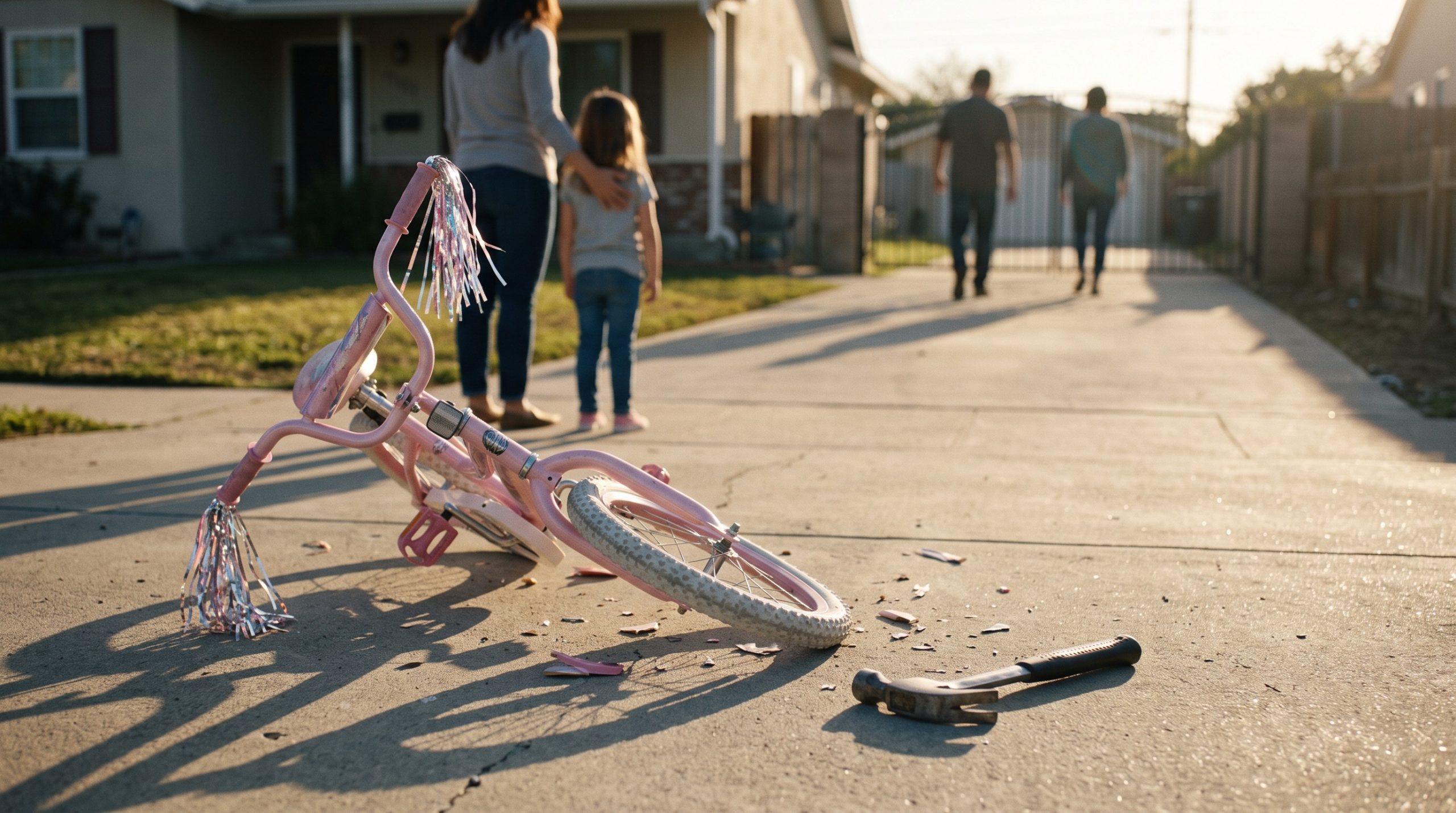
My sister smashed a brand-new children’s bike with a heavy claw hammer right in front of my six-year-old daughter’s eyes.
“That should be a lesson for her,” my sister said, her chest heaving.
“You shouldn’t have bought it for her, Catherine,” my mother added, folding her arms in righteous agreement.
I didn’t scream. I didn’t lunge at them. I just smiled, delivered a single sentence, and watched the color drain completely from their faces.
Let me back up for a second, because if I don’t give you the context, you’re going to think I’m making this up.
Picture a rare, golden Saturday afternoon. The laundry was actually folded, the dishwasher wasn’t beeping at me, and the world felt entirely manageable. My six-year-old daughter, Eliza, was bouncing around the driveway, practically glowing with excitement over the shiny, pastel-pink bicycle sitting beside our garage.
And who happened to drop by? My mother and my younger sister, Shayla.
The second Eliza spotted their car pulling up, she sprinted over, her voice bubbling with pure, unfiltered pride. “Have you seen the new bike?!” She grabbed their hands, tugging them toward the driveway as if she were about to unveil the Crown Jewels.
That was when I saw it—the look on Shayla’s face. Her smile vanished, her jaw clenched, and her eyes narrowed into two cold slits. It was the face of someone who had bitten into something rotting and wanted the whole room to taste it. Having grown up with her, I knew that look intimately. Still, nothing could have prepared me for what happened next.
Eliza was beaming, pointing out the metallic streamers on the handlebars and the way the clear coat caught the afternoon sun.
Shayla didn’t say a word at first. She just stared at the bicycle as though the metal itself had personally insulted her. Then, in a voice that was terrifyingly cool, she said, “Let me show you what I think about this.”
Before my brain could even process what she meant, she pivoted toward my husband’s open workbench near the garage door and picked up a heavy framing hammer.
In moments like that, your mind refuses to accept what your eyes are seeing. Surely she’s not going to—she wouldn’t.
Oh, she would.
With one vicious swing, Shayla brought the steel hammer down onto the bike’s top tube. The sound was sickening—like metal screaming. Eliza let out a tiny, choked gasp, her hands flying up to cover her mouth.
Another swing. A sickening crunch. Paint splintered into the air; the front spokes buckled and warped. I stood there paralyzed, every maternal alarm in my body blaring at once, yet my feet were rooted to the concrete by sheer, unadulterated shock.
Shayla didn’t rant. She let the hammer drop to the driveway with a heavy clatter, looked my trembling six-year-old square in the eyes, and said, “That should be a lesson for her.”
Eliza didn’t cry right away. She just stared at the mangled wreck, her lower lip quivering, her tiny shoulders shaking. An icy wave washed over me—not rage, not yet, just the freezing clarity that comes right before a storm.
You would expect a grandmother to scoop up her terrified granddaughter and tear into her grown daughter for acting like a lunatic. Instead, my mother shook her head and clicked her tongue at me. “You shouldn’t have bought it for her, Catherine.”
As if a grown woman taking a hammer to a child’s bike was somehow my fault.
And the truth is, that grotesque scene in my driveway didn’t happen in a vacuum. It was thirty years in the making.
Shayla is two years younger than me. She came into the world screaming, and as far as I can tell, she never stopped. When most children throw tantrums, parents teach them boundaries. When Shayla threw tantrums, our parents taught me how to accommodate her. Every meltdown of hers was magically reverse-engineered into being my fault.
If she wanted my toy: “Why didn’t you just give it to her, Catherine?” If she lost a board game: “Why couldn’t you let her win? You know how sensitive she is.”
When I was ten, I saved up my allowance for weeks to buy her a cheap little charm necklace for her birthday. She ripped open the box, saw that the stone was blue instead of pink, shrieked like I’d handed her a dead rat, and snapped the chain in half. My mother didn’t scold her. She turned to me and sighed, “You know she likes pink. Why would you provoke her with blue?”
Fast forward two decades, and the script hadn’t changed—only the tax brackets had. I put myself through law school, worked grueling eighty-hour weeks, and built a thriving career in corporate litigation. Because my husband, David, and I lived comfortably, I ended up becoming the family safety net. I put my credit card down for my mother’s utilities, covered Shayla’s groceries when she was short, and paid for their streaming services and medical co-pays.
Here is the fatal flaw with subsidizing people who already resent you: generosity is quickly mistaken for an obligation. Whenever I said no to their luxuries, I was painted as the cold, arrogant rich sister.
The catalyst for the driveway incident had happened four days earlier. Eliza and Shayla’s daughter, Brooklyn—who are both six—were playing outside. Brooklyn was riding her old hand-me-down bike when something metallic snapped underneath her, sending her tumbling onto the grass. Eliza, sweet-natured as ever, ran over and poked at the broken chain, declaring, “I can fix it!”
Shayla walked out at that exact second, pointed a finger at my daughter, and screeched, “Eliza broke it!” My mother immediately echoed her: “Catherine, Eliza needs to learn that actions have consequences. You need to replace Brooklyn’s bike.”
As a lawyer, I don’t argue without evidence. I calmly told them we would bring the broken bike to our garage so David could take a look at it.
David is an engineer—patient, methodical, and brilliant with his hands. Ten minutes after rolling the bike into our garage, he called me over, his face grim. “Catherine, Eliza didn’t do this. Look at the weld on the frame and the front axle. This is a catastrophic manufacturing defect. If Brooklyn had been riding downhill when this gave out, she would have ended up in the ER.”
That was when the lawyer in me took over. The next morning, I called the manufacturer’s corporate office. It’s amazing how quickly customer service escalates your call when you calmly weave terms like structural failure, product liability, and reckless endangerment of a minor into the conversation.
By Friday morning, an executive resolution was sitting in my inbox. Not only were they replacing the defective bicycle free of charge, I had pushed them to upgrade it to their flagship model—the exact pastel-pink dream bike with glitter streamers that Brooklyn had been begging Shayla for all summer.
It had arrived that Saturday morning. I hadn’t even told Eliza who it was really for yet; I just let her admire it in the driveway while waiting for Shayla and my mom to drop by so we could surprise Brooklyn together. For one naive, fleeting moment, I actually thought clearing Eliza’s name and gifting Brooklyn her dream bike might heal the rift between us.
I hadn’t accounted for the narrative rotting inside Shayla’s head. In her mind, Eliza had broken her daughter’s bike, and I had gone out and bought Brooklyn’s dream model for my daughter just to rub their noses in my wealth.
So, back to the driveway.
The mangled metal ticked softly as it settled. Shayla stood over the wreckage looking smug; my mother wore a thin smile of approval, as if justice had finally been served.
I let the silence stretch until even the neighborhood birds seemed to go quiet.
“I’m going to say this once,” I said, my voice so level and arctic it surprised even me. “That bike wasn’t for Eliza.”
Two beats passed. Their pupils darted, searching my face for a trick.
“It was for Brooklyn.”
Shayla blinked rapidly. “No, it wasn’t,” she blurted out, fast as a reflex.
“It was,” I said smoothly. “David found a dangerous factory defect on Brooklyn’s old bike. I threatened the manufacturer with a liability lawsuit yesterday, and they overnighted the exact upgraded model Brooklyn has been begging for all year. It was a surprise for her.”
My mother clicked her tongue, her default defense mechanism before launching into a lecture. “Don’t be dramatic, Catherine. You’re making that up to make your sister feel guilty.”
I looked down at the twisted spokes, then back up at my mother. “I’m not the one who brought a framing hammer to a child’s bicycle.”
Shayla’s face turned blotchy red. “You’re lying! You always lie when you get caught being selfish!”
“Lying about what?” I asked, letting a cold smile flicker across my lips. “The manufacturer’s emails? The shipping manifest in my inbox? Would you like me to pull them up on my phone right now, or would you prefer I print them out and read them aloud on the front lawn?”
That landed. I watched the realization hit her in slow motion—the dawning horror, the recoil, the frantic mental gymnastics as she tried to rearrange the furniture in her twisted story. Her gaze skittered from the ruined bike, to Eliza, and back to me.
“You expect me to believe you’d do something like that for my kid?” she whispered, her voice cracking.
“No,” I replied. “I expect you to regret what you just did.”
Eliza’s small, warm hand found the back of my leg. I reached down and covered it with mine, anchoring her.
My mother stepped forward, as if sheer proximity could rewrite reality. “Catherine, stop this at once. There is no need to humiliate your sister over a simple misunderstanding. You can fix this. Claim it on your homeowner’s insurance. Just order another one.”
“And the part where a grown woman deliberately terrorized my six-year-old daughter?” I asked quietly. “Do we file that under ‘misunderstanding’ or ‘teachable moment’?”
Shayla crossed her arms so tightly her knuckles turned white. “It was a heat-of-the-moment thing,” she muttered defensively. “People have moments.”
“Crying in the kitchen is a moment,” I said. “This was a demolition project. Leave.”
Shayla let out a sharp, disbelieving bark of a laugh. “Leave what?”
“My property,” I said. “And after that, my life.”
My mother gasped, her hand fluttering to her chest, clutching at pearls that weren’t there. “Don’t be ridiculous! We are family!”
“That word,” I said, “does not mean what you use it to mean.”
Shayla’s eyes flashed with panic and anger. She took an aggressive step toward me—and toward Eliza. Instinctively, I swept my daughter behind my back, just as the front door clicked open.
David stepped onto the porch. My husband is a quiet man, the kind whose stillness carries the weight of a boulder. He walked down the steps, wiped his palms on his jeans, and stood shoulder-to-shoulder with me.
“It’s time to go,” David said to them. Not yelling, not smug—just an immovable statement of fact.
“David,” my mother pleaded, turning on the charm, “talk some sense into your wife.”
“I don’t need to,” he replied evenly. “She’s making perfect sense.”
Desperation finally broke through Shayla’s armor. “We can fix this!” she scrambled. “We’ll tell Brooklyn it was an accident! Nobody else needs to know!”
“Eliza knows,” I said. “David and I know. And judging by the curtains twitching across the street, half the neighborhood knows. Get off my driveway.”
David walked over and swung the side gate open. For a few seconds, I watched the old habit of bulldozing war with the sudden realization that I was no longer handing them the keys to the bulldozer. Stiff-shouldered and pale, Shayla marched out first. My mother lingered at the gate, opening her mouth to deliver one last maternal scolding, before looking into my eyes and thinking better of it.
David latched the gate. It didn’t slam; it sealed.
When the roar of their car faded down the street, the silence left behind wasn’t heavy the way it had been my entire life. It felt sharp, clean—like a boundary finally drawn in permanent ink.
“Mom?” Eliza’s voice was papery and small. I crouched down so we were eye-to-eye. “Did I do something wrong?”
My heart fractured a little more. “No, baby,” I whispered, smoothing her hair. “You did nothing wrong. Sometimes adults get angry and do terrible things, and it is never, ever a child’s fault.”
Her little chin wobbled. “Do we still get ice cream?”
“Three scoops,” David chimed in gently from behind me. “With extra sprinkles. Scientifically proven to be the optimal choice.”
While David took Eliza inside to raid the freezer, I sat at the kitchen island and pulled out my phone. My hands weren’t shaking anymore. Methodically, I logged into every single portal I had been bankrolling for the past five years. My mother’s electric bill. Their shared cell phone plan. The grocery delivery account. The streaming services.
One by one, I deleted my credit card information. No grand speeches, no theatrical texts. Just quiet clicks. It wasn’t revenge; it was an amputation.
I was rinsing the ice cream bowls thirty minutes later when my phone lit up like a Christmas tree. A call from Mom. Then Shayla. Then Mom again. I let them go to voicemail and watched the text previews flood the screen.
We just got an automated email that your card was removed from the electric account. What is wrong with you? Put it back immediately.
Seconds later, another from Shayla: What are you playing at? This is pathetic and petty. Add the card back right now.
It’s fascinating how quickly people pivot from self-righteousness to outrage the moment the financial faucet is turned off.
When they realized I wouldn’t pick up, the final text came through dripping with venom: You’ll regret this, Catherine. Family is family. You can’t just cut us off.
I smiled, flipped the phone face-down on the granite, and went to read my daughter a bedtime story. For the first time in thirty-two years, I realized they were wrong. I could cut them off. And I just had.
By Sunday morning, the frantic calling had stopped, replaced by an eerie radio silence. I knew my family well enough to know that silence didn’t mean peace—it meant PR management.
Around noon, a cousin I hadn’t spoken to in months sent me a message: Hey, so sorry to hear about the fallout. Hope you and Eliza are doing okay.
When I asked what she meant, she sent me screenshots from the extended family Facebook group—a group I muted years ago. My mother and Shayla had launched a full-scale smear campaign. In their tragic retelling, Eliza had maliciously destroyed poor Brooklyn’s bike, I had refused to apologize or pay for it, and when they gently confronted me, I had cruelly cut off my aging mother’s utilities out of pure spite.
Not a single word about the hammer.
I had been prepared to ignore their gossip. I can live with people thinking I’m a cold-hearted lawyer. What I refused to tolerate was my six-year-old daughter being branded a spoiled bully to forty relatives.
I opened the app for our driveway security cameras—the high-definition ones with crystal-clear audio we installed for package thieves.
The footage was cinematic in its horror. It captured Eliza’s joyful bouncing, Shayla marching over with the hammer, the sickening crunch of metal, Eliza’s terrified gasp, and my mother standing there nodding while blaming me. Most importantly, it captured the audio of me calmly explaining that the bike was a warranty replacement meant for Brooklyn.
I downloaded the unedited two-minute clip and uploaded it directly into the family group chat. I added only two sentences:
For the record, the bike in this video was a warranty upgrade I secured for Brooklyn. This is why Brooklyn doesn’t have her dream bike today.
I set my phone down. Within three minutes, the family group chat detonated like a grenade in a tin can. Aunts were typing in all-caps; cousins were expressing sheer horror. The funhouse mirror my mother and sister had spent decades polishing shattered in 1080p resolution.
My mother called me forty minutes later. Curiosity got the better of me, and I answered.
“Yes, okay, maybe your sister overreacted!” she hissed, skipping hello entirely. “But how could you post that video?! You have destroyed her reputation! You don’t humiliate family in public, Catherine!”
“She ruined her own reputation, Mom,” I said mildly. “I just pressed upload. And as for humiliating family—that’s exactly what she tried to do to a six-year-old with a hammer.”
The silence on the other end of the line was sharp enough to draw blood. I hung up and blocked her number.
The fallout, however, reached further than I anticipated. One of my cousins shared the video outside the group, and it made its way to Shayla’s husband, Marcus. Marcus and I had never been close; he always looked like a man perpetually exhausted by his own life, working two jobs while walking on the same eggshells I had grown up on.
That evening, my phone rang from an unknown number. It was Marcus.
“Catherine,” he said, his voice flat, stripped of all emotion. “That video. Was that bike really for Brooklyn?”
“Yes, Marcus,” I said softly. “I still have the emails from the manufacturer. If you want, I can forward them to you.”
He let out a long, slow exhale, like air leaving a tire that had been overinflated for years. “Please do,” he said. “Thank you.”
Two weeks later, through the family grapevine, I learned that Marcus had used that video and those emails to file for divorce and emergency primary custody of Brooklyn. Strangely enough, that was the moment I felt true relief. It meant Brooklyn finally had one parent in her corner who looked at the madness and said, No more.
As for me, I sat on the edge of Eliza’s bed that night, watching the moonlight catch her hair as she slept peacefully. There was no rage left in my chest, no lingering guilt—just profound, quiet clarity.
For thirty years, I had been taught that “family” meant absorbing abuse so the people who broke things wouldn’t have to feel bad about the mess. Standing in that driveway, I finally learned the truth: family isn’t a free pass. It is supposed to mean safety, protection, and love. And when it doesn’t, it’s just a word bullies hide behind when they are terrified of the consequences.