


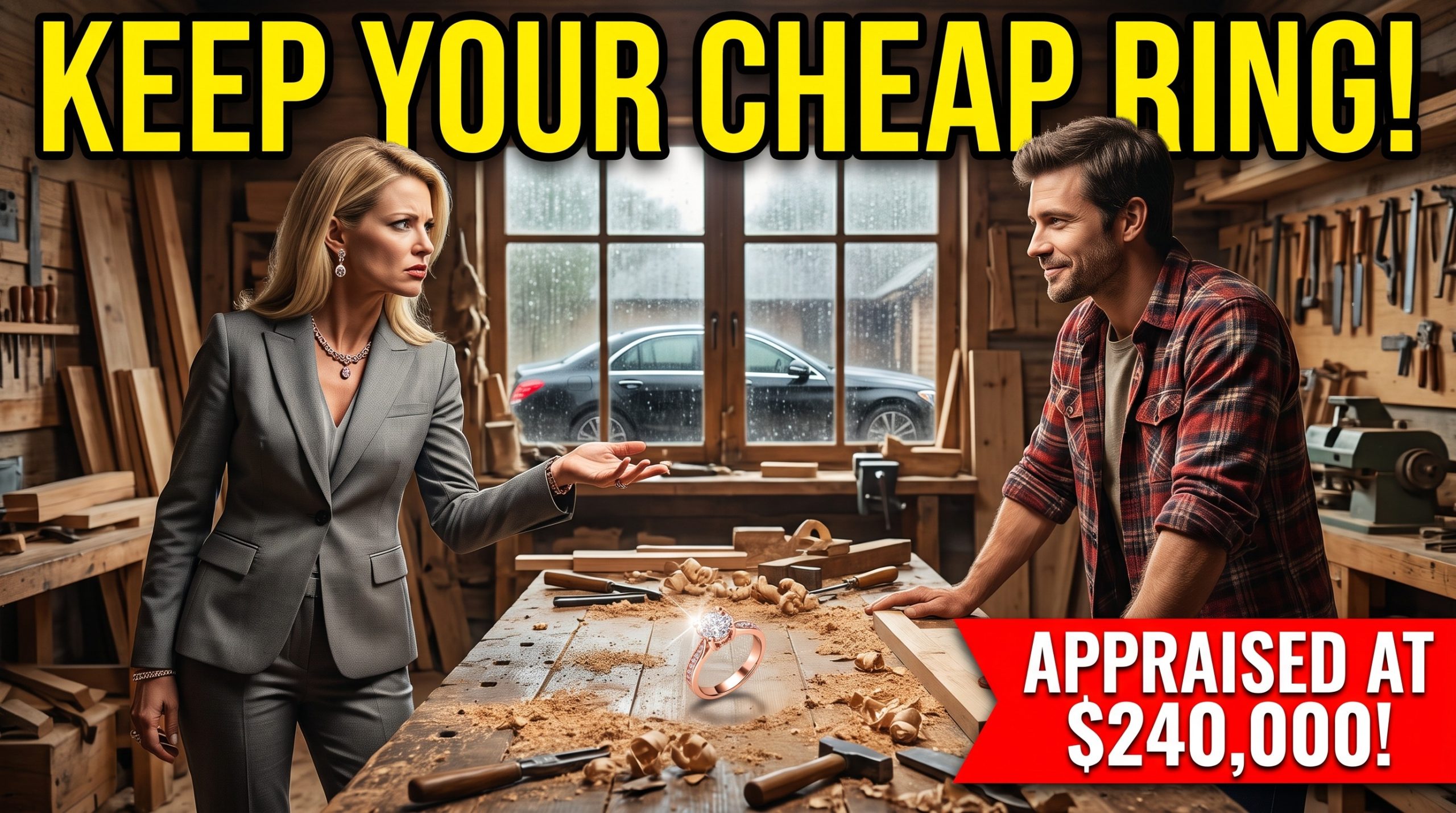
Keep your cheap ring—my parents found me a real man,” my fiancée said. I picked it up and smiled.
She threw the ring at me so hard it bounced off the corner of my workbench and disappeared into a pile of sawdust.
“Keep your cheap ring,” Vanessa said coldly. “My parents found me a real man.”
I got down on one knee, sifted through the wood shavings until my fingers closed around the cool metal band, and when I stood back up, I was smiling.
She thought I had lost my mind. She had no idea she had just handed back the most valuable object in the room. And she had even less of an idea that the man waiting for her outside in a black luxury sedan with the engine running—her own father—would be standing on that exact same spot eighteen months later, hat in hand, begging me for a job.
My name is Owen Mercer. I’m thirty-one years old, I build custom furniture for a living, and this is the story of how an entire family decided I wasn’t good enough for their daughter without ever bothering to find out who I actually was.
Let me back up a bit. My workshop sits on Harlow Street, down by the old river docks, occupying a three-story brick building that used to be my grandfather’s cooperage. Abe Mercer made oak barrels in that building for forty years, back when the waterfront smelled like river tar and salt fish instead of seven-dollar oat milk lattes. When the barrel trade died out, he converted the ground floor into a custom woodshop and taught me everything he knew inside it.
I was nine the first time he put a wood chisel in my hand. I was twenty-four when he passed away. At the reading of his will, I learned he had left me the entire three-story building, free and clear, held inside a private family trust with a sharp-tongued estate attorney named Margaret Osei guarding it like a hawk.
Along with the deed, my grandfather left me one piece of advice written in carpenter’s pencil on the back of an old lumber receipt: Never tell people what you own. Show them who you are.
I took those words to heart—maybe a little too seriously. Because when I met Vanessa Whitmore, I never mentioned that the building was mine. She simply assumed I rented the ground-floor workshop and the modest loft apartment upstairs, and I never corrected her. Hold on to that detail. By the end of this story, it’s going to matter more than anything else.
We met on a rainy Tuesday in October. She came stumbling through my shop door holding an expensive Italian heel in one hand and its snapped stiletto in the other, soaked to the bone and cursing the historic cobblestones outside. She had been rushing to a marketing meeting two blocks over when a gap in the stones claimed her shoe.
When I offered to fix it, she laughed and pointed out that it was a $600 designer pump and I was a guy covered in walnut dust. Twenty minutes later, I handed it back to her—glued, clamped, and internally pinned with a dowel of hard maple so fine you couldn’t see the seam with a magnifying glass. She wore those shoes for two more years. At our engagement party, she told all her friends that was the exact moment she fell in love with me.
I believed her. For three years, I believed every single word.
Vanessa worked as a brand director for her father’s firm, Whitmore Development—the kind of company that buys up historic working-class blocks and replaces them with sterile glass condominiums named The Meridian or The Sovereign. Her father, Gerald, had a handshake that felt like a hostile takeover. Her mother, Diane, had a Country Club smile that never once reached her eyes.
To them, I wasn’t Owen. I was “the carpenter.” They said it the way you’d refer to a plumber you had to call on a Sunday. “Will the carpenter be joining us for brunch?” “Does the carpenter eat oysters?” Whenever they did it, Vanessa would squeeze my knee under the table, roll her eyes, and whisper that they just needed time to come around.
Her younger sister, Tessa, was the only Whitmore who ever treated me like a human being. She was twenty-two, studying architecture at the state university, and she used to sit on a tall stool in my shop for hours with a sketchbook, asking how my grandfather had engineered the heavy timber roof trusses overhead without using a single steel bolt. Remember Tessa. She’s the reason I survived what came next.
After two and a half years together, I decided to propose. The stone was the only part of the ring I didn’t have to shop for. My grandmother, Ruth, had worn a single diamond her entire married life—an antique stone my grandfather bought in 1951 from an elderly European jeweler whose shop cabinets Abe had rebuilt after a fire. My grandfather had skipped lunch for an entire year to pay the man what he asked for it.
I didn’t want to just hand Vanessa an old setting from a drawer, so I spent three weekends at my friend Saul’s jewelry studio, learning how to forge a custom band myself out of hammered rose gold. It was slightly imperfect, the way truly handmade things always are. Before I set the stone, Saul insisted on having a certified gemologist appraise my grandmother’s diamond for insurance purposes. I’ll tell you what was written on that appraisal certificate later, because the number on that page is part of the payoff.
When I got down on one knee and told Vanessa I had forged the band with my own hands, her expression flickered for half a second. Something behind her eyes shuttered closed. Then she blinked, burst into happy tears, said yes, and immediately took a photo for Instagram with a caption about forever.
I brushed off that half-second of disappointment. I shouldn’t have.
The first real warning arrived at Thanksgiving, wearing a navy cashmere sweater and a wristwatch worth more than my pickup truck.
The Whitmores hosted Thanksgiving at their sprawling lake house an hour north of the city. That year, there were twenty guests around the mahogany dining table. When Diane showed me to my seat, my place card was exiled to the far corner next to Gerald’s deaf ninety-year-old former business partner. Vanessa’s card was dead center—right beside a man I had never seen before.
Preston Hale. Thirty-four, blindingly white teeth, sporting the kind of November tan you only get on a yacht someone else’s grandfather paid for. His father, Conrad Hale, ran Hale Capital, a private equity bank that financed half the skyline.
Diane introduced Preston as if she were unveiling a bronze statue. “Preston just closed his third private equity fund,” she announced to the room, before gesturing vaguely toward my end of the table. “And Owen makes tables.”
The whole room chuckled. Including Vanessa. That was new.
I spent two hours watching Preston lean into my fiancée’s shoulder, murmuring jokes that made her laugh behind her hand, while telling myself not to be insecure. Then, over pecan pie, Gerald stood up with a glass of scotch to talk business. He was beaming about the crown jewel of his career: a massive waterfront project called Harlow Yards. Four luxury towers, a boutique hotel, and a private marina stretching from the old docks to the iron bridge.
“We’ve officially locked up eleven of the twelve parcels on the block,” Gerald announced proudly. “Just one stubborn holdout left—some dusty family trust with an estate lawyer who won’t return a phone call. Likely some old widow holding out for an extra buck. Everybody has a price.”
From the center of the table, Conrad Hale raised his wineglass, his voice cool and sharp. “And until you have that twelfth signature in hand, Gerald, my bank’s capital stays right where it is.”
Everyone laughed again. I didn’t. Because I knew the exact block they were talking about. The twelfth parcel had my workbench sitting right in the middle of it.
On the drive home that night, with Vanessa asleep in the passenger seat, I kept my hands locked at ten and two and decided not to say a word. At the time, I thought I was avoiding an awkward conversation about business. I had no idea that Gerald and Vanessa already knew I was the owner—and were playing a much darker game.
Two weeks later, over takeout noodles on my couch, Vanessa casually brought up my living situation.
“Who actually owns this building, Owen?” she asked, twirling her fork. “You never talk about your landlord.”
“It’s held by a family trust,” I said, which was the truth.
“Do you know them?”
“I’ve met the lawyer.”
She nodded slowly. “You know, with all the development happening down by the docks, if that trust ever sold out, you’d be on the street in thirty days. Have you ever thought about what we’d do?”
“The trust isn’t selling,” I said evenly.
“How could you possibly know that?”
“I just do.”
She dropped the subject—for three days. Then she showed up at my shop carrying glossy real estate brochures for sprawling modern houses in the gated suburbs where her college friends lived. Four bedrooms, three-car garages, marble islands bigger than my timber lathe. She spread them out right across a walnut cabinet door I was hand-sanding.
“Just imagine,” she said, resting her chin on her hands, “if someone handed us two million dollars tomorrow. We could buy the corner lot in Oakridge, get you out of this dusty basement, and start a real life. What would you do with two million dollars, Owen?”
I looked at the brochures, then back at my shop. “Honestly? Pretty much what I’m doing right now. Maybe buy a wider planer.”
She stared at me as if I’d said I wanted to live in a dumpster. “That is your entire problem, Owen,” she snapped, sweeping the brochures back into her bag. “You have zero ambition.”
I didn’t realize it that night, but she wasn’t daydreaming. She was negotiating on behalf of her father.
That Friday, Margaret Osei called me. Margaret is seventy years old, stands barely five feet tall, and has put more ruthless developers in their place than federal regulators.
“Owen, we just received another buyout offer on Harlow Street,” she said dryly. “Two point one million from an LLC called Riverside Holdings. Which, as we both know, is Gerald Whitmore wearing a cheap trench coat and a fake mustache. I assume I’m declining?”
“Decline it,” I said.
Margaret paused for a beat. “Does your fiancée know your name is on the trust?”
“No.”
“Good,” she said sharply. “Keep it that way.”
A week later, Vanessa took me to an upscale steakhouse and slid a leather folder across the white tablecloth right as dessert arrived.
“Dad wants to bring you into Whitmore Development,” she said, beaming like she was handing me a pardon from the governor. “Site Supervisor for the new waterfront project. Full benefits, a company truck, a ninety-thousand-dollar salary. You’d finally have a real career, Owen.”
I opened the folder. The contract was for Harlow Yards. According to the project schedule stapled to page three, Phase One was the complete demolition of every existing brick structure on Harlow Street. Her father was offering me ninety grand a year to supervise the bulldozing of my own grandfather’s building—and more importantly, to get me onto his company payroll under an employment contract packed with conflict-of-interest clauses.
I closed the folder and slid it back across the table. “Tell your dad I said thank you, but I already have a career.”
The warmth vanished from her face instantly. “Do you have any idea what I had to go through to convince my father to offer you a seat at the table?” she hissed.
She didn’t speak a single word to me on the drive back. When we stopped at a red light on 4th Street, I glanced over and saw her furiously texting someone with her phone screen tilted toward the window so I couldn’t read it.
If Thanksgiving was a warning, the Whitmore Development holiday gala in December was a five-alarm fire.
It was held in the penthouse ballroom of The Meridian. All floor-to-ceiling glass, white orchids, and waiters in tuxedos circulating with champagne. Halfway through the evening, Gerald gripped my elbow and steered me over to Conrad Hale.
“Conrad,” Gerald said smoothly, “you remember Owen—Vanessa’s friend.”
Friend. Not fiancé. I looked right at Vanessa, who was standing four feet away holding a champagne flute. She heard every syllable. She didn’t correct him; she just stared down at her shoes.
Ten minutes later, Preston Hale tapped his glass on the stage to deliver a toast on behalf of Hale Capital. He spoke about vision, legacy, and how “the strongest developments are the ones that unite two great families.” When he said the word families, he looked directly across the room at my fiancée and raised his glass. Vanessa smiled and raised hers right back.
I walked out to the elevators alone. Vanessa didn’t follow me. At 2:15 a.m., she sent a three-word text claiming she was sleeping at her parents’ house in the suburbs because it was closer. Her parents lived forty minutes north. The Meridian had a hotel on the twelfth floor.
In early January, Diane Whitmore visited my workshop alone. She had never set foot on Harlow Street in three years. She stood just inside my front door in an ivory cashmere coat, looking at the wood shavings on the floorboards as if they were radioactive.
“I’m going to speak plainly, Owen, because I think you’re a sensible young man,” she said—which is what rich people always say right before they treat you like dirt. “Gerald has leveraged a great deal on Harlow Yards. More than he should have. The Hale family’s backing is vital to our survival, and the Hales believe in cementing business through family alliances.”
“What does that have to do with me, Mrs. Whitmore?”
She looked at me with cool pity. “Love is a luxury, Owen. And this year, Vanessa simply cannot afford it.”
She reached into her crocodile handbag, pulled out a cream-colored envelope, and set it on the corner of my workbench. Inside was a cashier’s check for $50,000.
“For your trouble,” Diane said softly. “And for walking away quietly.”
I picked up the envelope with two fingers, walked over to her, and tucked it right back into the pocket of her coat. “If Vanessa wants to end our engagement,” I said, opening the shop door for her, “she can look me in the eye and do it herself.”
Diane gave me her cold, teeth-only smile. “Oh, she will. Sooner than you think.”
Nine days later, on a freezing Thursday night, Vanessa walked in.
I knew it was over the second I saw her. Over the previous two weeks, her spare clothes and toiletries had quietly vanished from my apartment upstairs. Tonight, she was wearing a sharp charcoal business suit with her hair pulled back tight—the exact armor she wore when firing a vendor at work.
“I’ve been doing a lot of thinking,” she began, her voice sounding rehearsed, “about where my life is going, what I need, and what you’re actually capable of providing.”
I set my brass hand plane down on a clean rag. “And what is it I can’t provide, Vanessa?”
She gestured around the room—at the iron bar clamps lining the brick walls, the stacks of rough-sawn cherry lumber, the potbellied stove my grandfather had installed in 1962.
“A future!” she snapped. “You’re thirty-one years old, Owen, and you live above a dusty shop you don’t even own! You build tables. Tables. My parents gave you every opportunity to step into the real world, and you threw it back in their faces. I need a partner who understands how the world actually works. Preston understands how the world works.”
There it was. Finally out in the open.
“Do you love him?” I asked quietly.
She let out a short, sharp laugh, as if I’d asked if she believed in Santa Claus. “Love? Grow up, Owen.”
She twisted the hammered rose-gold band off her finger and hurled it at me. It struck the heavy oak corner of my workbench, bounced once, and vanished into the pile of sawdust beneath the vise.
“Keep your cheap, homemade ring,” she spat. “Do you have any idea how humiliating it was every time one of my friends asked to see my hand? My parents found me a real man, and he’s buying me a real ring.”
I didn’t yell. I didn’t beg. I calmly dropped to one knee, ran my fingers through the fresh maple shavings until I felt the familiar metal circle, and stood back up.
When I looked at her, I was smiling.
Her eyes narrowed. “What the hell is so funny?”
“Nothing at all,” I said, slipping the ring into my flannel shirt pocket. “I’m just really glad you gave it back.”
Outside on the street, a car horn tapped twice—impatient and entitled. Through the frosted front window, I saw the headlights of Gerald Whitmore’s black Mercedes sedan idling at the curb. Her own father had driven her here to dump me and was waiting outside like a getaway driver.
“That’s my ride,” Vanessa said, lifting her chin. And she walked out of my life, her heels clicking against the exact same cobblestones that had brought her into it three years earlier.
Earlier, I told you there were two reasons I smiled when I picked that ring up out of the sawdust.
The first reason was simple: that ring had rested on my grandmother Ruth’s hand for sixty years of loyal marriage, and deep down, for months, a quiet voice in my chest had been warning me that it was on the wrong finger. Getting it back without a fight felt like a reprieve.
The second reason? That was pinned to the wall right above my workbench.
Twenty-three days later, Vanessa Whitmore and Preston Hale announced their engagement in the Sunday society pages. Not that they were dating—engaged. Tessa later told me the ring came from a flagship showroom on Madison Avenue and was so heavy it spun sideways on Vanessa’s finger. The newspaper ran a half-page photo taken at the Whitmore lake house: Preston with a possessive hand on Vanessa’s waist, and right behind them, Gerald Whitmore and Conrad Hale shaking hands like two CEOs closing an acquisition.
I clipped that newspaper photo out and pinned it to the corkboard above my bench, right next to the gemological appraisal certificate for my grandmother’s diamond.
Exactly one week after that engagement announcement hit the press, three city building inspectors walked through my front door without a warrant or prior notice.
For twenty years, my grandfather and I had maintained every inch of that brick building to perfection. Yet in four hours, those three men with clipboards managed to invent nineteen separate municipal code violations—citing everything from the historic timber trusses to the emergency exit signage. Before they left, they slapped a bright orange RED TAG: CEASE OPERATIONS IMMEDIATELY notice across my front door.
I was legally barred from working inside my own shop until every single fabricated violation was litigated, cleared, and re-inspected.
At the time, I had six major furniture commissions in progress. Four of my clients couldn’t wait and canceled their deposits. The fifth was a custom walnut baby crib for a young couple named Marcus and Elena, who had lost their first child the year before and were due in less than a month.
On the third morning of the shutdown, while I was standing out on the sidewalk staring at that orange sticker on my door, a silver Porsche convertible pulled up to the curb. Preston Hale lowered his tinted window, looking me up and down in my dusty work boots.
“Rough week, pal,” he said, resting an elbow on the door frame. “Look, no hard feelings about V. Honestly, you did us both a favor—she had completely outgrown this whole starving-artist phase.”
He reached into his suit pocket and held out a thick cream business card between two fingers.
“My father’s bank is buying up this entire corridor,” Preston said smoothly. “If your landlord gets tired of dealing with city fines and wants an exit, tell him to call me directly. I’ll even throw five grand your way for moving expenses. Buy yourself a nice miter saw.”
I took the card from his hand and looked him dead in the eye. “I’ll make sure the owner gets this personally.”
Preston chuckled and sped off down Harlow Street. He had no idea he had just handed his business card to the owner—because, as I was about to find out, Gerald Whitmore had lied to him, too.
I won’t pretend that February was easy. While Margaret waged war against the city building department to clear the bogus violations, my savings bled out.
The only person who kept me grounded every single day was June, who owned and ran the artisan sourdough bakery right next door. Every morning at 6:00 a.m., she would leave a hot thermos of black coffee and a warm cinnamon brioche on my front steps. When I tried to pay her, she’d swat my hand away with a dish towel and tell me I owed her a custom oak bread rack once the city got off my back.
When Elena called me in tears three weeks before her due date, terrified that her baby wouldn’t have a crib to come home to, June didn’t hesitate. She cleared out the dry-storage room in the back of her bakery, right between the sacks of organic flour and the cooling racks. I carried my hand tools over in plastic milk crates and built that walnut crib entirely by hand—no table saws, no noisy routers, just chisels, hand planes, and mortise-and-tenon joints, the exact way my grandfather taught me.
The night Marcus and Elena picked up the finished crib, Elena cried and hugged June for five minutes straight. Afterward, June and I sat on her back loading steps in the cold night air, covered in a mix of bread flour and walnut dust, drinking cheap beer out of bottles. For the first time in a year, I laughed until my ribs hurt. And not once did June ever ask me how much money I made.
Then came a Sunday night in March. My phone buzzed at 10:30 p.m. with a text from Tessa Whitmore.
I can’t live with this anymore, Owen, she wrote. You deserve to know what they did. Please don’t ever tell them I sent this.
Attached were seven screenshots from the Whitmore family group chat. Reading them made my blood turn to ice.
The first screenshot was dated September—two full months before Thanksgiving.Gerald: Just got the title search back from my private investigator on the 12th Harlow parcel. The sole beneficiary of the Mercer Trust is Owen Mercer.Diane: Wait. Vanessa’s carpenter?!Gerald: The kid has been sitting on a $2M+ waterfront lot this entire time and living like a pauper. Do NOT breathe a word of this to Conrad or Preston. If Conrad finds out I don’t even have control over my own daughter’s boyfriend, Hale Capital will pull our loan commitment tomorrow. Tell Conrad the owner is a stubborn old widow.Vanessa: 😂😂😂 Oh my god. Wait, this is actually perfect. Leave him to me. Once we’re married, half of that trust is marital property. I’ll get him to cash out and move to Oakridge.
My stomach twisted as the pieces slammed together. The sudden questions about my landlord. The suburban house brochures. The two-million-dollar “daydream.” It had never been a conversation about our future—it was an acquisition strategy.
I scrolled to the next screenshot, dated mid-December, right after I turned down Gerald’s Site Supervisor job.Vanessa: He’s impossible. He turned down the job and won’t budge on the building. He treats that pile of bricks like it’s a church. I am not marrying a guy who refuses to cash in a goldmine.Diane: Then we pivot to Plan B. Conrad has made it very clear Preston is taken with you, and merging the families guarantees the Harlow Yards financing.Gerald: Dump him after New Year’s. If the carpenter won’t sell to us as family, he’ll sell to our shell company once the city bankrupts him with code violations. I’m calling Ray at the Building Department on Monday.
The final screenshot was timestamped from the night of our breakup, sent while Vanessa was sitting in the back of her father’s Mercedes outside my window:Vanessa: It’s done. Threw the ring in his face. He literally crawled around in the sawdust to pick it up and smiled at me like a lunatic.Diane: You didn’t keep the diamond?Vanessa: God no, Mom. It was some tiny vintage pebble on a crooked band he hammered himself. Embarrassing junk. Let him keep it.
I sat in the dark of my workshop and read those seven images until my eyes burned. Three years of my life. She had known I owned the building since September. When she couldn’t trick me into marrying her and handing over the deed, her family traded me in for a banker’s son and weaponized the city government to crush my livelihood.
I texted Tessa back: Thank you. I’ll protect your name.
Then I called Margaret Osei at 11:00 p.m. For the first time since I’d known the woman, she cursed like a dockworker.
The next morning, Margaret arrived at my shop carrying a legal pad and a thermos of Earl Grey tea. Right behind her came Tessa, who looked like she hadn’t slept in a week.
Tessa sat on her old wooden stool and looked up at my grandfather’s timber roof trusses. “Your grandfather built that whole roof without a single bolt, right?” she said quietly. “Every beam holds the weight because the pressure is applied in the exact right spot. Do the same thing to my father, Owen. He deserves it.”
Margaret adjusted her reading glasses and laid out the battlefield.
“Owen, you need to understand the leverage you hold,” Margaret said. “Harlow Yards is being funded by an eighty-million-dollar bridge loan from Hale Capital. That contract has a drop-dead contingency clause: Gerald Whitmore must hold clear title to all twelve waterfront parcels by midnight on June 30th, or the loan defaults. And to secure that money, Gerald signed a personal guarantee backed by every asset he owns—his company, his city townhouse, and the lake house.”
She tapped her pen against my workbench. “Your grandfather’s brick building sits dead center on the block, controlling the main utility easement and riverfront access. Without your lot, Gerald’s eleven parcels are landlocked dirt. What do you want to do?”
“I don’t want to sell my grandfather’s building,” I said. “And I want to make sure Gerald Whitmore never builds a single glass tower on this street.”
Margaret smiled—slow, sharp, and terrifying. “Nobody said the man who owns the center of the block has to sell, Owen. Sometimes, he decides what gets built around him.”
Two days later, standing in the back corner of June’s bakery, Margaret introduced me to Nadia Reyes.
Nadia ran a highly respected urban development firm specializing in mixed-use heritage projects—preserving historic brick architecture while building middle-income housing, local retail spaces, and public riverwalk parks. For a decade, she had been outbid on the waterfront by sharks like Gerald Whitmore.
We struck a joint-venture partnership that afternoon. My building went into the venture as my equity stake—with an ironclad clause that my ground-floor woodshop and upstairs apartment would remain untouched forever, and June’s bakery building next door would be protected under a historic preservation easement. In exchange for anchoring the block, my trust received a 30% equity stake in the entire waterfront development once we acquired the surrounding land.
All we had to do now was wait for June 30th.
In April, Margaret took the building department to court with proof of selective enforcement. Faced with a subpoena of his personal phone records, Ray—Gerald’s contact at the city—suddenly filed for early retirement, and every single violation against my building was expunged. The orange tag came off my door.
That same week, “Riverside Holdings” panicked and raised their buyout offer to $3 million. Margaret declined.
In May, they offered $3.5 million. Declined.
By the first week of June, the offer hit $4.2 million, accompanied by a desperate personal letter from Gerald praising the “vital craftsmanship and heritage of the Mercer family.” I used the letter to light the kindling in my shop stove.
On June 12th, the bell above my shop door chimed, and Conrad Hale walked in alone.
He wore a bespoke navy suit and moved with the quiet authority of a man worth half a billion dollars. He looked at my hand tools, glanced at the society page clipping of his son and Vanessa pinned above my bench, and turned to me.
“Mr. Mercer,” Conrad said evenly. “For nine months, Gerald Whitmore has assured my board that the final holdout on Harlow Street was an elderly widow in Florida. Yesterday, I had my own legal team pull the state trust registry. Imagine my surprise when I saw the name of the young man Gerald introduced at his Christmas party as his daughter’s friend.”
He stepped closer to my workbench. “Tell me plainly. Did Gerald know who you were while he was sitting at my Thanksgiving table?”
I didn’t say a word. I simply unlocked my phone, pulled up the screenshots from September—including the exact message where Gerald wrote Do NOT breathe a word of this to Conrad or Preston—and handed it to him.
Conrad read every word in silence. His expression didn’t flicker, but his eyes went cold as winter river water.
“In my business, Mr. Mercer, I can forgive a partner for being ruthless,” Conrad said, handing my phone back. “I never forgive a partner for making me look like a fool. Gerald lied to my face for nine months while gambling with my bank’s capital.” He buttoned his suit jacket. “I don’t suppose you would entertain a direct offer from Hale Capital for this building?”
“It’s already committed to a joint venture with Nadia Reyes, Mr. Hale.”
Conrad gave a single, respectful nod. “Then I wish you both good fortune. Good day, Mr. Mercer.”
On June 30th—the day of the deadline—Gerald Whitmore called Margaret’s office eleven times. Margaret let every single call roll to voicemail while we drank tea in my shop. By 4:00 p.m., Gerald was screaming into the phone, offering six million dollars. By 9:00 p.m., his voice was cracking, begging her to name any price on earth. By 11:45 p.m., he wasn’t speaking at all—just breathing heavily into the receiver before hanging up.
At 12:01 a.m. on July 1st, the deadline expired.
I walked next door in the warm summer night and tapped on the back door of the bakery. June opened it wearing an apron dusted with flour, her dark hair pinned up effortlessly, the smell of proofing sourdough wafting out into the alley.
“The bread rack is finished,” I told her, holding up a bottle of champagne. “And I finally got rid of a pest problem.”
We sat on those concrete back steps until sunrise, talking about everything we wanted to build.
The fallout for the Whitmores was swift and brutal. On July 2nd, Hale Capital formally declared Whitmore Development in default and called in Gerald’s personal guarantees. Two weeks later, Preston Hale dumped Vanessa via a four-line text message while she was standing on a tailor’s pedestal at her final wedding dress fitting: My father and I agree that moving forward with the wedding is untenable given your father’s fraudulent conduct. Keep the dress. Send the ring back via courier.
Diane Whitmore had once told me that love was a luxury Vanessa couldn’t afford. As it turned out, the Hales felt the exact same way about her.
By late August, the bank seized the Whitmores’ lake house and their city residence to cover the debt. To stave off total personal bankruptcy, the receivership court forced Whitmore Development to liquidate all eleven of its Harlow Street parcels at a massive fire-sale discount.
There was only one qualified buyer waiting at the courthouse steps: Nadia Reyes and the Mercer Trust. We bought the entire block for forty cents on the dollar.
Eighteen months after Vanessa threw my grandmother’s ring into the sawdust, on a cold, rainy afternoon in November, the bell above my shop door rang.
Gerald Whitmore stepped inside, closing a cheap black umbrella. I almost didn’t recognize him. He had lost thirty pounds, the gray hair at his temples had gone thin and white, and his expensive wool coat hung loosely off his shrunken shoulders.
He stood on the exact floorboards where his daughter had dumped me, holding his soggy fedora in both hands.
“I didn’t come here to cause trouble, Owen,” he said, his voice hoarse and quiet. “I came to ask for a chance.”
He swallowed hard, staring at my boots. “I heard Reyes-Mercer Partners is hiring a Senior Permitting Consultant for Phase Two of the riverwalk project. Nobody knows the zoning codes on this waterfront better than I do. Diane and I are living in a two-bedroom rental out by the airport, Owen. I’m sixty-two years old. I need the work.”
Slowly, his eyes drifted up to the corkboard above my workbench, where the engagement clipping and the gemological appraisal certificate were still pinned side by side. For the first time, he was standing close enough to read the official valuation line on the certificate.
His breath caught. His mouth fell slightly open as he read the text:Item: 1.85 Carat Antique Old European Cut Diamond. Color: D. Clarity: Internally Flawless (Type IIa, Golconda Mine origin). Certified Insurance Replacement Value: $240,000.00.
He stared at that number for ten seconds before looking back at me, a desperate,pathetic spark igniting in his eyes. “Owen… Vanessa talks about you constantly. She knows she made a terrible mistake listening to her mother and me. If the two of you just sat down for coffee—”
I set my mallet down on the bench. The sharp thud made him flinch.
“Mr. Whitmore,” I said calmly, “nineteen months ago, your wife stood right where you’re standing, offered me fifty thousand dollars to disappear, and told me that love is a luxury your family couldn’t afford.”
I walked over to the front door and pulled it open, letting the cold November rain blow across the threshold.
“She was wrong,” I told him. “Love isn’t a luxury. Respect is. And you can’t afford mine.”
Gerald lowered his head, put his hat back on, and walked out into the pouring rain. This time, there was no black sedan waiting for him at the curb—just the city bus stop at the end of the block.
Vanessa showed up three weeks later. Deep down, I knew she eventually would.
She came right at 6:00 p.m. on a Friday, wearing a plain trench coat, her hair damp from the mist, her left hand completely bare. She looked smaller than I remembered, as if someone had let all the air out of her sails.
“Can I come in?” she asked from the threshold.
“You can say whatever you came to say from right there, Vanessa.”
Tears welled in her eyes immediately. “My parents ruined my life, Owen. They got inside my head, they pushed me toward Preston, they made me feel like we’d be broke forever if I stayed with you. I never wanted to hurt you. I miss us. I miss sitting upstairs listening to the rain while you worked.”
Her gaze drifted past my shoulder to the corkboard—to the $240,000 appraisal paper her father had undoubted told her about—and then down to my hands.
“Do you… do you still have your grandmother’s ring?” she whispered, stepping over the threshold. “Because I realized I don’t care about big houses or society pages anymore. I just want my life back.”
I looked at the woman I had once loved enough to forge gold for, and I felt nothing at all. Not anger. Not hatred. Just the quiet relief of a man looking at a storm that had already passed downriver.
“I told you the night you threw it in the sawdust why I was smiling, Vanessa,” I said evenly. “My grandfather spent a year skipping lunch to buy that diamond from an old master jeweler whose life he’d helped rebuild. That jeweler didn’t give him a cheap chip of glass—he gave him a pre-war Golconda diamond worth a quarter of a million dollars. And when you threw it at me, I smiled because you saved me from giving my family’s legacy to someone who only knows the price of things, never their value.”
“Owen, please—”
Just then, the interior side door connecting my workshop to the building next door swung open.
June walked in, carrying a warm loaf of rosemary sourdough wrapped in butcher paper, laughing as she brushed a streak of flour off her cheek. “Hey, Owen, Tessa just dropped off the final blueprints for the courtyard pavilion, and she wants to know if we’re doing cedar or—”
June stopped short when she saw Vanessa standing by the front door.
As June tucked a strand of dark hair behind her ear, the warm amber light above my workbench caught her left hand—resting right against the hammered rose-gold band and my grandmother’s diamond, which fit her finger as if it had been forged for her from the very beginning.
Vanessa stared at June’s hand. The color drained completely from her face.
I walked over, slipped my arm around June’s waist, and kissed her temple. “Cedar,” I said, smiling down at my fiancée. “Definitely cedar. Let’s go upstairs and call Tessa.”
I looked back at the front door, where Vanessa was standing frozen in the doorway. “Have a good night, Vanessa. Please pull the door shut on your way out.”
She didn’t say another word. She turned, stepped back onto the wet cobblestones, and walked away into the dark.
I walked over, locked the front bolt, and turned off the shop lights—leaving behind a building that had survived a century of storms, surrounded by the only people who had ever loved it for the timber, not the price tag.