

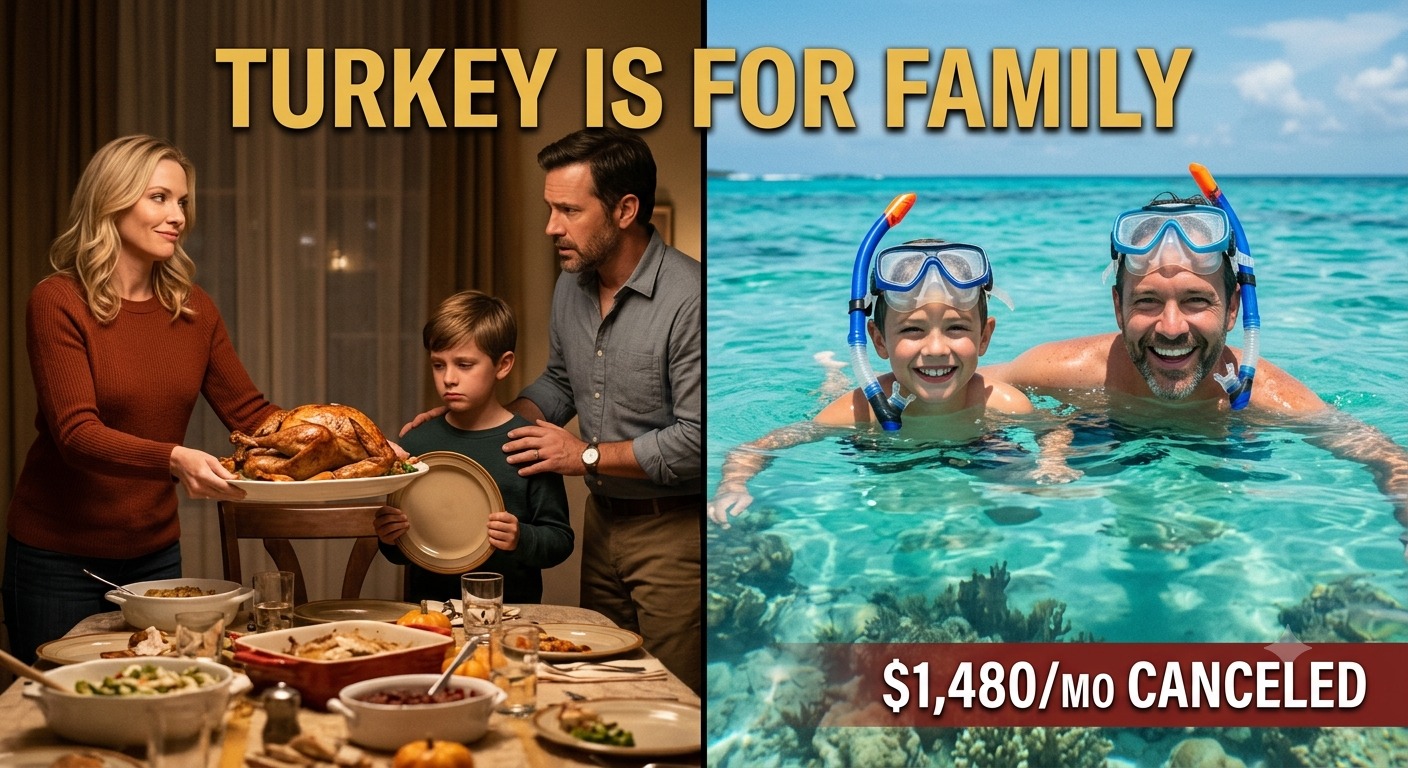
Some of our relatives chuckled. I calmly stood up, took my son’s hand, and said, “Let’s go, buddy.”
The following week, I posted photos from our trip to the Bahamas—first-class seats, a luxury resort, snorkeling over coral reefs. Twenty-three thousand dollars in total. When my sister called in a panic asking how I could possibly afford it, I gave her a simple answer: “Easy. I stopped paying your mortgage.”
By the time my sister leaned across the table and called my ten-year-old son “sweetheart,” my fork was already trembling over my plate.
“Sweetheart,” Caroline said, loud enough for the entire dining room to hear, “Thanksgiving turkey is for family.”
She slid the heavy porcelain serving dish away from him as if he were reaching for a fragile centerpiece rather than dinner.
Somebody snorted. One of my uncles let out a tight, awkward chuckle—the kind people make when they know something is cruel, yet don’t want to be the only one not laughing. My mom stared down into her wine glass. My dad kept carving the ham at the end of the table, pretending he hadn’t heard a thing.
My son, Luke, froze. His small hand hovered in mid-air, fingers still curled around the edge of the empty plate he had been holding out toward his aunt.
His ears turned pink first. Then his gaze dropped to the tablecloth, fixing on the pattern of little orange autumn leaves my mother only brought out for special holidays. He didn’t argue. He didn’t say, I am family. He just slowly pulled his plate back toward his chest, stared at the single dry scoop of mashed potatoes sitting on it, and swallowed hard.
I felt it then—that hot, stinging rush behind my eyes, followed by a vise-like tightness around my ribs. My first instinct was to stand up, flip the table, and scream until every single person in that room was forced to look at themselves in the mirror.
Instead, I sat very still.
Caroline laughed lightly and nudged the platter of turkey closer to her own kids. “You can have more potatoes, Luke,” she added, her tone dripping with mock generosity. “Besides, you probably had chicken nuggets with your dad three times this week, right? You’re not missing out.”
Luke nodded quickly. “Yeah. It’s okay.” His voice came out small. Far too small for a ten-year-old.
I looked around the table, waiting for someone—anyone—to step in.
My mom cleared her throat. “Caroline, just—”
Caroline cut her off with a bright, brittle smile. “Relax, Mom. It’s just a joke. He knows we love him.”
That word—joke—did the twisted thing it always did in my family: it took something mean-spirited and tried to spray cheap perfume over it. People shifted in their chairs. Silverware clinked against china. The dinner conversation lurched back into motion as if nothing had happened.
Except it had. Luke kept staring down at his lap, as though looking up and meeting my eyes would make the humiliation permanent.
I pushed my chair back. The legs scraped loudly against the dining room tile.
“Hey, buddy,” I said, standing up. My voice sounded much calmer than I felt. “Grab your hoodie.”
He blinked up at me, startled. “We’re going?”
“Yeah.” I reached down for his hand. My palm was sweating, but my grip was firm. “Let’s go.”
For a second, nobody spoke. Then my dad finally looked up, his carving knife hovering in the air. “Sam, come on. We just sat down.”
I didn’t look at him. “Luke,” I repeated gently. “Hoodie.”
Caroline let out a sharp, dismissive laugh—a sound I knew all too well from decades of being on the receiving end of it. “You’re really walking out over a piece of turkey?”
I squeezed Luke’s hand. “We’re leaving because I don’t let anyone talk to my son like that.”
Luke’s chair scraped softly as he stood. He didn’t look at his cousins or his grandparents; he kept his eyes locked on our joined hands, as if that were the only solid thing left in the room. I walked him out past the buffet counter and down the hallway, right past the wall of framed family portraits where he only appeared in a single group shot—half cropped out on the far edge.
The scent of roasted turkey and cinnamon candles followed us to the foyer. Not a single person got up to stop us. I pulled open the front door, letting the crisp November night air hit my face like a much-needed slap, and stepped out onto the porch with my boy. Behind us, through the closed door, the laughter started right back up.
My name is Samuel. I’m thirty-seven, and I live in Dallas, Texas. By trade, I’m a performance marketer—a digital media buyer, if we’re skipping the obnoxious LinkedIn jargon. I build ad campaigns on Meta and Google, optimize sales funnels, and stare at analytics dashboards until columns of numbers start to feel like living, breathing people.
More importantly, I’m a single dad. Luke is ten. He loves space documentaries, Minecraft, and dipping his chicken nuggets in honey instead of barbecue sauce because he thinks it feels fancy. Most weeks, it’s just the two of us in a two-bedroom townhouse with creaky wooden stairs and terrible guest parking, but great afternoon sunlight in his bedroom for homework and Lego builds. His mom—my ex-wife—moved to Denver two years ago for work. They do long weekends and summer breaks together. Our arrangement isn’t textbook perfect, but it’s peaceful, and peace is something I’ve learned never to take for granted.
My extended family, on the other hand, knows nothing about peace.
Caroline is my older sister by three years. She’s married, has three kids, and lives in the same quiet suburb as our parents. She quit her job when her oldest was born and never went back. Her husband, Todd, works construction whenever crews are hiring—which, according to them, happens less and less every year.
I do well for myself. Last year I cleared mid-six figures thanks to an e-commerce client whose brand blew up on TikTok, alongside a few steady retainers I’ve held onto since before the pandemic. I’m not private-jet wealthy, but I’m very comfortable. I max out my 401(k), contribute to a brokerage account, and occasionally splurge on things like first-class upgrades when Luke travels with me because he’s hitting a growth spurt and loves the extra legroom.
In my family, financial stability made me the default safety net.
It started small: a few hundred dollars here and there when Caroline and Todd fell behind on daycare. Covering an unexpected transmission repair when my dad’s truck died right before winter. Buying new mattresses for my parents’ guest rooms because my mom complained her back ached wheneverCaroline’s kids slept over.
Then came the mortgage.
Three years ago, Todd injured his back on a job site. It wasn’t life-threatening, but it was bad enough to keep him off his feet for a few months. They were already behind on their house payments. Caroline called me sobbing from the parking lot of their bank, swearing they were about to be foreclosed on and that her children would be traumatized for life.
I ran the numbers in my head the same way I would for a client: cash flow in, fixed expenses out, worst-case projections. I realized I could float them.
“I’ll cover the mortgage until Todd is back on his feet,” I told her, setting up an automated payment from my checking account.
It was supposed to last three months. It turned into thirty-six.
On the first of every month, $1,480 left my bank account and went straight to Caroline and Todd’s Wells Fargo mortgage. After the first year, I barely even looked at the notifications. It became just another fixed line item in my spreadsheet, right next to my own rent and utilities.
My parents knew all about it. They treated my checks as proof that I was finally “stepping up” as a good brother and son. And in exchange for over fifty thousand dollars of support, they gave me access. Not respect. Not warmth for my child. Just access.
We were invited to everything—Easter brunches, Fourth of July barbecues, Sunday potlucks. And I always brought Luke, desperate for him to grow up knowing his cousins and grandparents, wanting him to feel the warmth of a big family.
To do that, I forced myself to ignore the cracks.
I ignored it when Luke turned eight and my parents bought Caroline’s two older kids brand-new Nintendo Switches for “doing well in school,” while handing Luke a clearance-rack board game and a sweatshirt two sizes too big. “He moves back and forth between Dallas and Denver,” my mom had explained when she caught me staring at the electronics. “We just didn’t want anything expensive getting lost in the shuffle.”
I ignored it the spring Caroline took her kids and my parents to Six Flags without inviting us, then posted a photo of everyone eating funnel cakes with the caption: All the grandkids together! Luke had been sitting right next to me on the couch when that post popped up on my feed. I watched his face fall as he silently counted the kids in the picture—his two older cousins, plus his baby niece in a stroller. Three grandkids. No Luke.
“Guess they forgot I exist,” he had said, letting out a quiet, practiced little laugh that no eight-year-old should ever know how to fake.
Back then, I told myself they were just careless, not cruel. I convinced myself that if I kept showing up and kept paying the bills, they would eventually love my son the way they loved Caroline’s kids.
I should have known better.
We drove home from Thanksgiving in near-total silence. Luke sat in the back seat, the seatbelt cutting diagonally across his hoodie, his hands shoved deep into his front pocket. It was 7:30 p.m. and pitch dark outside, the streetlights casting blurry halos across the damp pavement.
In my head, I replayed the dinner scene on a loop: Caroline’s hand sliding the platter away; my father refusing to look up; my mother pressing her lips together in silence. That wasn’t a slip of the tongue. It was a boundary they had drawn right in front of us.
“Hey,” I said softly, glancing in the rearview mirror. “You hungry?”
“I’m fine,” he lied. He had eaten half a dinner roll and a single spoonful of cold potatoes. He was ten years old on Thanksgiving night; he should have been stuffed with pie and half-asleep, not hollow and quiet.
“Let’s grab something on the way home,” I said. “What do you feel like?”
He shrugged. “Doesn’t matter.”
I pulled into the drive-thru of the first diner we passed and ordered him a massive chicken tenders basket with extra fries and three cups of honey. He didn’t say a word until I handed the warm paper bag back to him.
“Dad?”
“Yeah, buddy?”
“Did I do something wrong? I thought Aunt Caroline liked me.”
My knuckles turned white on the steering wheel. “You didn’t do a single thing wrong, Luke. Sometimes adults forget how to be kind, and that is never on you.”
He stayed quiet for a moment, the crinkle of the paper bag filling the cab. “Her kids are more family than me, right?”
The question hit me harder than anything Caroline had said at that table, because I realized Luke hadn’t just noticed it tonight. In my line of work, we look at conversion signals—tiny data points like clicks, scrolls, and pauses that eventually add up to an undeniable conclusion. My son had been collecting data points for years: the uneven gifts, the cropped photos, the uninvited trips.
And honestly, so had I.
Just three months before Thanksgiving, Caroline had called me with a new request. “We’re thinking about remodeling the kitchen,” she’d said, as casually as if she were ordering takeout. “Since you’re already helping with the mortgage, the loan officer said we could easily refinance and pull cash out if you just co-sign for us.”
“No,” I had told her immediately.
She’d laughed, caught off guard because I rarely turned her down. “No as in not this month, or…?”
“No as in I already send you nearly fifteen hundred dollars a month, Caroline. I’m not tying my credit score to your new granite countertops.”
Her voice had gone ice-cold. “Wow. Okay. You don’t have to be rude about it.”
Ever since that phone call, her little jabs had grown sharper. At Sunday dinners, she’d make passive-aggressive remarks about how “some people think they’re better than everyone else just because they work on a laptop,” or roll her eyes when Luke talked about a science project and mutter, “He talks like a tiny forty-year-old. Guess that happens when your dad has no social life.”
I had brushed all of it off to keep the peace. But the turkey comment wasn’t directed at me. She had aimed straight at my kid to remind everyone at that table of the family hierarchy: her children were the “real” grandchildren, and Luke was just an outsider passing through.
And the family had laughed along.
After Luke finally fell asleep that night, full of chicken tenders and exhausted from the emotional weight of the evening, I sat on the living room couch with my laptop open.
On the left side of my screen was a client’s Black Friday campaign. On the right was my online banking portal.
I scrolled through my transaction history. Thirty-six neat rows of $1,480 payments, stretching back three years—a monument to “just until Todd gets back on his feet” and “we’re almost caught up, little brother.”
At the top of the page sat the scheduled transfers:Next Payment: December 1st — $1,480.00Recipient: Caroline & Todd / Wells Fargo Mortgage (Auto-Pay)
My cursor hovered over the Edit button.
I had been paying for the roof over the heads of people who had just looked my child in the eye and told him he wasn’t family enough to eat at their table. They had happily accepted my money for three years; they had never once accepted my son.
I clicked Edit. Then I clicked Cancel Recurring Payment.
A dialogue box popped up: Are you sure you want to cancel this automatic payment?
I sat in the dim light of the living room, listening to the hum of the refrigerator and the soft whir of Luke’s bedroom fan down the hall. My heart was hammering harder than it did before a six-figure campaign launch.
“Yes,” I whispered, and clicked Confirm.
At 11:47 p.m., the confirmation email landed in my inbox. I stared at it for three full minutes, then opened my personal finance spreadsheet. Line by line, I deleted “Caroline Mortgage — $1,480” from the next twelve months of projections.
I wasn’t sending a furious midnight text. I wasn’t issuing ultimatums. I was doing what I do best: reallocating the budget and letting the numbers speak for themselves.
Seeing an extra $17,760 stay in my account over the next year changed the entire picture. I added a new row to my monthly budget: Experiences with Luke — $1,200/mo.
Then I opened a new browser tab.
Earlier that afternoon, before we’d left for my parents’ house, an ad had played on the TV—ironically, a retargeting campaign for a luxury resort in the Bahamas that one of my agency friends managed. It showed a father and son snorkeling in crystal-clear turquoise water above bright yellow reef fish. Luke had actually paused the television just to stare at it.
“That looks fake,” he had said, half in awe. “The water is way too blue.”
“It’s real,” I’d told him. “Some places really look like that.”
Now, at midnight, I pulled up December travel packages. I knew I had plenty of cash sitting in my high-yield savings account, and with Caroline’s mortgage off my plate, I would make back the cost of a major splurge in just over a year.
I filtered for non-stop flights out of Dallas, leaving the following Friday:
-
Two round-trip first-class tickets to Nassau: $8,900
-
Seven nights in an ocean-view suite at an all-inclusive resort with a water park: $9,600
-
Private airport transfers, reef snorkeling excursion, and the dolphin swim package Luke had once talked about: $2,500
-
Extra budget for off-resort dining, tips, and souvenirs: $2,000
Total: $23,000.
Put another way: roughly fifteen months of my sister’s house payments.
My thumb rested on the trackpad. Authorizing $50,000 in client ad spend barely raised my pulse anymore, yet spending $23,000 on myself and my kid felt massive. Then I pictured Luke shrinking into his hoodie at that dining table while my sister slid the food away. If I could spend over fifty grand supporting people who wouldn’t even feed my son, I could damn well spend twenty-three grand giving him a week where he felt like the center of the universe.
I hit Book.
I waited until the next morning to tell him. At 8:00 a.m., Luke padded into the kitchen, his hair sticking straight up and his Star Wars pajama pants sitting an inch too high above his ankles.
“Morning,” I said, sliding a plate of warm pancakes across the counter. “Got a serious question for you.”
He yawned, rubbing his eyes. “Okay.”
“If you could go anywhere in the world with just me for a whole week—no school, no work, no relatives—where would you pick?”
He blinked, his eyes sharpening as the question registered. “Anywhere?”
“Anywhere.”
It took him less than three seconds. “That place with the fake-looking blue water from the commercial. Where they were swimming with the yellow fish.”
I smiled and spun my laptop around on the counter so he could see the confirmation page. “Good choice. Because we leave next Friday.”
His eyes went wide as saucers. “Wait. For real?”
“For real. You’ll miss a few days of school, but I already emailed your teacher.”
His jaw dropped. “Is this actually happening?”
“Pack your swim trunks, buddy. It’s happening.”
He practically vaulted around the kitchen island and threw his arms around my neck so hard I nearly spilled my coffee. For the first time in years, every dollar I had worked for felt like it was going to the exact right place.
I didn’t call my parents that week. I didn’t send a dramatic message to the family group chat. I just muted their notifications, finished up my work campaigns, and took my son to buy new rash guards and goggles.
When we boarded the plane the following Friday, Luke couldn’t stop pressing the buttons on his first-class seat, whispering, “Dad, this is crazy,” every time the flight attendant brought him warm nuts or a ginger ale in a real glass. As the jet climbed above the Gulf of Mexico, he pressed his forehead against the window and said, “Best day of my life.”
And the week only got better. The island air was warm and salty, and the resort smelled like coconut sunscreen and Belgian waffles. Luke spent hours hurtling down water slides, surfacing with his hair plastered to his forehead and a grin so wide it erased every bad memory of Thanksgiving. When we went out on the reef boat and jumped in with our masks on, the water really was that impossible shade of blue. Luke popped his head above the waves, spat out his snorkel, and yelled, “Dad! The yellow fish are real!”
On our last afternoon, we lay side by side in rope hammocks strung between two palm trees, listening to the ocean breeze rustle the fronds overhead.
Luke was quiet for a long moment, swinging gently. “Dad?”
“Yeah?”
“Is it bad that I don’t miss them at all?”
I knew exactly who he meant. The cousins. My parents. Caroline.
“No, buddy,” I said, looking over at him. “It’s not bad at all. It just means you’re finally somewhere you’re appreciated.”
He nodded slowly, tucking that thought away, and closed his eyes in the sun.
We flew home on Saturday evening, sunburned and exhausted in the best possible way. On Sunday morning, I uploaded a few photos to Instagram—not even to start a fight, just because I wanted to remember how happy he looked. A shot of Luke giving a double thumbs-up in his snorkel mask. A photo of our messy suite overflowing with room-service trays. A picture looking out over the jet wing from Seat 2A with Luke’s hand resting on the console.
I captioned it: Thankful looked a little different this year.
My phone rang twelve minutes later. It was Caroline.
I let it ring twice before picking up.
“What the hell, Sam?” she snapped. No hello, no asking how we were. “First class? A luxury resort in the Bahamas? How on earth can you afford that? Did you win the lottery or something?”
I leaned back against my kitchen counter, barefoot on the cool tile. “Hi, Caroline. Nice to hear from you, too.”
“I’m dead serious!” she barked. “Todd just saw your post and he’s freaking out. Have you been hiding money from us? Where did that cash come from? Wait—did your transfer get delayed? Because the bank just sent us a late notice on the December mortgage!”
There it was. The unspoken rule of our family: Your money is our money.
“It wasn’t delayed,” I said evenly. “I canceled the automatic payment.”
Silence fell over the line—complete, stunned silence. I could hear the faint murmur of her television in the background, but for three seconds, she didn’t even breathe.
“You what?”
“I canceled the bill pay the night of Thanksgiving,” I said. “That money goes toward my son now. You know—the kid you refused to give a slice of turkey to.”
Her breath came out in a sharp gasp. “You can’t just cut us off without warning, Sam! We built our entire monthly budget around that transfer!”
“That sounds like a conversation for you and Todd.”
“Are you out of your mind?” Her voice pitched high and shrill. “We’ll lose the house! What about my kids?!”
“What about them?” I replied, keeping my voice level. “Will they have to live in a house their parents actually pay for? I’ve carried your mortgage for thirty-six months, Caroline—over fifty-three thousand dollars. And in all that time, you couldn’t even treat Luke like he belonged at the dinner table.”
“That is ridiculous!” she shouted. “I love Luke! You are blowing one harmless joke completely out of proportion! You embarrassed the entire family by storming out, and Mom has been crying all week!”
“Then Mom can cry,” I said calmly. “And next time she can serve my son more than dry mashed potatoes. I’m done paying admission just so my kid can be treated like a second-class guest.”
Panic finally bled through her anger. “Sam, please, you can’t do this. We’re already behind on the utilities. If you pull the mortgage money now, the bank will start foreclosure. Think about the children!”
“I am,” I said. “I’m thinking about mine. You’re off my payroll, Caroline. Figure it out.”
I hung up before she could scream another word.
The fallout hit my phone within minutes. Caroline sent a barrage of texts accusing me of “financial abuse,” punishing my nieces and nephew, and being brainwashed by some imaginary new girlfriend.
Ten minutes later, my mother called. I let it roll to voicemail, then read the transcription: “Sammy, call me back immediately. Caroline is hyperventilating. You cannot just pull the rug out from under your sister over a misunderstanding. We are family.”
I sent a single text back: I don’t fund a family that my son isn’t part of.
She replied instantly: Nobody said Luke wasn’t family! Caroline made a silly tease at dinner. Do not throw away years of family love over a plate of turkey.
I looked across the living room at Luke, who was sitting on the rug building a Lego starship, the woven neon wristbands from the Bahamas resort still tied around his wrist.
It wasn’t about the turkey, I typed back. It’s about years of treating my kid like an afterthought while cashing my checks. That ends today.
I muted her notifications, right before my dad sent his own message: Your mother is sick over this. I raised you better than to use money as a weapon against your own blood.
I replied once: You raised me to pay everyone’s bills and swallow disrespect. I’m raising Luke differently.
He never wrote back. Over the next few days, Caroline resorted to sending guilt-trip photos—pictures of past-due envelopes, a staged photo of her kids looking sad on the living room sofa. If we end up on the street, this is on your conscience, she wrote.
If you lose the house, I replied, it’s because two capable adults lived beyond their means and bit the hand that funded them. Then I blocked her number.
A week later, my cousin Jenna—who had been sitting at the far end of the table during Thanksgiving—sent me a direct message. “Your mom is telling everyone you abandoned Caroline out of nowhere,” she wrote, “but she conveniently leaves out what Caroline did to Luke. I fixed the story in the family group chat. For what it’s worth, Sam, you did the right thing.”
I hadn’t realized how badly I needed just one person from that dining room to confirm I wasn’t crazy.
That night, as I tucked Luke into bed, I asked him with a smile, “How’s the noise level in here?”
He frowned up from his pillow. “What noise?”
“Nothing at all, buddy,” I said, switching off his lamp. “Go to sleep.”
Caroline didn’t lose her house. Through Jenna, I eventually heard that the bank modified their loan, Todd started picking up weekend overtime shifts, and Caroline finally took a part-time administrative job at a dental office. In other words, once their human ATM shut down, they figured out how to function like adults.
Naturally, Luke and I weren’t invited to Christmas. It stung a little on Christmas morning when I scrolled past a photo of everyone in matching plaid pajamas around my parents’ tree, captioned: Whole family together, just like always.
Luke caught a glimpse of the screen while we were frosting sugar cookies at the kitchen counter. He looked down at his own navy-blue fleece pajamas covered in planets and astronauts. “I like our pajamas way better,” he said matter-of-factly.
I looked at him, covered in flour and genuinely happy, and realized I meant it too. “Me too, bud.”
When the next Thanksgiving rolled around, I rented a cozy two-bedroom cabin on a quiet lake two hours outside Dallas, complete with a stone fireplace and a slightly wobbly wooden dock. I invited Jenna and her ten-year-old twins to join us.
We set the rustic wooden table with mismatched cabin plates. At the end of the table sat two extra wooden chairs that had come with the dining set.
“Who are those for?” Luke asked while lining up slices of canned cranberry sauce on a dish.
“Nobody,” I said easily. “We don’t need to fill seats with people who don’t know how to act like family.”
When I pulled the roasted turkey out of the oven, I carved the first thick, golden slice and laid it right on the center of Luke’s plate. “First piece goes to the heart of the family.”
Luke rolled his eyes, grinning. “Cheesy line, Dad.”
“Hey, you’re stuck with my script.”
“I’ll allow it.”
Later that night, after everyone was stuffed with pumpkin pie, Luke handed me a folded piece of notebook paper. Inside was a crayon drawing of our cabin dinner table—five smiling stick figures representing me, him, Jenna, and her twins, surrounded by plates of food. Across the top, in neat ten-year-old handwriting, he had written: Thanksgiving = Me + Dad + People Who Act Like Family.
My throat tightened. “I love it, buddy. This is going straight on the fridge when we get home.”
Around 9:00 p.m., a generic text from my mother buzzed on my phone: Happy Thanksgiving. Love you. No mention of Luke. No apology for the year before. I didn’t bother replying.
For years, I had foolishly believed that paying for everyone else’s comfort was the price I had to pay so my son would have a place to belong. It took a cruel remark over a holiday dinner for me to finally learn that you cannot buy love from people who only value your wallet. Instead, you use what you have to build a life where your child never once has to wonder if he deserves a seat at the table.
Down the hallway, Luke’s laughter echoed as he and his cousins built a blanket fort in the bedroom. Walking back into the dining area, I folded up the two empty wooden chairs, leaned them neatly against the back wall, and turned off the light.
For the first time in my life, the table looked complete.