


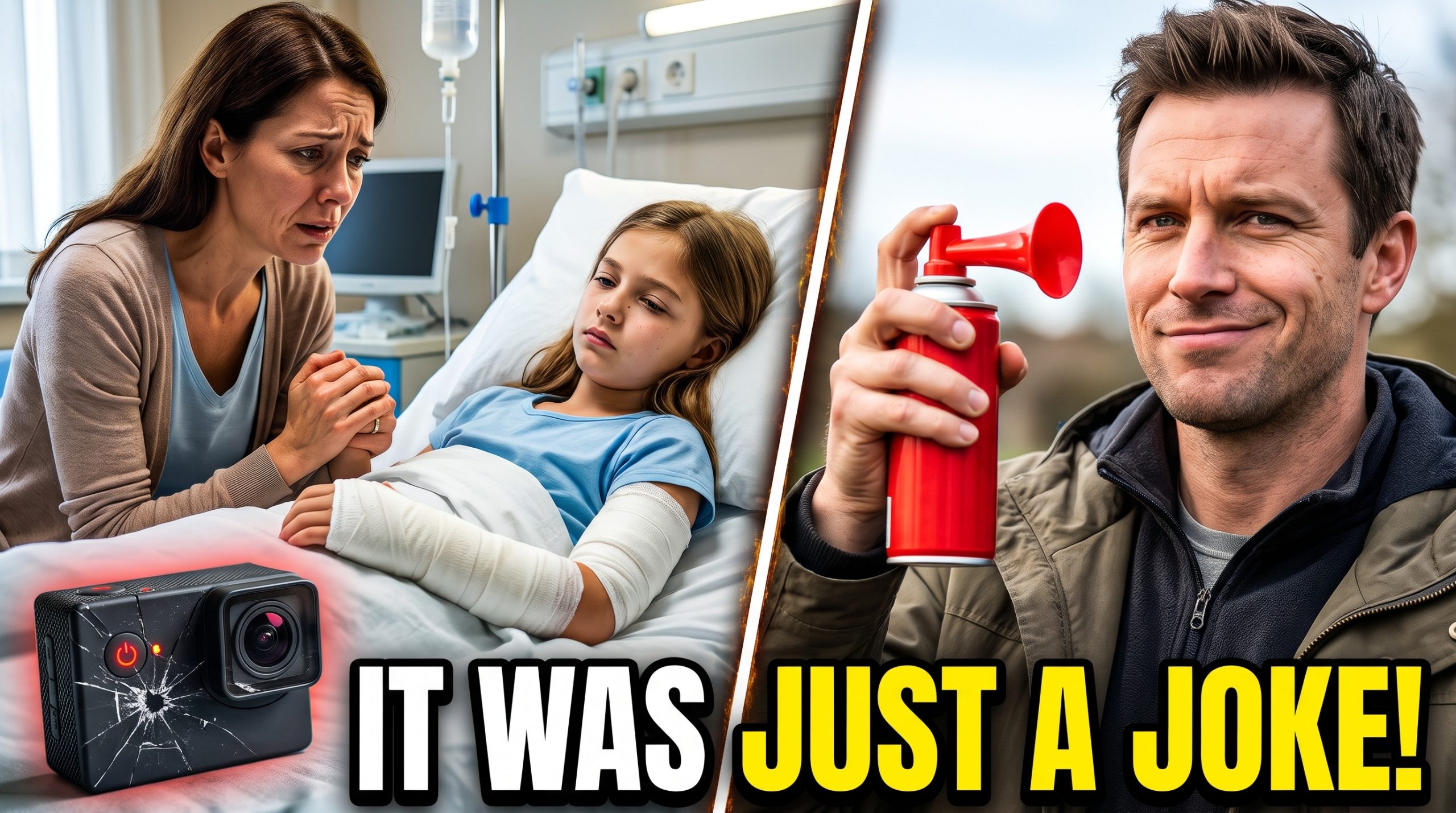
My name is Rachel Mercer Hale. I am thirty-seven years old.
The moment I knew something in my family was permanently broken, my eleven-year-old daughter was being lifted onto a stretcher while my younger brother stood six feet away in the driveway, laughing.
Maya’s face had gone completely pale. Blood was soaking through the kitchen towel my husband was pressing firmly against her right forearm. And the pieces of the heavy ceramic casserole dish she had been carrying were still scattered across the bottom of my parents’ hallway steps.
Derek kept saying the exact same thing. “It was a joke, Rachel. Just a joke.”
I remember looking at my brother and thinking that something was fundamentally wrong with what I was seeing. Not because Derek had never taken a joke too far before—he had, more times than I could count—but because Maya was crying so hard she could barely catch her breath, and he was still chuckling like the rest of us had simply missed the punchline.
What I didn’t know yet was that Maya’s arm would require emergency surgery. I also didn’t know that a few hours later, while Derek was still texting me to complain about how unfairly he was being treated, a nurse would hand me a clear plastic bag containing something my brother hadn’t realized Maya was carrying. And once I saw what was on it, I would never look at that afternoon—or my family—the same way again.
Before I tell you how we got there, if stories about family dynamics, hidden warning signs, and the moments that change everything matter to you, please take a second to subscribe and like this post. It helps this community keep talking about the things people brush under the rug far too often.
To understand why Derek was laughing beside an injured child, I have to go back a few hours before the ambulance and the hospital—back to when I was still telling myself I knew how to manage my brother.
My parents’ house had always been our family’s gathering spot. That Sunday afternoon, the dining room was warm and crowded, smelling of roast chicken and garlic, with serving dishes spread across the counter. Maya was sitting at the corner of the patio, excited about a tiny pocket action camera she had saved up her own allowance to buy. She had been filming little clips all afternoon—zooming in on the family dog, interviewing her grandfather, and narrating the day like a miniature documentary filmmaker.
From across the room, Derek noticed her. “Careful,” he announced loudly to the room. “Maya’s filming us now. Better act normal or she’ll put us on the internet.”
Maya immediately lowered the camera, her shoulders shrinking inward.
Derek grinned. “What? I’m kidding.”
That phrase had done a lot of heavy lifting in our family over the years. Derek was thirty-three. Charming when he wanted to be, quick with a comeback, and utterly allergic to accountability. Growing up, I was always cast as the “reasonable, responsible” one, and Derek was the “fun” one. If he made a mess, someone else cleaned it up. If he hurt someone’s feelings, my mother found a way to soothe the room. And if I pushed back, I was usually reminded that I was the older sister and should know better than to start an argument. I spent decades believing that keeping the peace made me mature. That afternoon, it just made me blind to what was happening right in front of me.
Ten minutes later, Derek walked up behind Maya in the kitchen and sharply flicked the back of her ear.
She spun around, startled, rubbing her ear. “Uncle Derek, stop!”
He laughed. “You should’ve seen your face.”
“I told you I don’t like that,” Maya said quietly, her voice tight.
I looked up from the sink. “Derek, leave her alone.”
“I barely touched her,” he scoffed.
“Then it should be very easy for you to stop,” I replied.
Before the tension could settle, my mother stepped between us holding a large ceramic baking dish. “Who wants to help set the table?”
Derek threw his hands up in mock surrender. “See? Everyone’s so sensitive today.” The conversation moved on. That was what we always did.
A few minutes later, Maya came back into the kitchen while I was helping my mother wrap up the side dishes. “Can I carry something out, Grandma?”
My mother gestured to the heavy ceramic dish of scalloped potatoes sitting on the island. “You can take this to the dining room table for me, sweetheart. Use both hands—it’s heavy.”
“Got it,” Maya said, gripping the handles carefully with oven mitts.
The path from the kitchen to the dining room goes through a wide hallway with a sunken floor—just three tiled steps leading down. My father had always reminded the grandkids not to run near those steps.
I was rinsing a knife at the sink when I heard Derek’s voice from the living room. “Watch this.”
I turned, my view partially blocked by the pantry doorway. Another voice—one of my cousins standing near the patio door—answered him immediately in a low, urgent tone: “Derek, don’t. Not by the steps.”
Then I saw Maya. She was walking carefully toward the sunken hallway, holding the heavy ceramic dish with both hands, her eyes fixed on her footing. And standing near the window was Derek, holding a red canned air horn someone had brought earlier for my nephew’s soccer game.
My stomach dropped. “Derek—”
He looked right toward the hallway. “I know what I’m doing.”
He pressed the button.
The blast was deafening inside the enclosed house. Even seeing it coming, I flinched. Maya violently jolted in mid-step. Her foot missed the edge of the top stair. For one agonizing second, she tried to hug the heavy ceramic dish to her chest to save it. Then her ankle twisted, and she went down hard.
The ceramic dish shattered against the tile steps with a sickening crash.
“Maya!”
I don’t even remember crossing the kitchen. One second I was at the sink, and the next I was on my knees beside my daughter. She was curled on the bottom step amidst a mess of food and jagged porcelain shards, clutching her right arm. A thick piece of glazed ceramic was wedged deep into her forearm, and bright red blood was already pooling on the pale tile.
“Don’t move, baby, don’t move,” I gasped, my hands trembling.
“Mom—my arm—Mom, it hurts!” she sobbed, hyperventilating.
“I know, baby, I’m right here.”
My husband, Daniel, was there in seconds, ripping a clean kitchen towel from the counter and pressing it firmly around the wound while barking at my father to call 911. My mother stood frozen at the top of the steps, her hands over her mouth.
And that was when I heard it. A laugh. Not a hysterical laugh of shock—a breathy, nervous chuckle.
I snapped my head up. Derek was still standing near the window, the red air horn dangling from his hand. The smirk faded from his face the second his eyes met mine, but instead of rushing over to help, he shifted his weight defensively.
“Oh, come on,” Derek said. “I didn’t push her.”
Nobody answered him. Daniel kept pressure on Maya’s arm while I held her left hand, trying to keep her from looking at the blood.
Derek took a half-step back. “It was a prank. She just tripped.”
“Say my name, baby, look at me,” I whispered to Maya, completely ignoring him.
The next several minutes blurred into sirens, heavy boots, and paramedics crowding the hallway. I rattled off Maya’s age, weight, and allergies while holding her hand. When the paramedics carefully wrapped her forearm, I saw the two of them exchange a quick, serious look that made my heart seize.
As they wheeled her stretcher out the front door, Derek tried one more time. “Rachel, obviously I didn’t mean for her to fall.”
I finally stopped and looked back at him. He looked frustrated—as if my silence were an overreaction he was being forced to endure. That was the first moment I realized this wasn’t going to end with Derek apologizing.
The paramedic called for me. I climbed into the back of the ambulance beside my daughter, and the heavy doors slammed shut, leaving Derek standing on the porch with the air horn still in his hand.
The ride to the hospital took fourteen minutes. I know because I stared at the digital clock above the doors while Maya squeezed my fingers every time the ambulance hit a bump. The paramedic kept his voice calm, asking her if she could wiggle her fingers or if she felt any numbness or tingling in her hand. When she whispered that her fingers felt “fuzzy and cold,” the look on his face nearly broke me.
“The doctors are going to know exactly how to fix it,” I told her, kissing her forehead. “Just keep looking at me.”
Daniel arrived at the ER just minutes after we did, having followed right behind the ambulance in our car. He didn’t offer empty promises that everything would be fine; he just put his steady hand on the back of my neck and stayed beside me.
After the initial examination and X-rays, the ER doctor—and then the orthopedic hand specialist—explained the situation. Along with several smaller lacerations, one large shard of ceramic had sliced deep into Maya’s anterior forearm, partially severing a flexor tendon and damaging a nearby nerve branch. They needed to take her into surgery tonight to irrigate the wound, make sure no microscopic ceramic fragments were left behind, and repair the tendon and nerve.
Maya looked up at me in panic. “Surgery? Mom, I don’t want to go to sleep. What if I wake up and my hand doesn’t work?”
Before my voice could crack, the surgeon gently stepped in, assuring her that protecting the full use of her hand was the exact reason they were operating right away. When the orderlies came to wheel her toward the pre-op doors, Maya cried silently, gripping my left hand until the very last second I was allowed to walk beside her bed.
As I stood staring at the closed double doors, my phone buzzed in my pocket. I pulled it out and saw eleven missed messages in the family group chat and my private texts.
From my mom: We’re on our way. From my dad: How is she? And then, four messages from Derek:I swear I didn’t think she’d drop the dish.Tell me what the doctors say.Rachel, I feel awful.Everyone is acting like I did this on purpose.
That last line changed something inside me permanently. Not because it was the worst thing he could have said, but because while my eleven-year-old daughter was lying under surgical lights wondering if her hand would ever work normally again, my thirty-three-year-old brother was already busy building his defense.
Daniel saw my face. “Him?”
I handed him the phone. His jaw tightened. “Don’t reply.”
“I won’t.” For the first time in my life, I felt zero urge to cushion Derek from the consequences of his own actions.
Twenty minutes later, my parents walked into the waiting room—with Derek trailing right behind them. My mother’s eyes were red and swollen; my father looked like he had aged ten years since lunch. Derek just looked uncomfortable.
My mother hugged me first, asking how Maya was. When I explained the severed tendon, the nerve damage, and the months of physical therapy she would need, my mother covered her mouth and sobbed.
“I never should have asked her to carry that heavy dish,” my mother whispered, shaking her head. “If I hadn’t asked her—”
“Mom, stop,” I said firmly. “Don’t do that.” I knew that road too well—the family habit of everyone rushing to blame themselves so the person who actually caused the harm wouldn’t have to carry the guilt alone.
Derek rubbed the back of his neck, letting out a loud sigh. “Look, I didn’t know she was going to freak out like that.”
Daniel stepped toward him, and I put a hand on my husband’s chest—not to protect Derek, but because this was mine to say.
“You were told not to scare her by the steps,” I said, my voice dead calm.
Derek frowned. “Who said that?”
“Cousin Mark. I heard him tell you directly.”
“Rachel, people say ‘don’t’ when someone’s messing around all the time,” Derek argued, his voice rising defensively. “I didn’t think she’d actually fall! You know how jumpy she is. She’s eleven—everything scares her.”
He gave a small, dismissive huff—almost a laugh.
My father spoke his name sharply. “Derek.”
“What?” Derek threw his hands out. “I’m not laughing at Maya! I’m just saying nobody could have predicted this!”
“Mark predicted it two seconds before you pressed the horn,” I said, staring straight through him.
“Then why didn’t somebody stop me?!” Derek snapped.
The silence that followed was deafening. Derek seemed to realize how absurd those words sounded only after they were already hanging in the air.
“Enough,” my father said, his voice shaking with anger.
“You are not putting this on anyone else,” I told Derek quietly. “Everyone in that room had two seconds to react. You had all the choices.”
My mother stepped between us, falling right back into her lifelong role. “Please, we are all hurting right now. This is not the time to tear each other apart.”
I looked at my mother. “When is the time, Mom? When nobody is bleeding anymore so it doesn’t feel urgent? When Derek says ‘sorry’ just loud enough to make everyone feel awkward if we don’t forgive him, and then we all move on to dessert?”
“Rachel, that’s not fair,” she whispered.
“No. Maya being in an operating room because a grown man needed to terrify an eleven-year-old for a laugh—that’s what isn’t fair.”
“I wanted her to jump! I didn’t want her to fall!” Derek shot back.
For thirty years, that distinction between his “intentions” and the damage he caused had been enough to get him off the hook. Not anymore. I sat back down in my chair. “I am done talking to you until I know my daughter is okay.”
The surgery took just over two hours. Two hours is an eternity when your child is behind locked doors. I paced the hallway. Daniel brought me water I didn’t drink. My mother cried quietly, my father stared at the floor, and Derek sat in the corner glued to his phone. At one point, I heard him snort at something on his screen—probably a video or a meme—and when he looked up and saw me staring at him, he quickly put the phone away.
When the surgeon finally came out, I stood up so fast the room spun.
“She did great,” the doctor said, and I let out the first real breath I’d taken all afternoon. They had removed two tiny fragments of ceramic glaze, repaired the tendon, and stitched the nerve sheath. She would be in a splint and cast, followed by months of rehabilitation, before we knew if she’d regain 100% of her sensation and dexterity—but the surgery was a success.
As the surgeon turned to leave, a recovery nurse walked up holding a clear plastic hospital biohazard bag. “We removed her personal items while prepping her in the ER,” the nurse said gently. “I wanted to make sure you got them back.”
Inside the bag was Maya’s blood-stained sweatshirt, her little silver bracelet, and her tiny pocket action camera. The corner of the camera’s plastic casing was cracked, and there was dried blood smeared across the grip. I thanked the nurse and slipped the bag into my tote.
By the time Maya was settled into a private room for the night, my parents had gone home after peeking in on her, and Derek had long since left. Daniel stayed until Maya drifted back to sleep, then drove home to grab clothes, chargers, and toiletries for us.
The hospital room was quiet, save for the rhythmic beeping of the monitor. As I sat beside Maya’s bed, my phone buzzed again. It was Derek.
Are you going to tell me how she is, or are you going to keep punishing me? Followed by a second text:I already said I feel terrible. I’m not going to keep apologizing for an accident I didn’t mean to happen.
I set my phone face-down without replying. Reaching into my bag to find a charger, my fingers brushed against Maya’s cracked pocket camera. I remembered her walking around before lunch, happily recording her little family vlog. And then a memory clicked into place: right before my mother handed her the casserole dish, Maya had clipped the tiny camera onto the strap of her overalls so she could have both hands free.
When Daniel returned with our overnight bag and his laptop, I handed him the little camera. “Can you check the SD card? I just want to know if her videos from today were ruined. It’ll break her heart if she lost them.”
Daniel popped the memory card into his laptop and plugged in a pair of headphones, sharing one earbud with me. The first few clips were exactly what I expected—shaky footage of the backyard, Maya giggling into the lens, my dad showing off his grill.
Then Daniel clicked on the final video file.
The camera angle was pointing outward from her chest strap. We saw Maya’s hands slipping on the oversized oven mitts. “I call this the world’s biggest dish of potatoes,” Maya whispered playfully to the camera, “because Grandma made enough for an army.”
My mother’s laugh echoed in the background as Maya carefully lifted the ceramic dish and walked out of the kitchen. The camera bobbed gently as she approached the hallway.
Then, cleanly picked up by the microphone, came Derek’s voice from a few feet away:“Watch this. I’m finally gonna cure Maya of being scared of everything.”
My blood turned to ice.
Cousin Mark’s voice followed immediately: “Derek, don’t. Not by the stairs.”
There was a brief pause. Then Derek’s voice, clear as day: “I know what I’m doing.”
Two seconds later, the deafening blast of the air horn tore through the audio. The camera violently jerked upward, followed by the sound of Maya’s terrified scream, the horrific crunch of shattering ceramic, and a heavy thud. The lens was facing the ceiling now. Maya was gasping, sobbing for me.
And right there on the audio track—before our footsteps even reached the hallway—was the unmistakable sound of Derek laughing.
Daniel paused the video. Neither of us spoke.
I stared at the frozen screen, thinking of Derek standing in the waiting room yelling that nobody could have predicted this. Thinking of him claiming it was just a split-second prank. “I’m finally gonna cure Maya of being scared of everything.” He knew she was carrying a heavy dish. He knew she was at the top of the stairs. He was explicitly warned. And he decided his ego and his joke mattered more than her safety.
“Save three copies of that file,” I whispered to Daniel.
The next morning, Maya woke up feeling much more like herself. She asked for apple juice, joked about how giant her splint looked, and wondered what her friends at school would say. Then she spotted her little camera sitting on the bedside table. Her face fell slightly.
“Did it break?” she asked quietly.
“The case is cracked, honey, but the memory card is fine,” I told her. “We saved all your videos.”
Her eyes flicked up to mine. “Even… even the last one?”
“Yes, baby.”
Maya looked toward the closed hospital room door. “Is Uncle Derek here?”
“No.”
“Is he coming?”
“No.”
Her shoulders visibly dropped in a tiny sigh of relief. That small physical reaction hurt me more than anything Derek had said the night before. I pulled my chair closer to her bed and took her good hand.
“Maya, I need you to know something. You are not in trouble, and you didn’t do anything wrong. I just need to understand. Has Uncle Derek scared you like that before?”
She looked down at the blanket. “Not with the air horn.”
“What about other ways?”
She nodded slowly.
“How many times?”
“I don’t know. A lot.”
“Did you ever tell him you didn’t like it?”
She nodded again, her lip trembling. “He always says I make it too easy. He likes it when I jump. Sometimes he hides behind doors when I come out of the bathroom, or grabs my ankle from under the table, or slams his hand on the wall behind me. And when I tell him to stop, he laughs and says I can’t take a joke.”
My chest tightened so hard I could barely breathe. “Baby, why didn’t you tell me or Dad?”
Maya didn’t answer right away. When she finally looked up, tears were pooling in her eyes. “Because whenever he does stuff, everyone always laughs or says ‘that’s just how Uncle Derek is.’ And I didn’t want to be the one who causes problems at Grandma’s house.”
For a second, I couldn’t speak. She hadn’t learned that lesson from nowhere. She had learned it by watching us—by watching me swallow my frustration for years just to keep the family peace.
“Listen to me carefully,” I said, wiping a tear from her cheek. “You never have to let anyone scare you, hurt you, or make you feel small just because they are family. And you are never ‘causing problems’ by asking to be treated with respect. Are you worried I’m mad at you?”
“Because I broke Grandma’s dish,” she whispered, her voice breaking.
“Oh, Maya, no. I don’t care about that dish at all. Neither does Grandma. I only care about you. And I am so sorry I didn’t pay closer attention before.”
Later that afternoon, while Maya was napping, I told Daniel everything she had said. He listened quietly, his jaw set, and then asked me the only question that mattered: “What do you want to do?”
“I don’t want Derek around her anymore,” I said. “Not until he apologizes, not until he ‘learns his lesson’—I mean I don’t want him near my daughter. Period. I don’t trust him.”
“Then he’s not coming near her,” Daniel replied without hesitation.
Maya came home two days later. That evening, my mother called to ask if she and my father could come over to bring dinner and see Maya. I said yes.
Then she paused. “What about Derek? Rachel, he wants to see her. He feels awful.”
“No,” I said calmly. “He sent me texts blaming everyone else and complaining that I’m ‘punishing’ him. He doesn’t feel remorse, Mom—he feels uncomfortable with guilt. And it is not Maya’s job to make him feel better before she can even bend her own fingers.”
My parents came over without him. After Maya went upstairs to rest in her room, I asked my parents to sit at the dining table, and I placed Daniel’s laptop in front of them. I pressed play on the video.
My mother gasped and covered her mouth the moment Derek said, “I’m finally gonna cure Maya of being scared of everything,” followed by Cousin Mark’s warning. When the crash and Maya’s screams played out—followed by Derek’s laugh—my father stared at the table in complete silence.
Finally, my father spoke, his voice hollow. “Play it again.”
I did. The second time through, nobody said a word.
When it ended, my mother’s hands were shaking. “He… he still didn’t mean for her to get hurt like that, Rachel.”
There it was. The reflex that had kept our family sick for thirty years.
“I know he didn’t want her arm sliced open, Mom,” I said quietly. “That isn’t the point anymore. The point is: how many times does an eleven-year-old girl have to say ‘no’ before her safety matters more than his amusement?”
My father looked up sharply. “She told him to stop before?”
“Many times,” I said, and I told them everything Maya had confessed in the hospital—including why she had been afraid to speak up. My father took off his glasses and rubbed his eyes, looking utterly defeated.
“I love Derek,” I told them. “That’s what makes this hurt so much. But he is not going to be around Maya anymore.”
My mother stared at me in shock. “Ever? What if he changes?”
“If he grows up and changes, that will be wonderful for him,” I said. “It still won’t mean he gets access to my daughter.”
Before my mother could respond, the front door opened. Daniel walked in from the driveway, and the look on his face told me instantly what was wrong.
“Derek is outside,” Daniel said flatly.
My mother stood up, panicked. “I didn’t tell him to come, Rachel, I swear—”
A sharp knock hit the front door. I walked past Daniel and pulled it open. Derek was standing on the porch holding a cheap bouquet of grocery store flowers and a get-well balloon.
“I just need five minutes,” Derek said, trying to step past me.
“No,” I said, blocking the doorway. “Maya is resting.”
“Rachel, come on, I’m her uncle!” His face hardened immediately as the “nice guy” act slipped. “I came over here to apologize because she got hurt, and you won’t even let me in the door?”
“You came over here to clear your conscience because nobody is laughing with you anymore,” I said. I held up my phone and played the audio from Maya’s camera over the speaker.
For the first time in his life, Derek had nothing to say. The color drained from his face as his own voice echoed on the porch: “I’m finally gonna cure Maya of being scared of everything… I know what I’m doing.” Followed by the air horn, the shatter, and his laugh.
“Where did you get that?” he stammered.
“Maya’s camera,” I said. I watched his eyes dart past me toward our parents standing in the hallway, calculating his next move. “Were you secretly recording us?” he demanded, grasping at straws. “That’s weird, Rachel! I’m standing here trying to make things right! What do you want from me? You want me on my knees? You want to call the cops? What?”
“I want you to leave,” I said.
He let out a bitter, incredulous scoff, then looked past me at our mother. “Mom, are you really going to let her do this?”
My mother was crying, clutching a tissue to her chest. I braced myself for her usual plea to let him inside. Instead, she looked at the floor and didn’t say a word. And my father walked up behind me, looked straight at Derek, and said quietly: “Go home, Derek.”
Derek stared at us for a long second, threw the balloon onto the porch chair, and stormed down the driveway to his car.
That was the last time he was ever near my house. Over the next few weeks, his messages shifted from defensive excuses to bitter anger, accusing me of tearing the family apart over an “accident.” I blocked his number and left the family group chat. My father ended up paying for the entirety of Maya’s medical deductibles and physical therapy, and for the first time in my life, my parents stopped mentioning Derek’s name when they visited us.
Today, Maya has a thin white scar running down her right forearm, and after four months of hard work in physical therapy, she got full use of her hand back. She still loves making videos with her new camera. And more importantly, she knows that in our house, when she says “stop,” the adults around her will actually listen.