


She’s the unstable one in this family. My sister told the two officers standing in my parents’ kitchen, and then she pointed at me like she was picking me out of a lineup. My name is Kayla Peters, and within ten seconds of walking into that room, my entire life as I knew it was quietly dismantled by the people who were supposed to protect me. I’m 31 years old, a pediatric nurse, and until that Sunday afternoon, I had never so much as gotten a parking ticket. I was standing at the counter in my mother’s kitchen in Dayton, Ohio, slicing a lemon pound cake for my cousin’s kids. Eleven relatives were scattered through the house, laughter and fragments of conversation bouncing off the drywall.
The Bengals game was muted on the living room TV. Somebody’s toddler was banging a wooden spoon on a pot, a sharp, repetitive rhythm that suddenly felt like a countdown. Then the doorbell rang, and my father, Bruce, went to answer it with a face so gray I knew instantly he’d made a phone call he couldn’t take back. Before I go any further, tell me the town you’re listening from. It means a lot to me. $89,000 was gone from the Kenneth Peters Education and Emergency Fund, the account my grandfather set up before he died so that any of his grandchildren could someday pay for school or survive a bad year.
My parents had been the trustees ever since. Three transfers in six weeks, all of them sent to a credit union account that, according to the statement my sister Alexis had somehow already printed and highlighted in yellow, belonged to me. I had never opened that account in my life. I said so. I said it twice, then a third time, louder, and heard my own voice crack in a room full of people who had gone completely silent. My Aunt Joyce pulled her grandkids behind her skirts as if I had suddenly transformed into someone dangerous.
My mother Cheryl stood by the refrigerator with her arms folded, looking at the floor tiles like they were the most interesting thing she’d ever seen. She’s been obsessed with that fund for years, Alexis said, and her voice wobbled in exactly the right places, carrying the practiced quiver of a victim. She’s always been jealous. We were scared to say anything. We just wanted her to get help. One officer asked me to put down the knife in my hand. I’d forgotten I was holding it. I set it next to the pound cake and put my hands where he could see them, and the cuffs went on in front of my whole family, with the game still playing silent in the next room.
The younger officer was gentle about it. He kept saying, I’m sorry, ma’am, under his breath, the way you do when you suspect the paperwork is fundamentally wrong, but the paperwork is still the paperwork. Walking out to the squad car, I looked back once. Alexis had her face buried in my mother’s shoulder, but she had turned just enough that I could see her over it. For half a second, the grief slid off her like a heavy coat. What was underneath was pure, clean relief.
I didn’t shout in the back of the cruiser. I didn’t shout when they walked me past the front desk at the Dayton police station, or when they took my shoelaces and my phone and put me in a beige room with a steel table and a camera blinking in the corner. I sat down and folded my hands. I breathed the way I teach scared parents to breathe in the pediatric ER. In for four, out for six. If you’ve never had a family like mine, it’s hard to explain the golden child dynamic. People think it’s an exaggeration, a buzzword you throw around at therapy. It’s not. It’s a weather system. You live under it.
Alexis is two years older than me, and from the time I could form memories, she was the one who got the infinite benefit of the doubt. When she backed my father’s Buick into the mailbox at 16, the street was slick. When I brought home a B-minus in 8th grade algebra and forgot to mention it for a day, I was being sneaky and deceitful. When Alexis was caught at 14 with $60 of my mother’s grocery money stuffed in her jacket pocket, my mother decided she must have been planning to put it right back. When my bike chain snapped on the way home and I walked in 11 minutes past curfew, I lost my phone for a month.
For a long time I thought it was just luck, the way some siblings inherit more patience than others. But luck doesn’t hold steady for 19 consecutive years. This was an engineered pattern, and once I could see the machinery behind it, I could never unsee it. I was 12 when I started keeping things. It began small, born from a kid’s desperate reflex for survival. I’d been accused of taking a $20 bill from my mother’s wallet, and I knew I hadn’t. More importantly, I knew who had, because I’d watched her do it through the narrow crack in the bathroom door. I got grounded anyway, branded a liar.
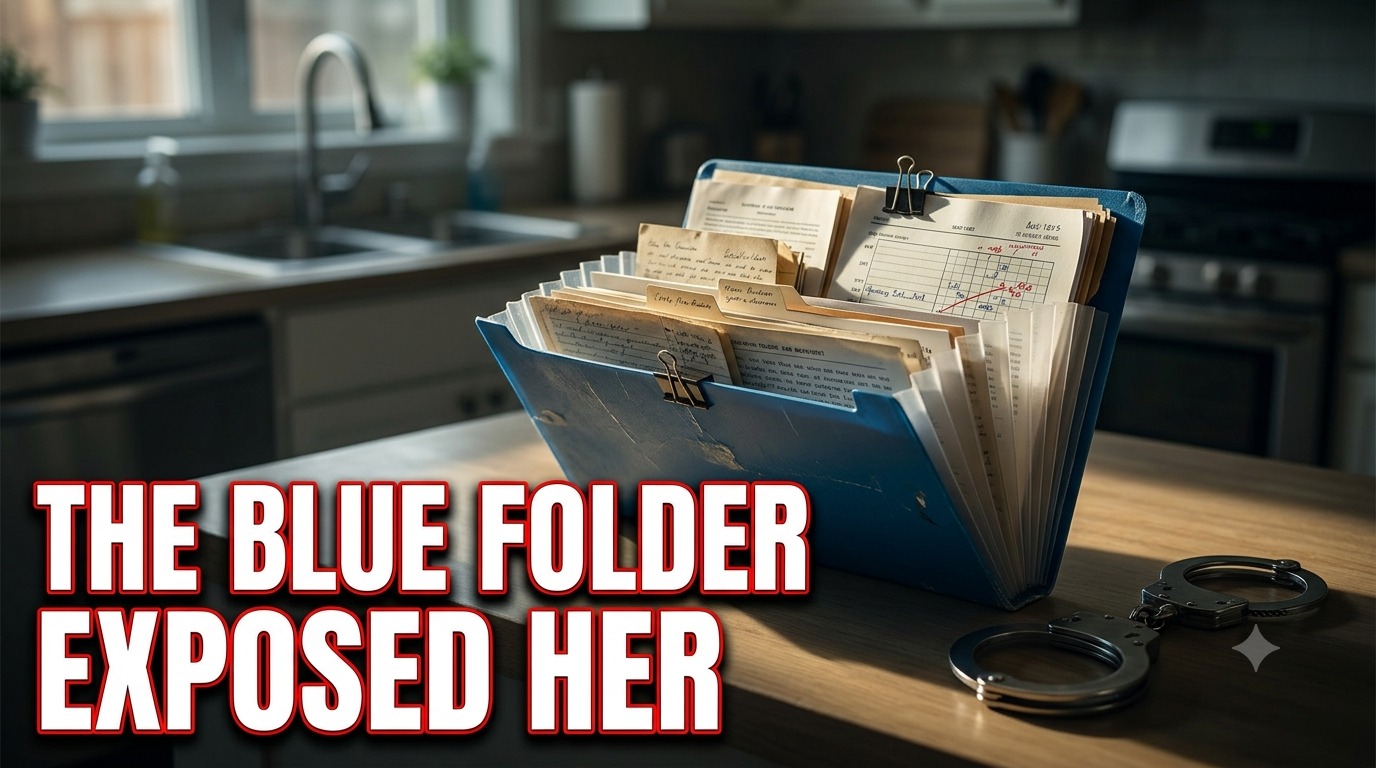
That night I lay on my bedroom floor and thought, nobody is ever going to believe me unless I can force them to look at the facts. So I took a blue accordion folder from my father’s desk, the cheap kind with the elastic string, and started to fill it. At 12, it was a lined spiral notebook where I wrote down dates and what happened, cataloged in the stiff, careful handwriting of a kid pretending to be an official archivist. At 14, it was a pawn ticket I found crumpled in the pocket of a hoodie Alexis had borrowed from me, for the gold bracelet my grandmother Rita had given me for my confirmation—the one that had supposedly been lost when I took it to a friend’s house.
At 16, it was a printed screenshot of Alexis texting her best friend, bragging that she could do anything she wanted in our house, because mom and dad would always take her side no matter what. I printed it at the school library and tucked it inside a library copy of Jane Eyre, because even then, I knew my mother never opened books she didn’t own. I hid the folder under a loose floorboard in my closet. Later, when I grew older, I taped pieces of it inside the linings of my college textbooks. When I finally had a nursing salary and an apartment of my own, I bought a fireproof box with a combination lock, and the folder lived there, thick and soft at the corners, for years.
I never planned to use it as an offensive weapon. It was just my insurance policy against insanity, a physical testament that I wasn’t crazy. Then, three months before that fateful Sunday, I got a notification on my phone from a credit-monitoring app my husband, Tyler, had talked me into downloading. A hard inquiry for a credit union account in Beaver Creek. I’d never been to Beaver Creek for anything except the outlet mall. I told no one. Not Tyler, not my parents. Something old and cold in me whispered, this is how it starts. And before I did anything else, I started building the folder again, updating every single detail.
The detective who came into the interrogation room was a woman in her late 40s with reading glasses pushed into graying hair and a coffee cup that read World’s Okay-est Aunt. She introduced herself as Detective Laura Mills. She sat down and set a thin manila folder on the table, and she looked at me for a long, calculating moment before she spoke. Do you understand why you’re here, Ms. Peters? I do. Do you want to tell me anything before we continue? I thought about my sister’s voice echoing in that kitchen. My mother staring fixedly at the floor. My father standing at the front door with a face like wet cement. I thought about every holiday where Alexis’ gift was twice the size of mine, every fight where nobody asked for my side of the story. I didn’t raise my voice.
Before we go any further, I need someone to go to my apartment, I said steadily. In the bedroom closet, there’s a fireproof box. The combination is my grandmother’s birthday, 031449. Inside is a blue folder. I started it when I was 12 years old. I think you’ll want to read it before anybody signs anything. Her pen stopped moving. Down the hall, I could hear my mother’s voice climbing in the lobby, where she and my father had just arrived to give their formal statements, and for the first time since the handcuffs snapped shut, my chest unclenched. Nineteen years of being the one nobody believed was about to end, and it wasn’t going to end with me screaming. It was going to end with paper, dates, and irrefutable proof, the way I’d always known it would.
After I signed a formal consent form and told her to use the apartment key from my property bag, Detective Mills made the call herself. Fifty minutes later, a uniformed officer came back with the heavy box and set it on the steel table like it might break open if handled roughly. She put on rubber gloves. She lifted out the folder, soft as flannel from years of being handled, and started at the very beginning. She read the spiral notebook pages first, my childish 12-year-old handwriting, the precise dates in the margins. She read the pawn ticket. She held up the screenshot from Jane Eyre, and her eyebrows lifted, just slightly, in silent acknowledgment.
Then she turned to the later pages, the ones I’d added in the past three months, and she stopped scanning and started reading properly. The credit union had sent me a letter, after I called and played the confused customer, confirming the account had been opened online using my social security number, my date of birth, and my mother’s maiden name—all pieces of data Alexis had known my entire life. The statement showed the three massive transfers from the family fund. They also showed a fourth smaller one, three weeks earlier, which had sent $1,200 to a boutique in Oakwood that happened to be owned by Alexis’ best friend.
There was an exhaustive log I’d built from the credit union’s own login history, which I’d requested in writing under my own name as the legal account holder. Every single login to that fraudulent account had originated from one of two IP addresses. One was the Wi-Fi network at my sister’s real estate office at Harrison Partners; the other was her private condo in Kettering. And tucked neatly at the very back of the folder was a small, cheap prepaid phone I’d bought at a local pharmacy. Two weeks earlier, I’d stopped by Alexis’ condo to drop off a casserole dish, set the phone to voice-record while she was in the bathroom, and slid it discreetly between two couch cushions before retrieving it on my way out.
I’m not proud of the method, but I’m also not sorry. On the clear recording, my sister was on speakerphone with someone, laughing, saying she only needed to borrow the funds until a big Cleveland real estate deal closed. She boasted that if anyone ever noticed, Kayla was the obvious scapegoat, because nobody in our family ever believed her anyway. Detective Mills read in complete silence for 40 straight minutes. When she finally closed the folder, she took off her glasses and looked at me, and I saw that her eyes were wet. Mrs. Peters, she said softly, you essentially did my job for me.
My parents weren’t allowed to see me right away. Instead, Detective Mills brought them into a different room, laid the blue folder wide open on the table, and let them read the evidence with their own eyes. I wasn’t present for that reckoning, but I heard what happened later, in jagged pieces, from people who were there. My mother went completely white when she reached the page detailing the pawn ticket for my grandmother’s bracelet; she had spent years telling everyone that my jewelry must have accidentally fallen down a storm drain. My father didn’t say a single word for ten full minutes, and then he asked for a glass of water, his hand shaking so violently he couldn’t hold the cup steady.
When the detective walked them through the digital IP logs, my mother asked, in a hollow voice that nobody in that room recognized, whether it was possible there had been some kind of massive mistake. There hadn’t been a mistake. There had only been 19 years of a conscious choice. They released me that very night. Detective Mills walked me out herself, and my husband Tyler was sitting in the lobby, having run straight out of our apartment the moment the call came through. I’d never been so glad to see anyone in my life. He didn’t ask a single interrogation question; he just wrapped his arms around me and held on tight.
Alexis was arrested four days later. Not in my parents’ kitchen in front of eleven relatives, and not with a sobbing theatrical performance. She was picked up quietly in the parking garage at Harrison Partners, dressed in her expensive blazer, right on her way to a high-profile listing appointment. A neighbor in the building next door filmed the arrest on their phone, and the clip accumulated 400,000 views before the weekend was even out. What happened after that was what prosecutors called a catastrophic unraveling. Once investigators began pulling at the loose threads, they discovered the family fund wasn’t the first target. In the six years before my grandmother Rita died, Alexis had been quietly siphoning money out of her checking account after convincing grandma to let her handle the household bills. Quiet, invisible sums. A few hundred here, a thousand there. Over time, it added up to a staggering $72,000. My grandmother had passed away two winters earlier, and nobody had ever thought to audit the books managed by the family’s golden child.
Two weeks after the arrest, my mother called me. She cried for an hour on the phone. It wasn’t the loud, attention-seeking kind of crying; it was the quiet, hollow kind that comes from a person standing amidst the ruins of a room she’d refused to look at for decades. She said she didn’t know how she’d missed all the warning signs. I could have hurled a dozen bitter things at her. Instead, I said, You didn’t miss it, Mom. You looked right at it every single time and chose not to see. The line went so profoundly quiet I momentarily thought the call had dropped. Then she whispered, You’re right.
I’d waited my whole life to hear those words. I expected them to feel like an overwhelming victory. Instead, they felt like finally setting down a very heavy, mud-soaked bag I hadn’t even realized I was still carrying across my shoulders. My father came to my apartment the following Saturday unannounced. He stood in my doorway holding a weathered shoebox, and inside were all my old school photos, my report cards, the blue ribbon from the 5th grade science fair—all of it meticulously organized. He’d been secretly keeping them. For 19 years, apparently, he’d been keeping a mental ledger of his own regrets, but he’d never had the spine to hand it to me.
I should have spoken up sooner, he told me, his voice cracking. I thought if I just kept the peace, nobody would get hurt. Dad, I said, looking right into his eyes, I got hurt every single day. He nodded slowly. He had tears running down his weathered face, and he didn’t bother to wipe them away. We sat together on my couch and went through that shoebox item by item until twilight filled the room.
The sentencing took place in March on a cold, gray Tuesday at the Montgomery County Courthouse. I wasn’t originally planning to attend. Tyler gently asked if I was sure. I told him I needed to see the absolute end of it, the same way you need to watch the final stitches of a long, ugly surgery close up, just to know it was genuinely over. The courtroom was half empty. My mother sat on the left side in the second row, wearing the exact same navy cardigan she’d worn to my grandfather’s funeral. My father sat beside her with his hands clasped tightly between his knees, looking ten years older than he had back in the fall. Neither of them looked toward the defense table.
Alexis sat completely alone, with no supporters behind her. Her friend from the boutique hadn’t shown up. Her boyfriend of two years had stopped answering her calls the very day the arrest video went viral. The presiding judge was a woman named Pamela Edwards, with a voice like cold iron, and she did not mince words. She stated that the defendant had heinously exploited the trust of a grandfather, a grandmother, and a sibling, and then maliciously attempted to orchestrate the criminal prosecution of an innocent person to conceal her crimes. She repeated that last part twice for emphasis. She sentenced Alexis to four years in the Ohio Reformatory for Women in Marysville, followed by five mandatory years of probation. She ordered full financial restitution—$161,000 in total—to be recovered through the immediate seizure of her frozen accounts, real estate commissions, and permanent garnishment of any future wages, alongside the permanent revocation of her real estate license, effective immediately.
When the bailiff stepped forward with the handcuffs, my sister finally spun around in her chair. She looked desperately at my mother. She looked at my father. She cried out in a voice I hadn’t heard since we were small children, Mom? Dad? My mother pressed her lips together into a thin, bloodless line and did not stand. My father looked firmly down at his own clasped hands. I watched that moment unfold. I watched my sister realize, for the very first time in her entire life, that cavalry wasn’t coming to rescue her.
And I’ll be completely honest, I felt something deeply complicated. I didn’t feel a surge of malicious joy. I felt something closer to the profound quiet after a violent storm, when you step outside into an air that feels strange and still, and you aren’t quite sure whether to feel immense relief or lingering sadness. The metal cuffs clicked shut. The steel was cold, I knew intimately. She walked out through the heavy wooden doors without looking back, and the door shut behind her with a soft, ordinary sound.
My parents officially stepped down as trustees of the Kenneth Peters Fund that very same week. The court appointed a neutral corporate bank to manage it, and a lawyer named Craig Howard sent out a transparent audit to every single cousin on my grandfather’s side. The restored balance, plus the first wave of restitution payments, was safely back in place by summer. My cousin Hazel used a portion of it to fund her very first semester at Ohio State that autumn, sending me a card adorned with a bright sunflower. It read: Thank you for protecting what Grandpa built. I keep it proudly affixed to my refrigerator.
The prosecutor’s office formally dropped every single bogus charge against me before the end of that first week, and Detective Mills sent an official letter on department letterhead confirming my record was entirely pristine. I keep that letter locked securely in the fireproof box, right next to the blue folder. I won’t pretend that everything in my world is magically fixed. You cannot simply undo 19 years of a family playing toxic favorites with a single clean Hollywood ending. My mother and I have coffee together every other Thursday now. Some of those Thursdays are warm and conversational, while others are filled with long, echoing silences punctuated only by the clinking of spoons against porcelain cups. She apologized again last month in a handwritten letter, and I read it three separate times before I felt ready to answer. My father calls me every Sunday without fail.
Now, when I tell my parents about something happening in my life, they don’t immediately call Alexis behind my back for a second opinion. That is the part that still stuns me. I didn’t realize how desperately starved I was for that basic validation until it finally became my reality. I think about that 12-year-old girl sometimes, sitting alone on her bedroom floor with a cheap blue folder and a stubby wooden pencil, diligently writing down dates and facts as if they were pieces of evidence in a grand trial. She had no way of knowing it would take 19 agonizing years to see justice. She only knew one absolute rule: never let anyone steal the truth away from you.
People often spend their whole lives waiting passively for somebody in authority to finally believe them. What I learned the hard way is that belief isn’t something you wait around to be gifted. It’s something you build yourself, one dated page at a time, until the truth stands tall enough that it can no longer be argued away. There are more stories like mine waiting to be told, real accounts that remind you the truth always finds a way to break out into the light eventually. And if you happen to have your own hidden folder tucked away somewhere safe, keep it secure. Few hurts in this life cut quite as deep as being doubted by the very people who brought you into this world.
Have you ever been blamed by your own family for something you didn’t do, and how did you find your way through it?